The Dukas Sorcerer’s Apprentice backstory begins with a poem by Goethe: a young apprentice borrows a spell, sends a broom to fetch water, and discovers he cannot make it stop. Paul Dukas turned that tale into an orchestral work that premiered in Paris in 1897, more than four decades before Disney’s Fantasia gave it a new audience.
If you know the music through Mickey Mouse, try hearing it first as a story told entirely by instruments. Dukas gives you enough clues to follow the action without a screen—and enough musical wit to make the apprentice’s mistake feel inevitable.
📑 Table of Contents
Goethe’s Sorcerer’s Apprentice Poem Gave Dukas a Plot
Goethe’s ballad Der Zauberlehrling has a neat, alarming premise. While the master is away, his apprentice uses a spell to make a broom carry water. The broom obeys, but the apprentice cannot remember the words that would stop it. He chops it apart; now two brooms carry water. Only the returning master can end the flood.
That sequence gave Dukas more than a colorful subject. It offered a chain of musical problems: how does an orchestra suggest a broom coming to life, make repeated trips feel increasingly urgent, and turn one moving figure into two? The poem’s repetition is particularly useful. Each return of the broom seems familiar, while the accumulating water changes what that repetition means.
Dukas called his work a scherzo after a ballad by Goethe. A scherzo is usually a lively, playful piece, though its humor can have an edge. Here the joke grows out of control. The apprentice wants the convenience of the master’s power without knowing how to manage it, and Dukas lets the orchestra expose that gap one trip at a time.
You do not need to memorize Goethe’s poem to hear the story. Knowing the basic sequence—spell, broom, flood, split, rescue—is enough. Then the pleasure lies in noticing how Dukas makes those events happen in sound.
Dukas’s 1897 Paris Premiere Came Before the Cartoon
When The Sorcerer’s Apprentice premiered in Paris in 1897, its audience encountered an orchestral telling of Goethe’s tale, with no animated images attached. Dukas was working in a tradition of pieces that suggest a story or scene through instrumental music. Such a piece is often called a tone poem: rather than setting words for singers, it uses changes in melody, rhythm, and orchestral color to guide your imagination.
That choice matters to the backstory. A song could have quoted the apprentice’s spell or announced the master’s return. Dukas had to make each turn of the plot audible. The music begins by establishing a mysterious world, then sets a purposeful motion in place. As the motion repeats and intensifies, you can hear the difference between a clever trick and a crisis.
The work also has to stand up as music when you are not tracking every event. Dukas builds momentum through repetition, changes in volume, and the way instruments pass ideas among themselves. The story gives those choices direction, but the orchestral writing makes you want to keep listening. That is why a listener who knows nothing of Goethe can still sense when the situation has become much too large for its young magician.
Its Paris premiere belongs to the piece’s own history. Fantasia belongs to a later chapter. Keeping those moments apart makes Dukas’s achievement easier to hear: he had already made the broom, the water, and the apprentice’s mounting panic vivid without a single drawing.
How Dukas Turns a Broom Into an Orchestral Character
Listen for the difference between the opening and the broom’s work. The beginning leaves room for uncertainty; it suggests magic before anyone puts it to use. Then a steady, recognizable figure takes hold. Its repeated movement can sound almost reassuring at first: the broom has a job, and it appears to be doing it well.
The trouble is that it keeps doing it. Dukas makes repetition carry the drama. A figure you recognized as orderly becomes threatening when it returns with greater force and more activity around it. You can picture water rising, but you can also hear a simpler musical fact: the apprentice has started something he cannot interrupt.
The moment he attacks the broom does not provide the release he expects. The music’s renewed energy suggests that the problem has multiplied. Dukas can put related ideas into different parts of the orchestra, making the action feel busier and harder to contain. The arrival of the master finally changes the terms of the piece; authority is heard as the power to stop what has been set in motion.
This is a useful way to listen to storytelling in classical music. An instrument does not have to imitate an object perfectly. A clear pattern, a change of color, or an idea that returns at the wrong moment can do the work. If you enjoy hearing an orchestra combine familiar ideas into a busier finale, our guide to Bizet’s Farandole offers another example of musical parts changing meaning when they meet.
From Dukas’s Concert Piece to Fantasia
Disney’s Fantasia, released in 1940, paired Dukas’s music with the animated apprentice played by Mickey Mouse. The film made the tale instantly legible to viewers who had never heard a tone poem or read Goethe. For many people, the pointed hat and marching brooms became inseparable from the score.
The film did not create the story, though, and Dukas did not write the piece for it. Goethe supplied the ballad; Dukas supplied the orchestral retelling; Disney later added a visual interpretation. Each version makes different choices. The poem tells you what the apprentice does, while the music lets a repeated action grow from amusing to frightening before it is finally halted.
That distinction can make your next listen more interesting. Try the piece once without watching the animation. Notice when you first recognize the broom’s motion, when you begin to wish it would stop, and how long Dukas makes you wait for relief. You may find that the most memorable effect is not a single tune but your changing reaction to hearing it again.
For another kind of unstoppable musical motion, try our listening guide to Bach’s English Suite No. 2 Prelude. Bach’s music tells no runaway-broom story, yet it offers a good point of comparison: what happens when a composer keeps a small pattern moving, and how does that motion hold your attention?
Dukas’s answer depends on a story with a beginning, a mistake, and a rescue. Tonight, you can follow those turns without needing to identify every instrument. Hear the broom start its task, hear its task become a problem, and wait for the moment the orchestra finally lets it rest.
Listen to This Piece
Frequently Asked Questions
What is Dukas’s The Sorcerer’s Apprentice based on?
It is based on Goethe’s ballad Der Zauberlehrling, in which an apprentice magically orders a broom to fetch water but cannot stop it. Dukas retold the escalating mishap in an orchestral scherzo, using instruments instead of sung words.
When did Dukas’s The Sorcerer’s Apprentice premiere?
The work premiered in Paris in 1897. That was decades before Fantasia brought its music to movie audiences in 1940.
Was The Sorcerer’s Apprentice written for Disney’s Fantasia?
No. Dukas wrote it as a concert work based on Goethe’s poem, and Disney later used the existing music in Fantasia. Mickey Mouse is part of the film’s telling of the story, rather than the origin of Dukas’s piece.
Sources
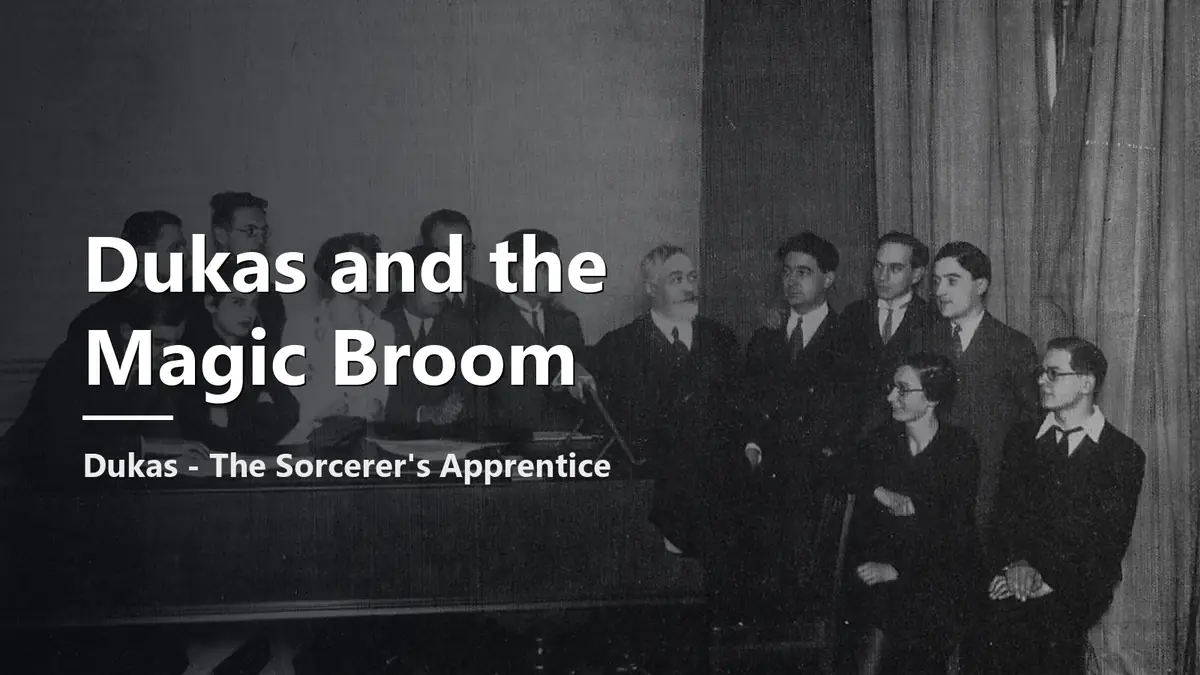
Cover art: Dukas composition class, Unknown author, 1929-01-01. Wikimedia Commons (public domain).