Table of Contents
When Voices Lost Beyond the Sea Return
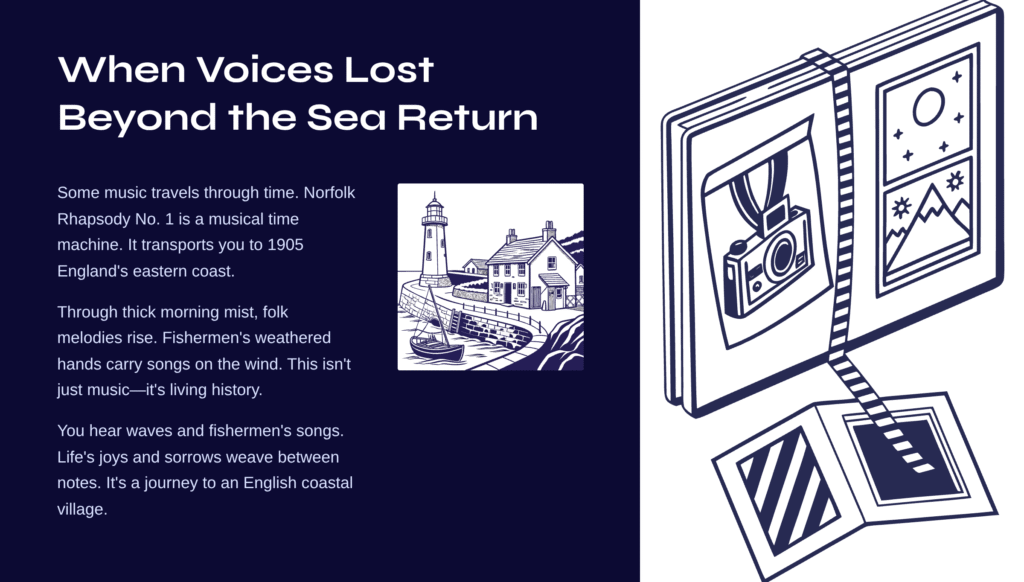
Some music possesses the power to travel through time. Like flipping through an old photo album, each piece reveals fragments of memory, one by one. When I first heard Vaughan Williams’ Norfolk Rhapsody No. 1, I felt as though I was standing in a small harbor town on England’s eastern coast in 1905. Through the thick morning mist, I could almost hear folk melodies rising from fishermen’s weathered hands, carried on the wind.
This isn’t just music to listen to—it’s a musical time machine that transports you to an English coastal village from 150 years ago. What you hear isn’t the applause of a glittering concert hall, but the sound of waves and fishermen’s songs, with all of life’s joys and sorrows woven in between.
From Folk Song Collector to Composer: A Young Man’s Awakening
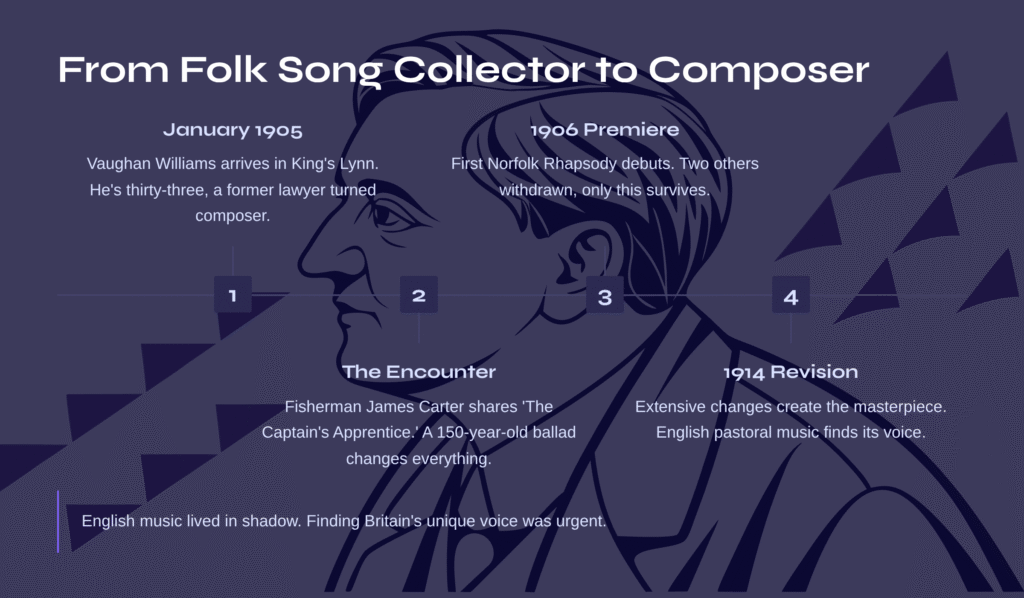
In January 1905, thirty-three-year-old Ralph Vaughan Williams set foot in King’s Lynn, a small harbor town in Norfolk. He was a young composer who had come to music late, having started as a lawyer. At the time, English music lived in the shadow of German Romanticism, and finding Britain’s unique musical voice was an urgent mission.
In King’s Lynn’s North End district, where fishermen lived and worked, he had a fateful encounter. A fisherman named James Carter shared a folk song called ‘The Captain’s Apprentice’ that would change Vaughan Williams’ life forever. This ballad told the true story of a whaling captain who cruelly murdered a poor apprentice 150 years earlier and was hanged for his crime.
Vaughan Williams originally envisioned a symphony composed of three Norfolk Rhapsodies. But numbers 2 and 3 were withdrawn by the composer himself after a few performances, leaving only the first to survive as a masterpiece of English pastoral music. Premiered in 1906, this work was extensively revised in 1914 to achieve its current form.
Five Folk Songs Weaving a Musical Tapestry
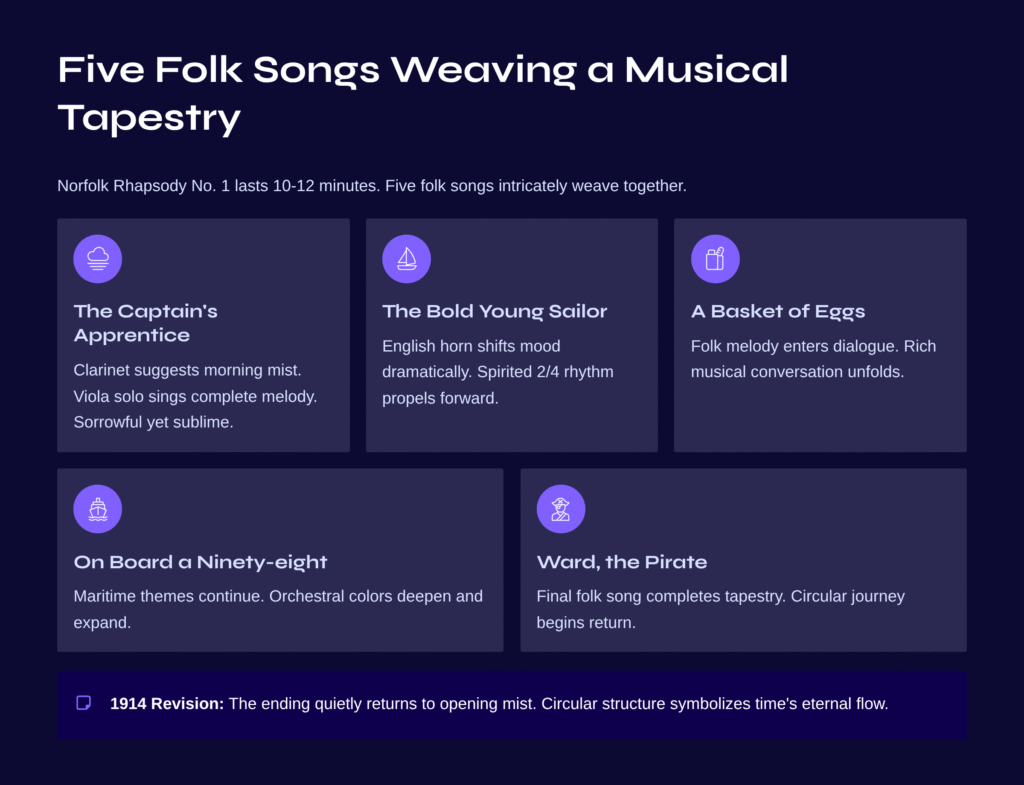
Norfolk Rhapsody No. 1 is a single-movement work lasting about 10-12 minutes. Structured with a slow introduction (Adagio) and fast main section (Allegro vivace), it intricately weaves together five Norfolk folk songs.
The First Voice Rising from the Mist
The piece begins with a clarinet’s faint suggestion, ambiguous and dreamlike like a misty morning in the Fenlands. Then a viola solo sings ‘The Captain’s Apprentice’ in its complete form. The beauty of this moment defies description—simultaneously sorrowful and sublime, personal yet universal, with emotions washing over you like waves.
The Sea’s Lively Rhythms
When the introduction ends, an English horn introduces ‘The Bold Young Sailor,’ dramatically shifting the mood. The spirited 2/4 rhythm propels the music forward like a ship with sails full of wind. Other folk songs—’A Basket of Eggs,’ ‘On Board a Ninety-eight,’ and ‘Ward, the Pirate’—enter in turn, creating rich musical dialogue.
The Circular Journey of Time
The most significant change in the 1914 revision is the ending. Originally concluding with a brilliant finale, the revised version quietly returns to the misty landscape of the opening. This circular structure seems to symbolize time’s eternal flow and memory’s return, leaving the peaceful sense of coming home after a long journey.
The English Landscape Music Planted in My Heart
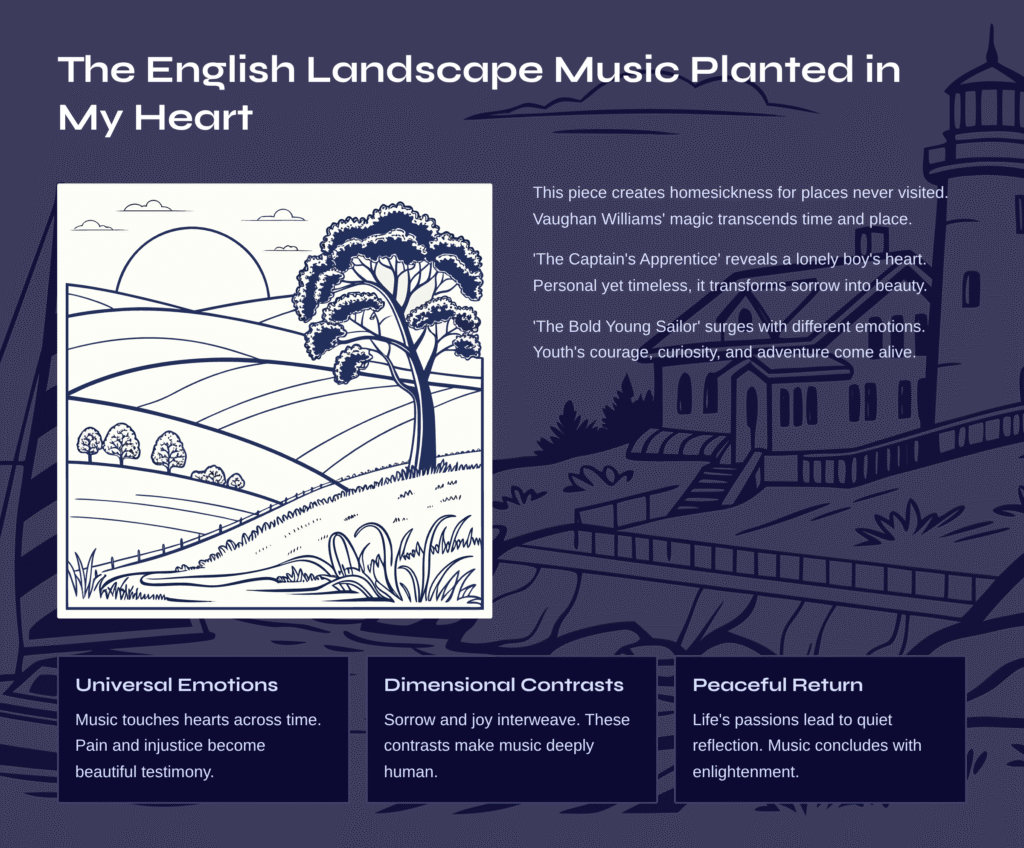
Every time I hear this piece, I find myself homesick for England, despite never having been there. Vaughan Williams’ music has a special magic—the power to transcend specific places and times to touch universal human emotions.
When ‘The Captain’s Apprentice’ melody flows, I feel the heart of a poor, lonely boy. That sadness is both personal and timeless, like testimony to the pain and injustice all the vulnerable have endured. Yet the music doesn’t simply recreate that sorrow—it transforms it into something beautiful.
When ‘The Bold Young Sailor’ appears in the Allegro section, completely different emotions surge forward. Youth’s courage toward the sea, curiosity about unknown worlds, and longing for adventure all come alive in the music. These contrasts make the piece more dimensional and human.
And in the quiet return at the end, I’m always deeply moved. Just as life’s passions and adventures ultimately lead to quiet reflection, the music concludes with peaceful enlightenment.
Secrets for Deeper Listening
First Tip: Listen to the Stories
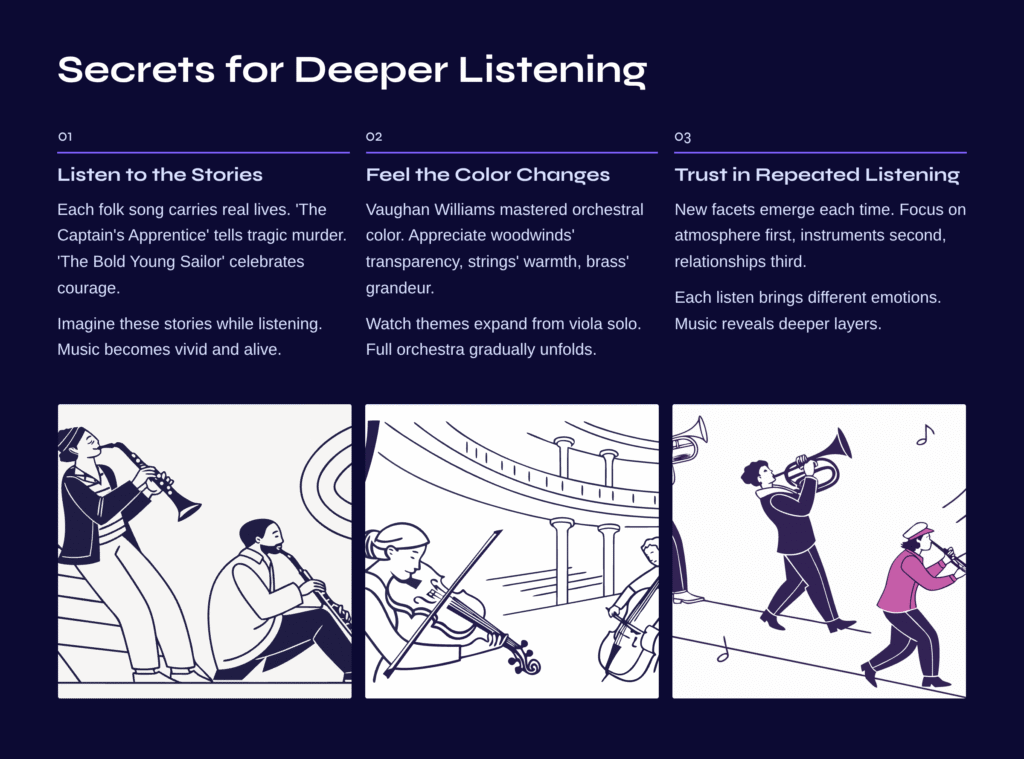
Each folk song carries tales from real people’s lives. ‘The Captain’s Apprentice’ tells of a tragic murder, while ‘The Bold Young Sailor’ celebrates a young man’s courage heading to sea. Imagining these stories while listening makes the music much more vivid.
Second Tip: Feel the Color Changes
Vaughan Williams was a master of orchestral color. Consciously appreciate the palette created by the transparency of woodwinds, warmth of strings, and grandeur of brass. Don’t miss the process where the theme, beginning with viola solo, gradually expands to the full orchestra.
Third Tip: Trust in Repeated Listening
This music reveals new facets with each hearing. Focus on the overall atmosphere first, individual instruments’ roles second, and the relationships between folk songs third. Each listen will bring different emotions.
The Power of Timeless Folk Song: An Eternal Journey Home
Norfolk Rhapsody No. 1 transcends being merely an orchestral work—it’s musical time travel. Folk songs sung by Norfolk fishermen 150 years ago reached us through a 20th-century composer’s imagination. Each time I hear this piece, I’m reminded of music’s most fundamental power: connecting human hearts across time and space.
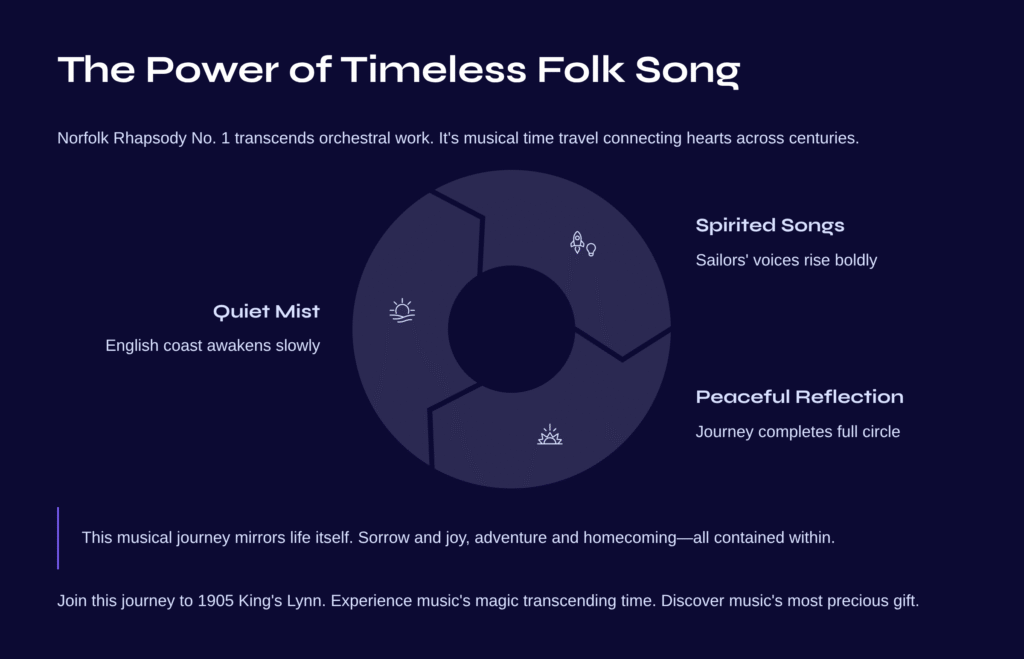
This musical journey—beginning with the quiet mist of the English coast, moving through sailors’ spirited songs, and returning to peaceful reflection—mirrors life itself. Sorrow and joy, adventure and homecoming, dreams and reality are all contained within a single piece.
Join this music on a journey to a misty morning in 1905 King’s Lynn. There you’ll experience the magic of music that transcends time. And through the lasting resonance after the music ends, you’ll discover what music’s most precious gift to us truly is.
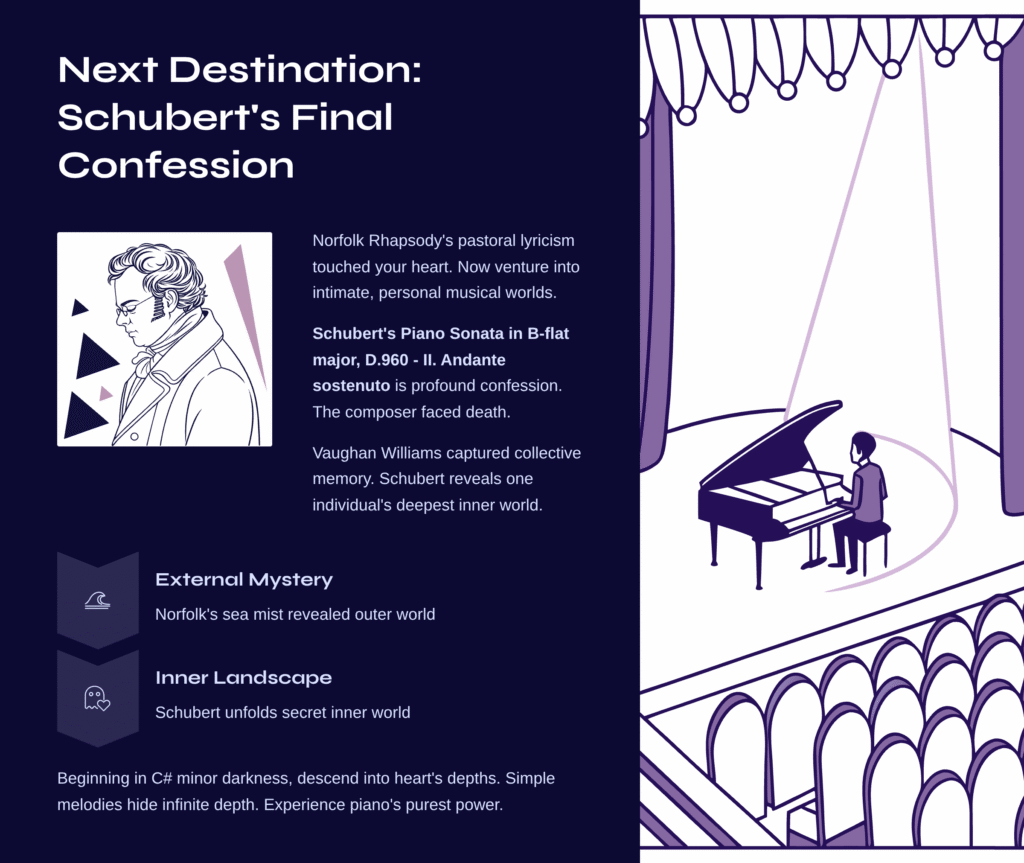
Next Destination: Schubert’s Final Confession
If Norfolk Rhapsody’s pastoral lyricism has left its mark on your heart, perhaps it’s time to venture into an even more intimate and personal musical world.
Franz Schubert’s Piano Sonata in B-flat major, D.960 – II. Andante sostenuto is the second movement of the composer’s final piano sonata, one of the most profound confessions left by Schubert facing death. While Vaughan Williams’ folk songs contained collective memory, this slow movement by Schubert reveals one individual’s deepest inner world.
Beginning in the darkness of C# minor, this movement feels like descending stairs into the depths of one’s own heart, step by step. If Norfolk’s sea mist revealed the mystery of the external world, Schubert’s music unfolds the secret landscape of our inner world. The moment you discover the infinite depth hidden within seemingly simple melodies, you’ll experience the purest power of the piano as an instrument.