📑 Table of Contents
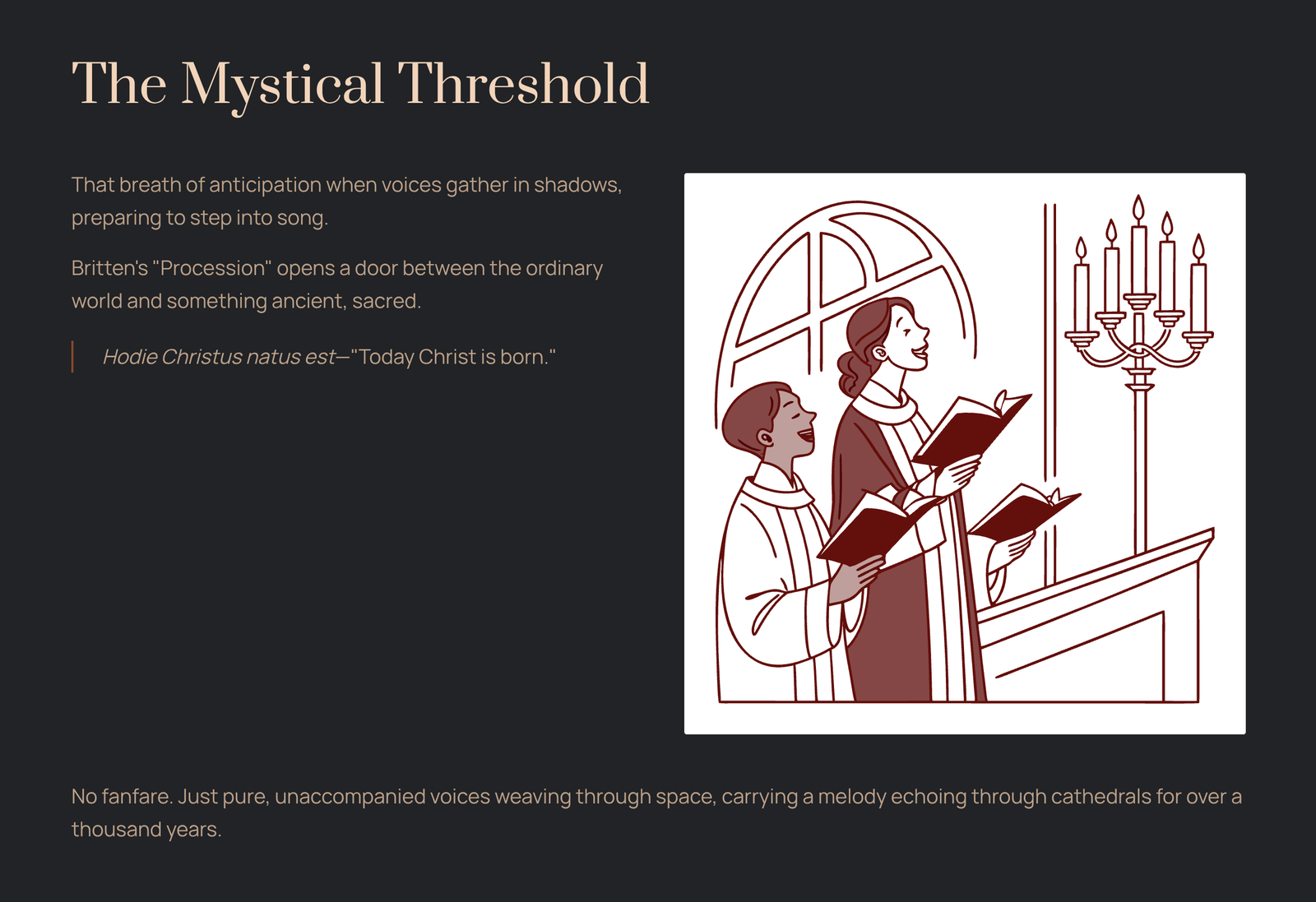
There is something almost mystical about the moment before music truly begins—that breath of anticipation when voices gather in the shadows of a candlelit church, preparing to step forward into song. Benjamin Britten understood this threshold intimately. In his “Procession,” the opening movement of A Ceremony of Carols, he doesn’t simply start a concert. He opens a door between the ordinary world and something ancient, something sacred.
The first notes rise like incense: Hodie Christus natus est—”Today Christ is born.” No fanfare, no dramatic entrance. Just pure, unaccompanied voices weaving through space, carrying a melody that has echoed through cathedrals for over a thousand years.
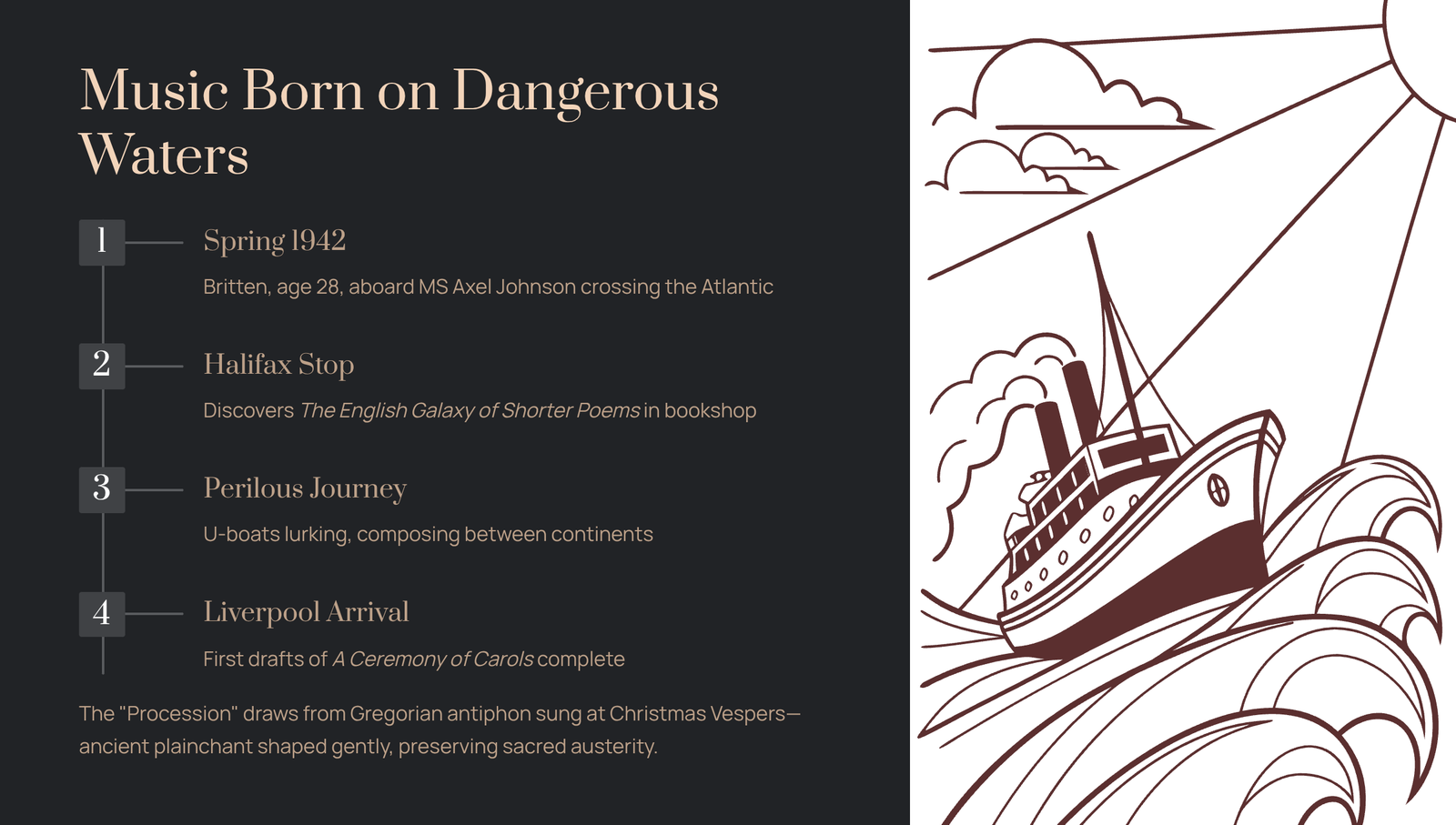
The Composer’s Journey: Music Born on Dangerous Waters
To understand why this Procession feels so otherworldly, we must travel back to the spring of 1942. Benjamin Britten, then twenty-eight years old, was aboard the MS Axel Johnson, a Swedish cargo ship making the perilous crossing from North America to wartime England. U-boats lurked beneath the gray Atlantic. Each day brought the possibility of torpedoes.
Yet in this liminal space between continents, between safety and danger, Britten composed. During a brief stop in Halifax, Nova Scotia, he wandered into a bookshop and discovered The English Galaxy of Shorter Poems—a collection that would ignite his imagination. The medieval texts within, with their strange spellings and timeless devotion, called to him. By the time the ship reached Liverpool, the first drafts of A Ceremony of Carols were complete.
The “Procession” itself draws from something even older than those medieval poems: the Gregorian antiphon traditionally sung at Christmas Vespers. Britten took this ancient plainchant and shaped it gently, preserving its sacred austerity while making it unmistakably his own.
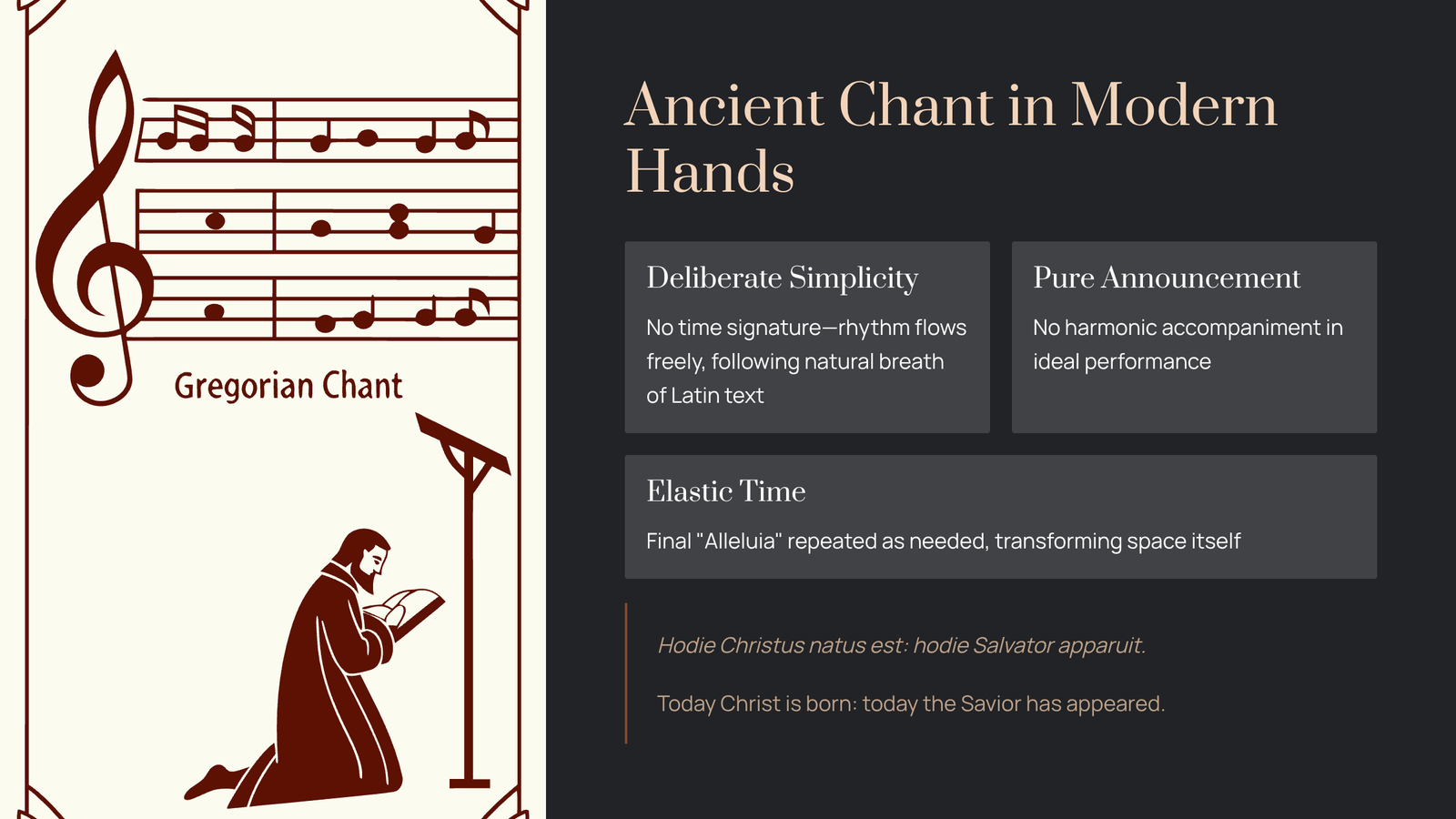
Understanding the Music: Ancient Chant in Modern Hands
What makes the “Procession” so immediately striking is its deliberate simplicity. In an era when composers often reached for complexity, Britten stripped everything away. There is no time signature—the rhythm flows freely, following the natural breath of the Latin text. There is no harmonic accompaniment in the ideal performance; Britten specifically noted that the harp should only play “when an actual procession is impossible.”
The text itself is pure announcement:
Hodie Christus natus est: hodie Salvator apparuit.
(Today Christ is born: today the Savior has appeared.)
Hodie in terra canunt angeli, laetantur archangeli.
(Today on earth the angels sing, the archangels rejoice.)
Hodie exsultant justi, dicentes: Gloria in excelsis Deo. Alleluia!
(Today the righteous exult, saying: Glory to God in the highest. Alleluia!)
Listen for how the melody rises and falls in gentle waves, never pushing, never rushing. The final “Alleluia” can be repeated as many times as needed—allowing the choir to physically walk from the back of the church to their places, their voices drawing nearer with each repetition. This is music designed to transform space itself, to turn a concert hall into a medieval cathedral, to make time feel suddenly elastic.
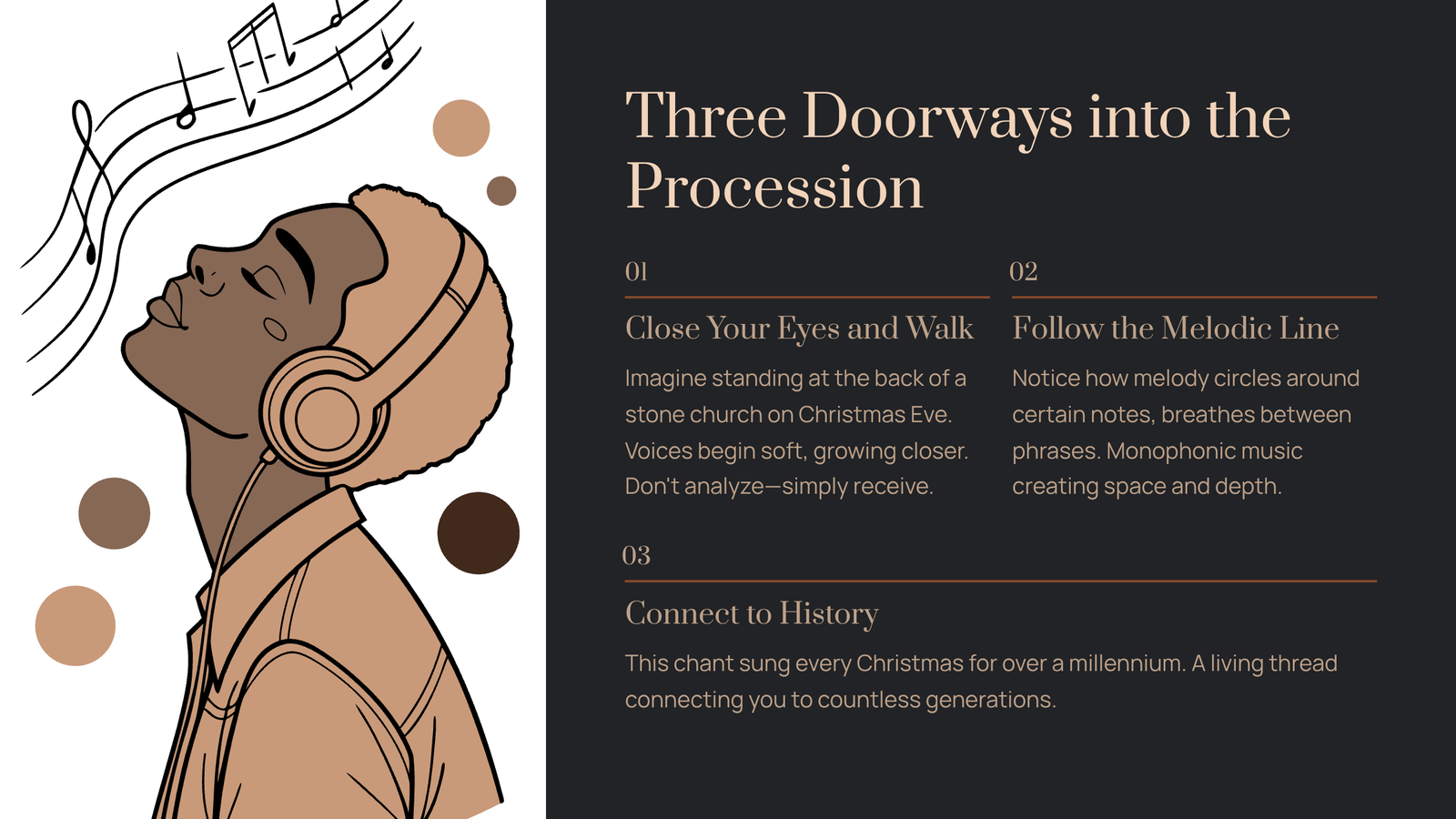
How to Listen: Three Doorways into the Procession
First Listening: Close Your Eyes and Walk
Imagine yourself standing at the back of a stone church on Christmas Eve. The air is cold. Candles flicker in distant sconces. Now, from somewhere behind you, voices begin—soft at first, then growing closer. Let the music move past you, around you, through you. Don’t analyze. Simply receive.
Second Listening: Follow the Melodic Line
Now listen more carefully to the shape of the melody. Notice how it circles around certain notes, how it breathes between phrases. This is monophonic music—a single melodic line shared by all voices—and yet it creates a sense of space and depth that more complex textures often cannot achieve.
Third Listening: Connect to History
Remember that this same chant, or something very like it, has been sung every Christmas for over a millennium. Britten knew this. He was reaching back through centuries, through plagues and wars and revolutions, to touch something constant. When you hear the “Procession,” you are hearing not just one composer’s vision, but a living thread connecting you to countless generations of Christmas celebrations.
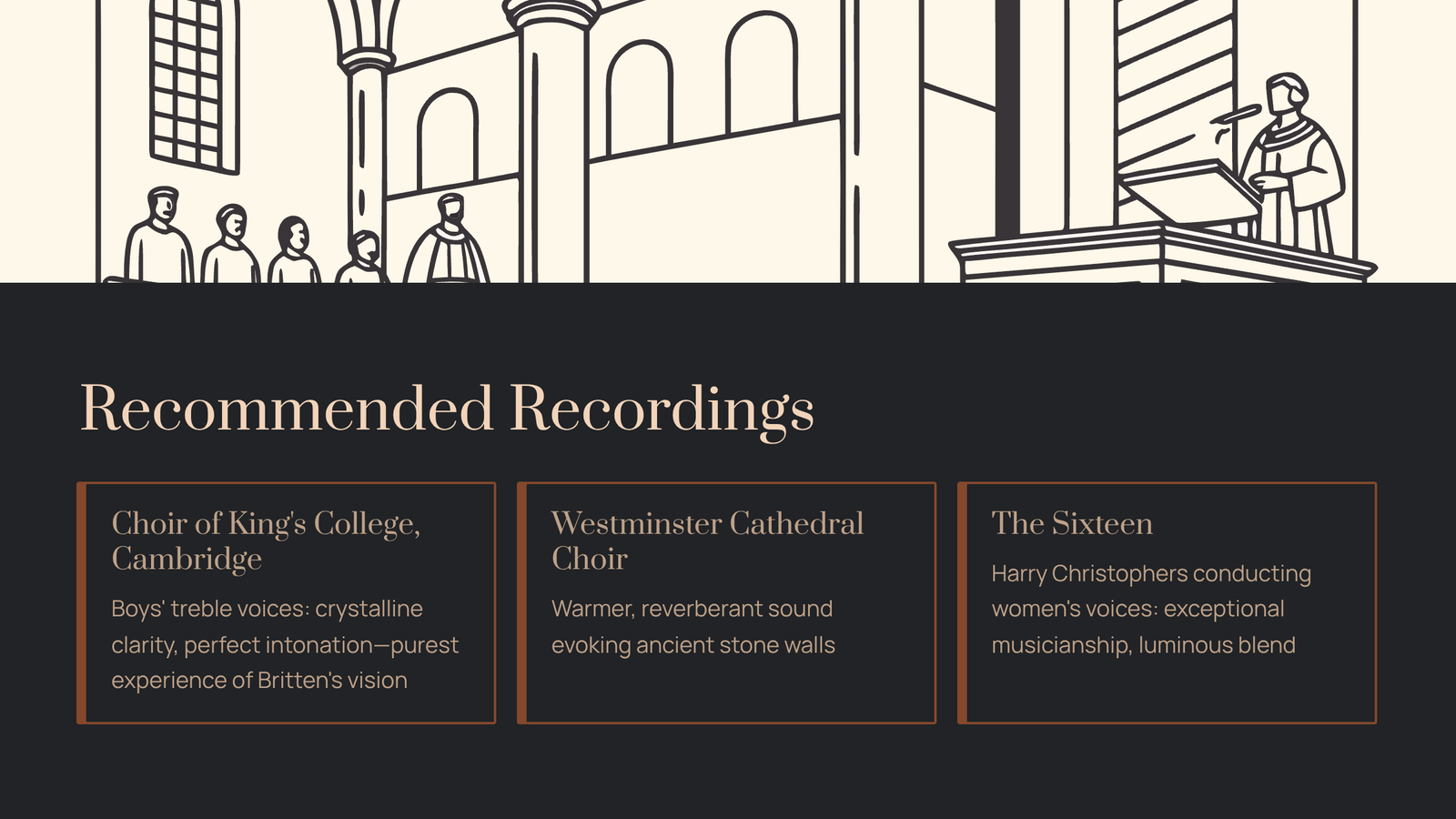
Recommended Recordings
For the purest experience of Britten’s vision, seek out recordings featuring boys’ treble voices. The Choir of King’s College, Cambridge offers crystalline clarity and perfect intonation. The Westminster Cathedral Choir brings a slightly warmer, more reverberant sound that evokes ancient stone walls.
If you prefer women’s voices, The Sixteen under Harry Christophers delivers exceptional musicianship with a luminous blend that honors the work’s original premiere by the Fleet Street Choir’s women’s voices in December 1942.
Why This Music Matters Now
In our age of constant noise and digital distraction, the “Procession” offers something increasingly rare: permission to slow down. Its unhurried pace refuses to compete with our scrolling thumbs. Its ancient text speaks of joy and wonder in a language that predates our anxieties.
Britten composed this music while sailing through waters where death waited beneath every wave. Perhaps that proximity to danger made the Christmas story feel more urgent, more necessary. Today the Savior has appeared—not yesterday, not in some distant theological past, but today. Now. In this moment of listening.
The “Procession” lasts barely two minutes. It makes no demands. It offers no arguments. It simply opens a door and invites you to step through—into a space where time moves differently, where angels sing on earth, and where the oldest story feels suddenly, startlingly new.
A Ceremony of Carols continues with ten more movements, each a small masterpiece of text painting and vocal imagination. But none quite matches the quiet power of this beginning—this threshold—this gentle hand reaching across the centuries to lead us into Christmas.