📑 Table of Contents
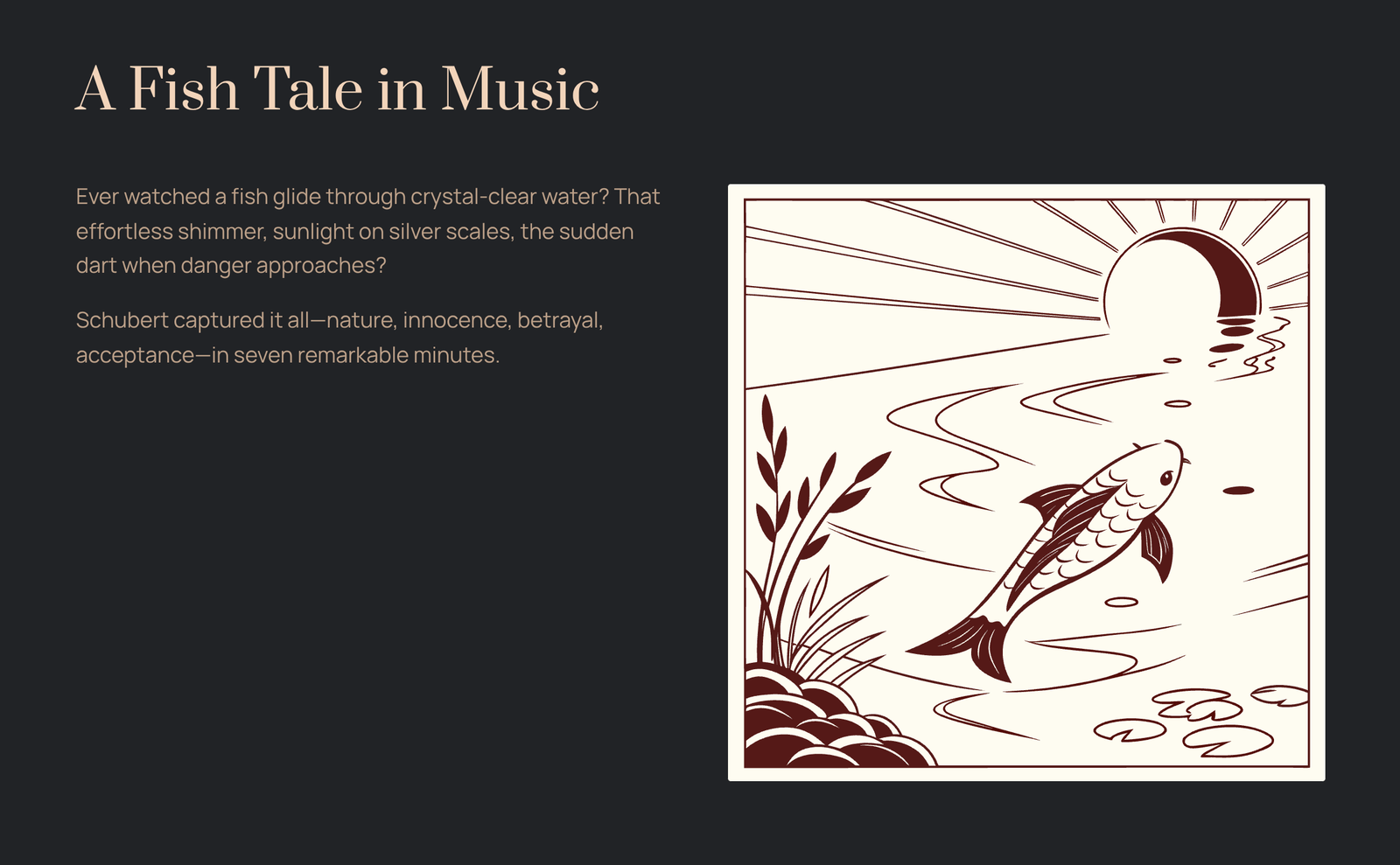
Have you ever watched a fish glide through crystal-clear water? That effortless shimmer, the play of sunlight on silver scales, the sudden dart when danger approaches? Franz Schubert captured all of this—and so much more—in one of classical music’s most charming movements.
The fourth movement of his Piano Quintet in A major, affectionately known as the “Trout” Quintet, tells a complete story without a single word. It’s about nature, innocence, betrayal, and acceptance. And remarkably, it all unfolds in about seven minutes.
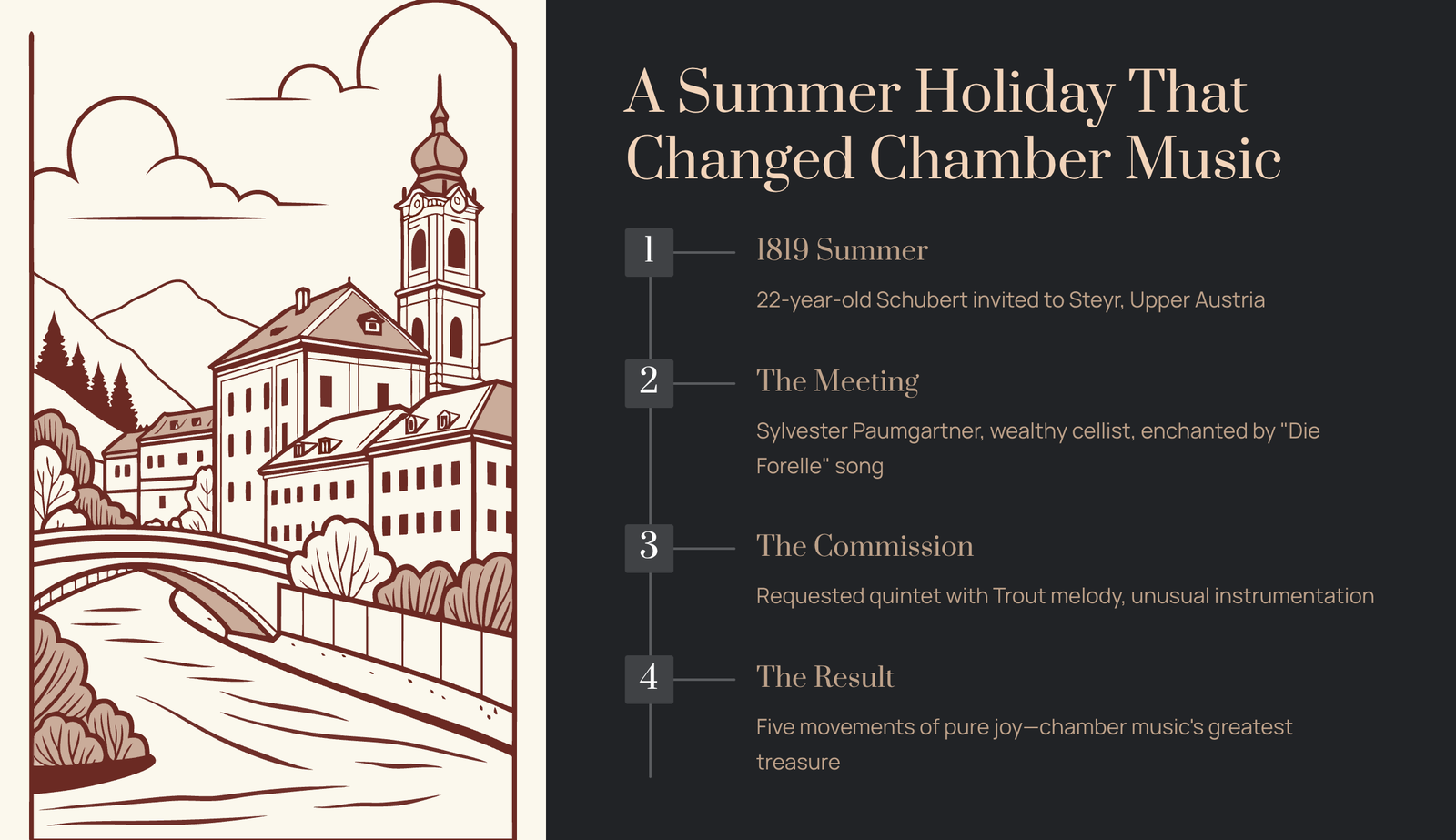
A Summer Holiday That Changed Chamber Music
The year was 1819. A 22-year-old Schubert was invited to spend the summer in Steyr, a picturesque town in Upper Austria. His friend Johann Michael Vogl, a celebrated baritone, had connections there, and the young composer desperately needed a break from Vienna’s pressures.
In Steyr, Schubert met Sylvester Paumgartner—a wealthy mining executive, amateur cellist, and passionate music lover. Paumgartner hosted regular musical gatherings at his home, where Schubert performed his songs. One piece particularly enchanted Paumgartner: a little art song called “Die Forelle” (The Trout), which Schubert had composed two years earlier.
Paumgartner made a request that would result in one of chamber music’s greatest treasures. He asked Schubert to write a new piano quintet—but with two conditions. First, it had to include his beloved “Trout” melody. Second, it had to match the unusual instrumentation of a Hummel quintet he owned: piano, violin, viola, cello, and double bass.
The resulting work—five movements of pure joy—has been beloved ever since. And the fourth movement, where that famous Trout melody finally appears, remains its emotional centerpiece.
The Poem Behind the Music
Before diving into the music itself, it helps to know the story Schubert was painting.
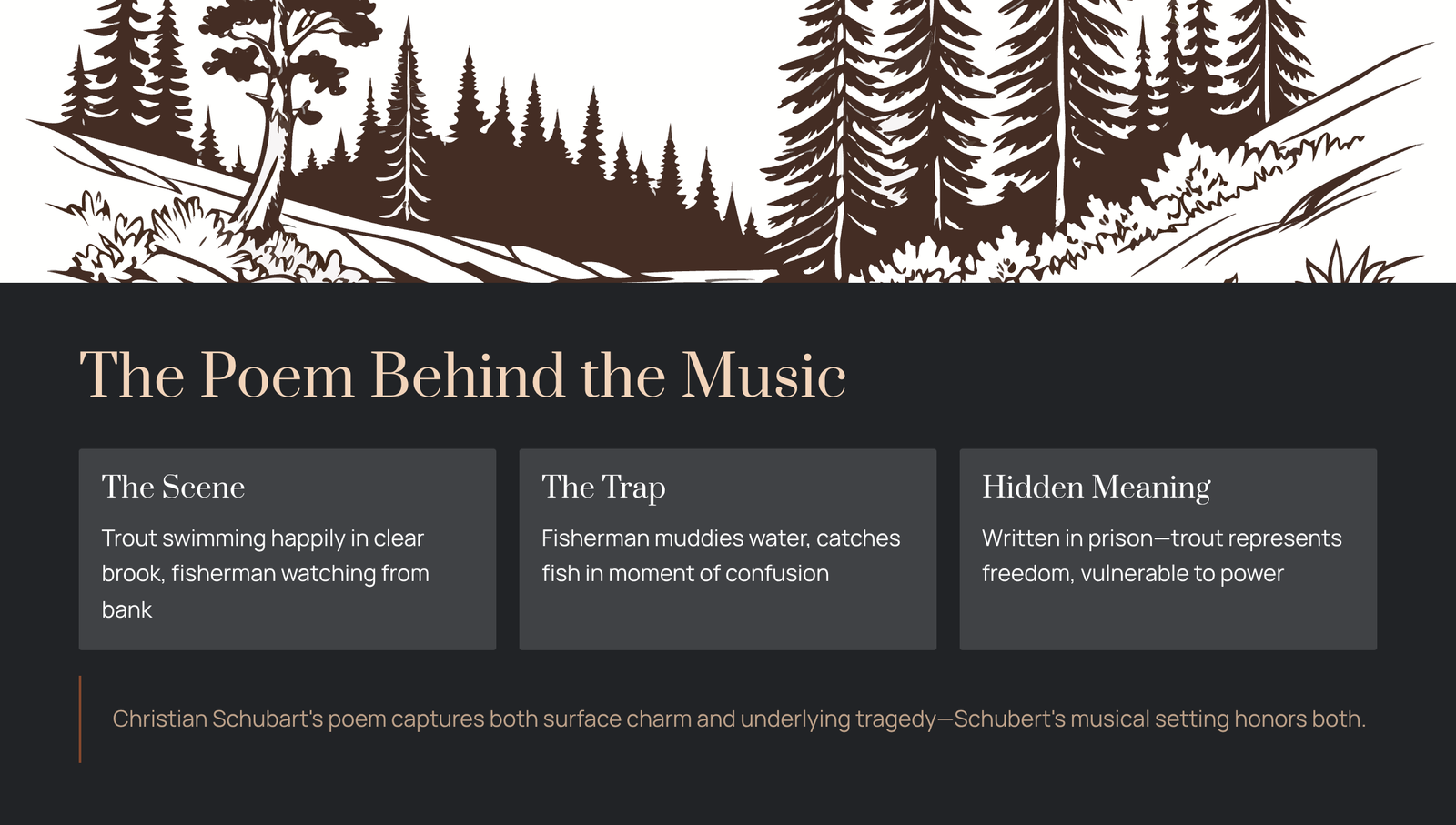
The original poem by Christian Schubart describes a trout swimming happily in a clear brook. A fisherman stands on the bank, watching. As long as the water stays clear, the narrator thinks, the fish is safe. But then the fisherman grows impatient. He muddies the water, and in that moment of confusion, catches the fish. The observer watches this unfold with “blood boiling” in anger.
What the poem doesn’t reveal at first is its deeper meaning. Schubart wrote it while imprisoned for political dissent, and the trout represents freedom itself—beautiful, vulnerable, and all too easily destroyed by those with power.
Schubert’s musical setting captures both the surface charm and the underlying tragedy.
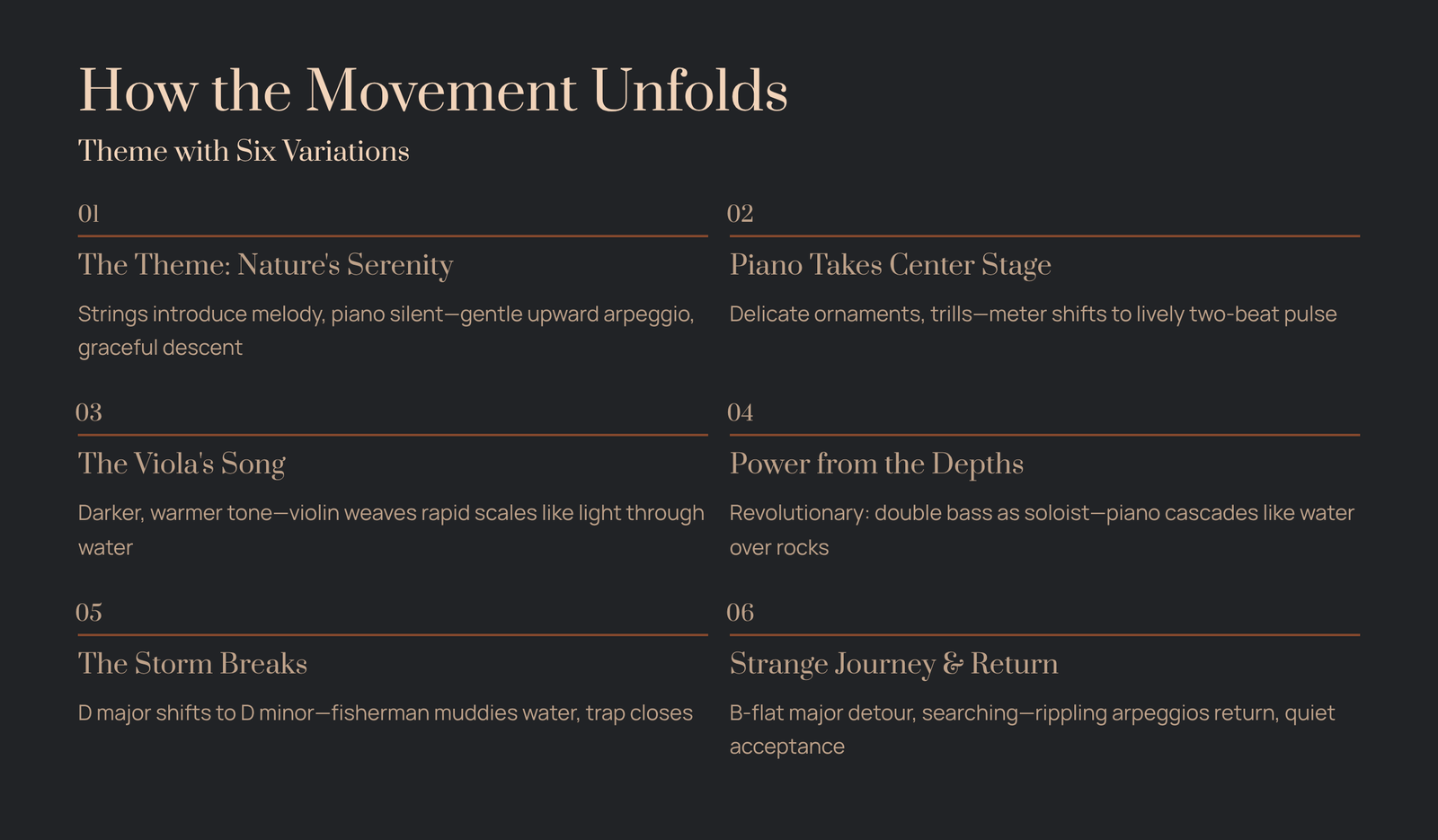
How the Movement Unfolds: A Listening Guide
The fourth movement is structured as a theme with six variations—a form as old as music itself. But Schubert’s genius lies in how each variation tells a different chapter of the story.
The Theme: Nature’s Serenity
The strings introduce the famous melody together, gentle and unadorned. Notice how the piano remains almost silent here—a deliberate choice. Schubert saves the piano’s characteristic rippling accompaniment for later, making its eventual appearance all the more meaningful.
The melody itself floats upward in an arpeggio (the notes of a chord played one after another), then descends in graceful steps. It’s the musical equivalent of watching that trout glide through the water.
Variation 1: The Piano Takes Center Stage
Now the piano claims the melody, decorating it with delicate ornaments and trills. The strings step back into a supporting role. Listen for how the meter shifts from the theme’s gentle three-beats-per-measure to a more lively two-beat pulse. The music feels lighter, more playful—the trout is dancing.
Variation 2: The Viola’s Song
In a touching change of color, the viola takes over the melody. This darker, warmer instrument gives the tune a more introspective quality. Meanwhile, the violin weaves rapid scale patterns around it, like light refracting through moving water.
Variation 3: Power from the Depths
Here’s something extraordinary: Schubert gives the melody to the double bass. In 1819, this was revolutionary. The double bass was typically relegated to providing low-end support, never featured as a soloist. But Schubert treats every instrument as an equal voice. The piano responds with cascading figures that tumble down the keyboard like water over rocks.
Variation 4: The Storm Breaks
This is the movement’s dramatic turning point. Without warning, the key shifts from sunny D major to shadowy D minor. The peaceful scene is shattered.
This is the moment the fisherman muddies the water. Listen for the violin’s urgent trills, the piano’s agitated chords, the sense of genuine danger. Everything Schubert has built—the pastoral calm, the playful variations—suddenly feels fragile. The trap closes.
Variation 5: A Strange Journey
The music takes an unexpected harmonic detour, starting in B-flat major—a key quite distant from where we began. It’s disorienting, like waking from a bad dream. Gradually, through a series of modulations, Schubert guides us back toward home. There’s a quality of searching here, of trying to find our way back to innocence.
Variation 6: Return and Resolution
Finally, the famous trout accompaniment appears—those signature rippling arpeggios that mimic the brook in the original song. It’s as if the music itself remembers where it came from. The melody returns one last time, now shared among all the instruments in warm harmony.
The ending is quiet, accepting. The fish has been caught; nothing can change that. But something of its beauty lingers in the music’s final, peaceful measures.

What Makes This Movement Special
Several elements elevate this beyond a simple set of variations.
The storytelling is remarkably sophisticated. Schubert doesn’t just decorate a tune—he narrates a journey from innocence through crisis to acceptance. Each variation builds on what came before while moving the emotional arc forward.
The instrumental writing is democratic in a way that was unusual for its time. Every instrument gets its moment in the spotlight, including the often-overlooked viola and double bass. This creates a sense of musical conversation among equals.
The harmonic surprises keep us engaged. That sudden shift to minor mode in Variation 4 hits with genuine dramatic impact precisely because the earlier variations have been so serene. And the strange harmonic journey of Variation 5 adds depth and mystery to what could have been a straightforward return home.

Recommended Recordings
If this movement has captured your imagination, here are some recordings worth exploring.
The 1957 recording with Clifford Curzon and members of the Vienna Octet remains a classic. There’s an elegance and warmth here that feels authentically Viennese—the players seem to be smiling as they perform.
For a more intimate approach, look for the 1969 documentary film “The Trout,” featuring an all-star ensemble including Jacqueline du Pré, Daniel Barenboim, Itzhak Perlman, Pinchas Zukerman, and Zubin Mehta. Watching these master musicians interact adds another dimension to the experience.
More recent recordings on period instruments offer fascinating insights into how this music might have sounded in Paumgartner’s salon. The lighter touch of a fortepiano (the piano of Schubert’s era) creates a different balance with the strings, revealing details that modern instruments sometimes obscure.
Why This Music Endures
Two centuries after Schubert penned these notes in an Austrian summer, the “Trout” Quintet continues to enchant listeners worldwide. Its fourth movement, in particular, offers something increasingly rare: a complete emotional journey in a modest time frame.
In just seven minutes, we experience nature’s beauty, playful joy, sudden crisis, and quiet acceptance. We hear a young composer at the height of his powers, transforming a simple folk-like tune into something profound. And we’re reminded that the deepest truths often swim just beneath the surface, waiting to be discovered.
The next time you find yourself near a clear stream on a summer afternoon, perhaps Schubert’s music will come to mind. Listen to the water. Watch for the flash of silver scales. And remember that every beautiful thing, however fleeting, leaves its trace in the world.
This article is part of an ongoing series exploring classical music masterworks for newcomers and enthusiasts alike. Each piece is selected for its emotional depth, historical significance, and accessibility.