📑 Table of Contents
There is a particular kind of silence inside noise. Anyone who has ever driven a little too fast on an empty road late at night knows it: the engine is screaming, the world is a blur, and yet somewhere in the center of all that chaos, your mind goes strangely quiet and clear. That paradox—violent motion wrapped around a still, focused core—is exactly what Hans Zimmer captured in the main theme from Rush.
The first time it swells, you might expect a film about Formula 1 to sound like pure aggression. Instead, the theme rises with something that feels almost mournful, a long-breathed melody carried by strings and cello over a restless, pulsing engine of percussion. It is the sound of a person choosing, again and again, to risk everything for something they cannot name. You don’t need to know a single thing about racing to feel it. You only need to have wanted something badly enough to be a little afraid of it.
Who Is Hans Zimmer?
If you have cried in a movie theater in the last thirty years, there is a good chance Hans Zimmer was partly responsible. Born in Germany in 1957, he is one of the most influential film composers alive, the mind behind the scores for The Lion King, Gladiator, Inception, Interstellar, and Dune, among dozens of others.
What makes Zimmer unusual is that he didn’t arrive through the traditional conservatory pipeline. He came up through rock and electronic music, and he never left those instincts behind. His scores often fuse a full orchestra with synthesizers, electric guitars, and thunderous, almost physical percussion. Purists sometimes raise an eyebrow at this, but it is precisely why his music feels so immediate and modern. He doesn’t just want you to admire a melody from a distance—he wants the sound to press against your chest. Rush is one of the clearest examples of that philosophy in action.
The Story Behind the Score
Rush, directed by Ron Howard and released in 2013, tells the true story of the fierce 1976 rivalry between two Formula 1 drivers: the charismatic British playboy James Hunt and the precise, calculating Austrian Niki Lauda. It is a film about two opposite temperaments chasing the same impossible goal, and about a horrific crash that nearly ended Lauda’s life.
Zimmer’s challenge was to score not just speed, but the inner lives of two very different men. Rather than writing a conventional symphonic score, he leaned hard into the textures of 1970s rock—electric guitars, growling bass lines, and percussion that ticks and pounds like a racing heart. Yet running underneath all that grit is the main theme: a soaring, noble melody, often carried by cello, that lifts the film out of pure spectacle and into something genuinely emotional. The score sounds like the era it depicts while still aching with the universal weight of ambition and mortality.
How to Listen: A Guide for First-Timers
You don’t need headphones and a music degree to appreciate this, but a few anchors will deepen the experience.
Listen for the engine underneath. Notice how the percussion almost never fully rests. Even in the theme’s most lyrical moments, there is a forward-driving pulse beneath it. That is the racing world refusing to let go—the constant reminder that this beauty exists in a place where time is measured in fractions of seconds.
Follow the cello. The emotional core of the theme lives in the lower strings. Where you might expect triumphant brass, Zimmer often gives us something warmer and more vulnerable. Let that line guide your ear; it is the human being inside the machine.
Feel the contrast between grit and grace. The genius of the score is how it sets rough, distorted, electric textures against a melody of real tenderness. Speed and fear on one side; longing and meaning on the other. That tension is the whole film in miniature.
If you want to understand what the theme is for, watch the moments in the film where it plays in full—it tends to arrive not during the loudest races, but in the quieter beats where a character confronts what the racing has cost them.
Where to Start Listening
For the definitive version, begin with the official Rush: Original Motion Picture Soundtrack (Sony Classical / WaterTower, 2013). The track simply titled “Lost but Won” is where the main theme reaches its fullest, most cathartic expression, and it is the best single entry point into the whole score. From there, the track “1976” sets the scene and “Inferno” reveals the score’s darker, more dissonant side surrounding Lauda’s crash.
If you prefer to hear it in context first, the film’s climactic sequences pair the theme with the story it was written for, which makes the eventual standalone listen hit even harder. However you come to it, give the theme one uninterrupted play from start to finish before you reach for anything else. Let it build the way it was meant to.
Why This Music Stays With You
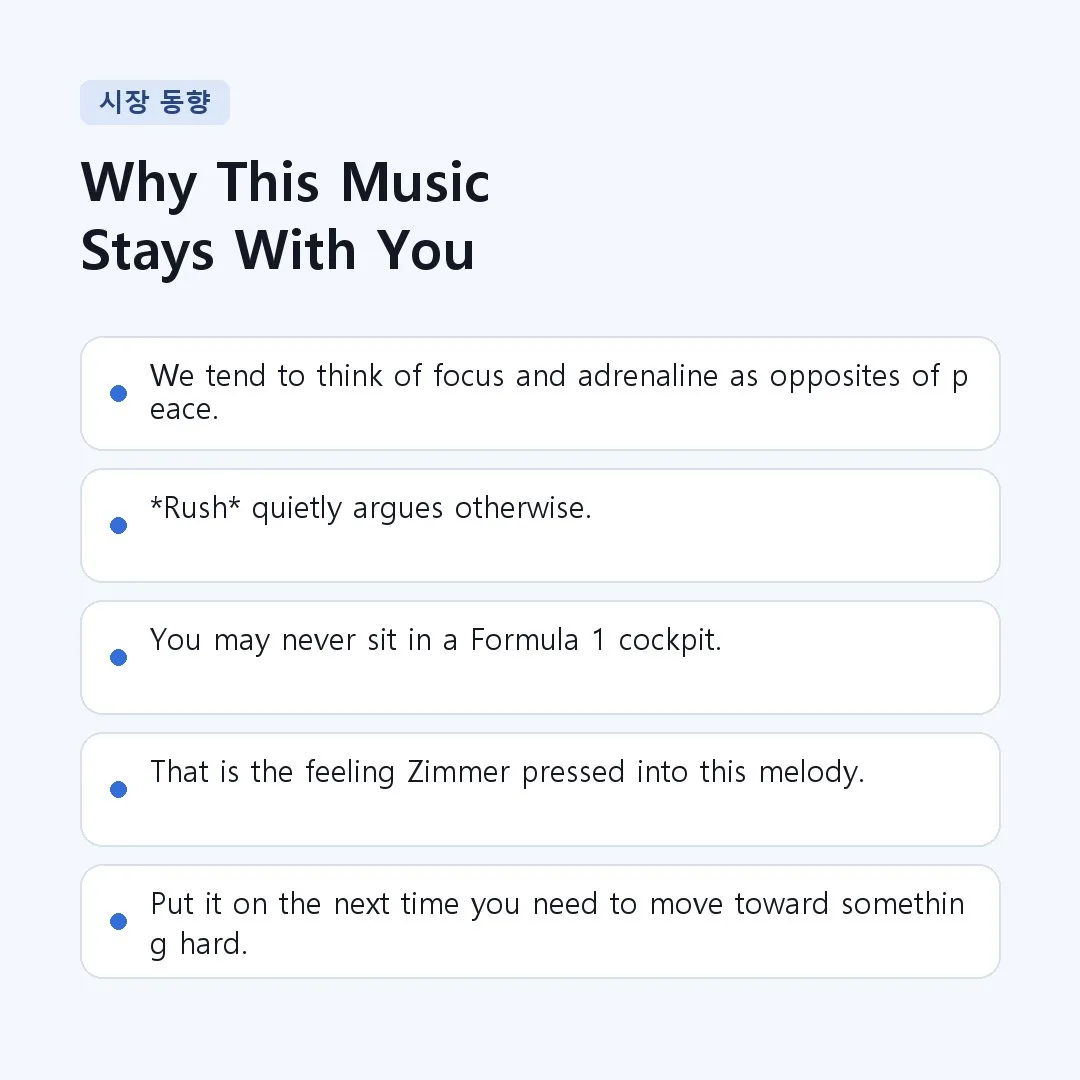
We tend to think of focus and adrenaline as opposites of peace. Rush quietly argues otherwise. The theme suggests that there is a kind of stillness available only to those who throw themselves completely at something—that total commitment, even to something dangerous, can feel like the closest thing to clarity a person ever gets.
You may never sit in a Formula 1 cockpit. But you have almost certainly had a moment where you wanted something so much that the fear and the desire became indistinguishable. That is the feeling Zimmer pressed into this melody. Put it on the next time you need to move toward something hard. It won’t make the fear disappear. It will just remind you that the fear and the wanting have always traveled together—and that you can drive anyway.