📑 Table of Contents
“I think I have been brought down really low when I have been forced to compose for money.”
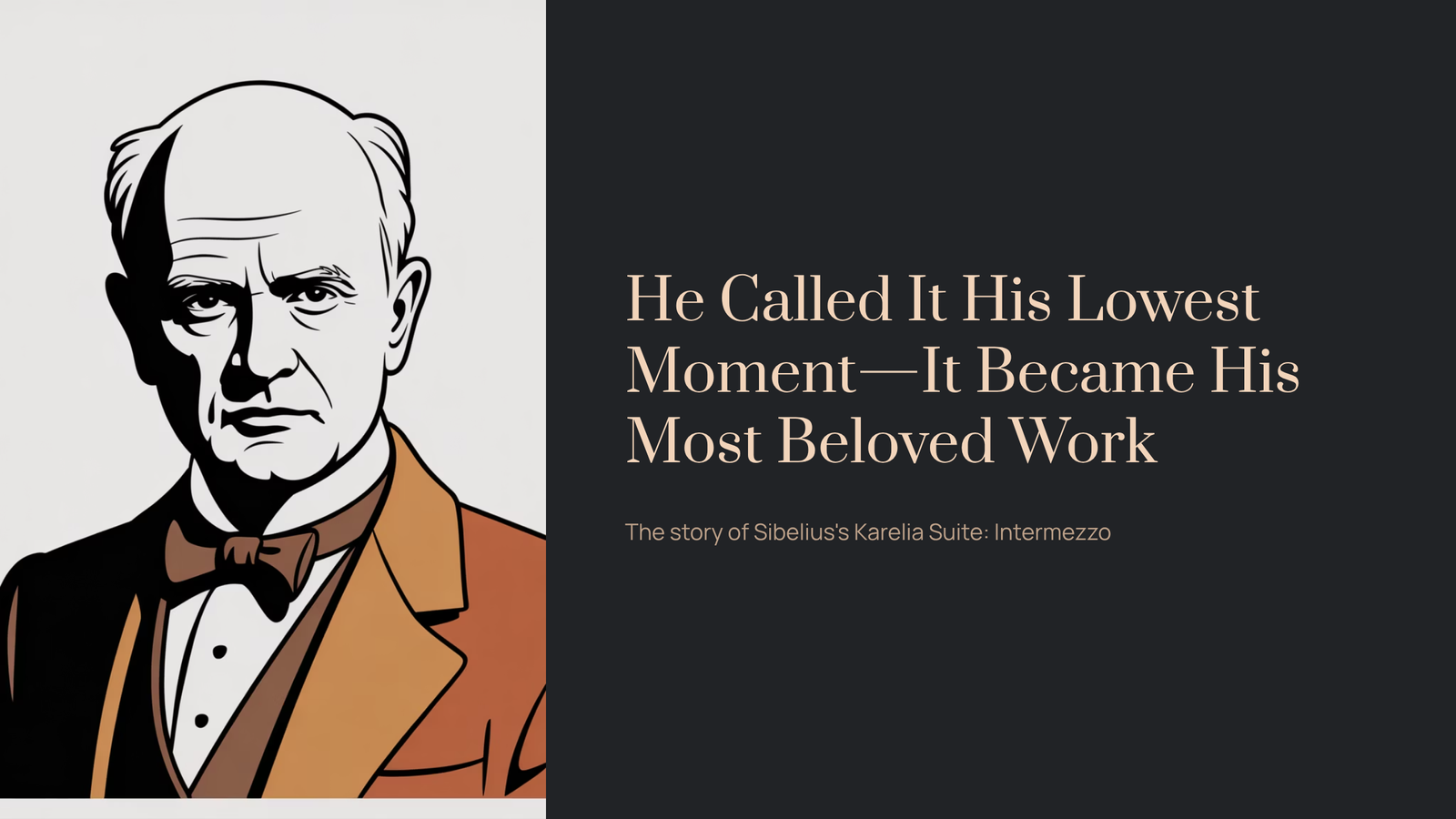
Jean Sibelius wrote these words in early November 1893, just days before premiering his Karelia Music. The 27-year-old composer, freshly married and still finding his professional footing, felt humiliated. He had accepted a commission from a student association—not for artistic glory, but simply because he needed the paycheck.
What Sibelius couldn’t know then was that this “shameful” gig would produce one of the most recognized pieces of Finnish classical music. The Intermezzo from his Karelia Suite would eventually soundtrack serious British journalism for over two decades, inspire a progressive rock adaptation, and become a symbol of an entire nation’s cultural identity.
Sometimes, the music we create reluctantly becomes the music the world refuses to forget.
The Commission That Changed Everything
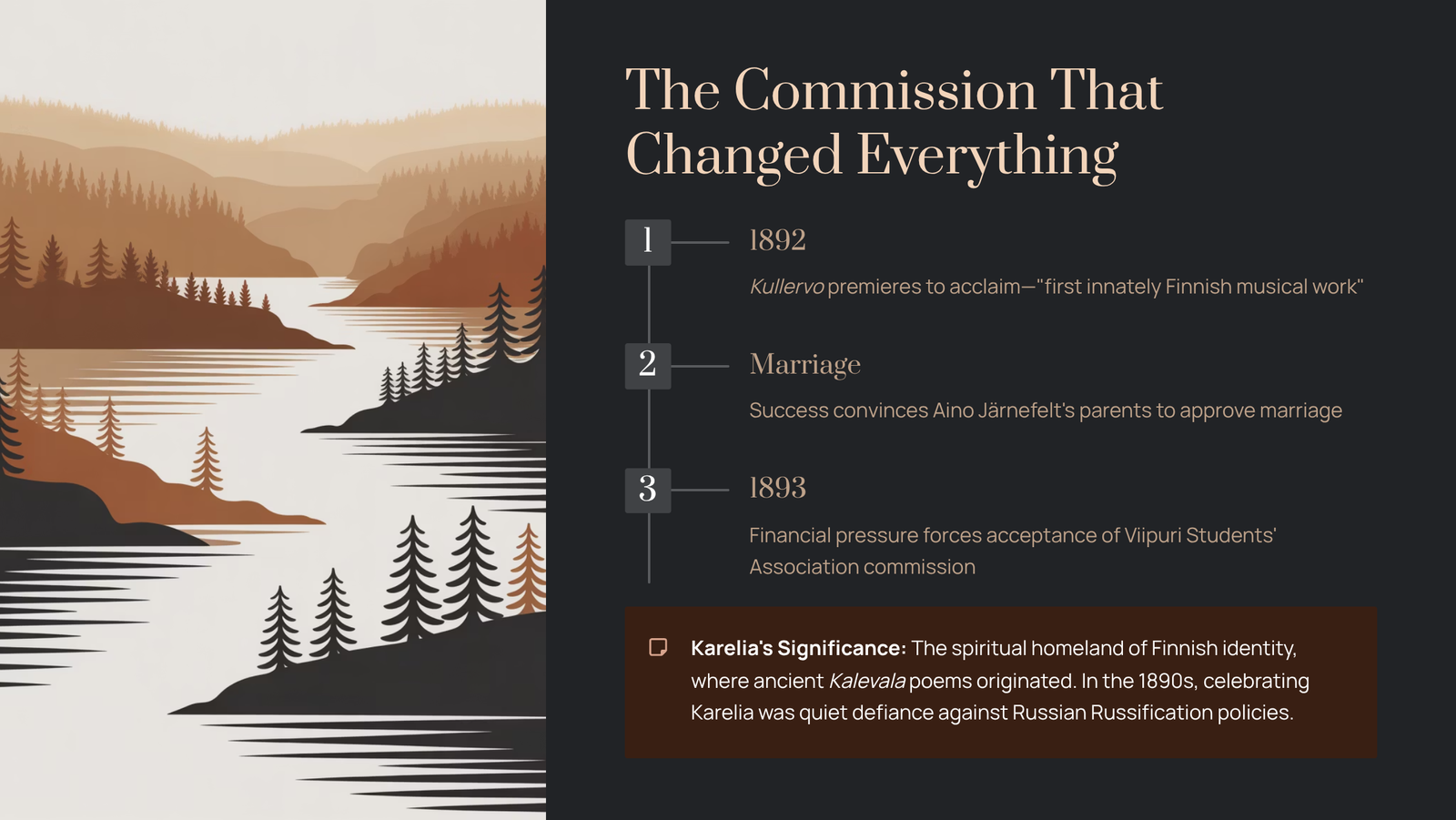
The year 1893 found Sibelius in a complicated emotional state. Just a year earlier, his massive choral symphony Kullervo had premiered to spectacular acclaim. Critics hailed it as “the first innately Finnish musical work.” That triumph had convinced Aino Järnefelt’s parents to finally approve their daughter’s marriage to the young composer. Life was looking up.
But artistic success doesn’t always translate to financial stability. When the Viipuri Students’ Association approached Sibelius to compose music for their patriotic historical pageant—essentially a fundraising event complete with lottery tickets and theatrical tableaux—he couldn’t afford to say no.
The pageant told the story of Karelia, a region in eastern Finland that held almost mythical significance for Finnish nationalists. This was the land where the ancient poems of the Kalevala originated, the spiritual homeland of Finnish identity. And in the 1890s, with Russia’s “Russification” policies threatening Finnish culture and autonomy, celebrating Karelia wasn’t just entertainment—it was an act of quiet defiance.
What You’re Actually Hearing
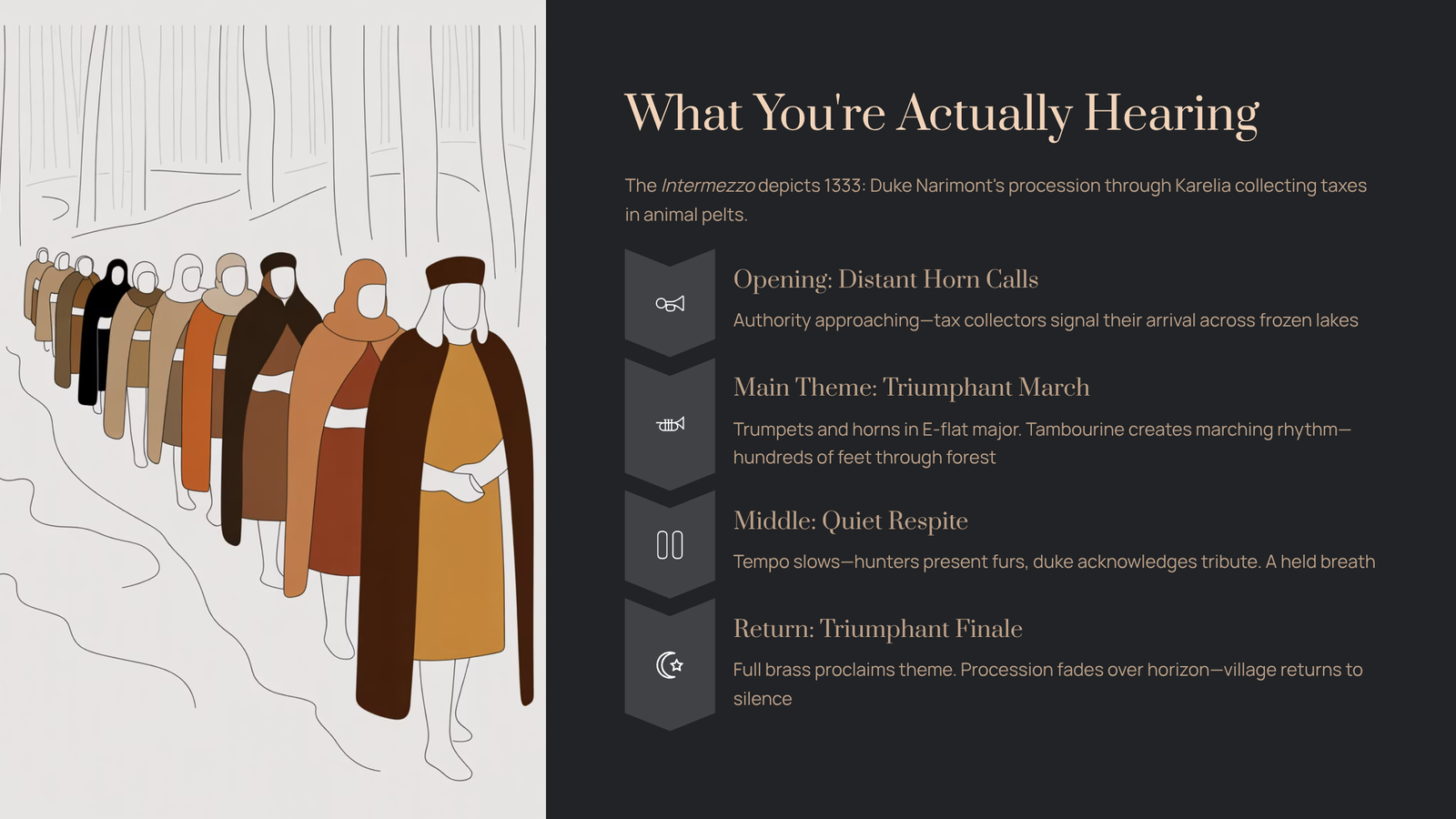
The Intermezzo depicts a specific historical scene: the year 1333, when Narimont, a Lithuanian duke, led his procession through Karelia to collect taxes. Local hunters would pay their dues in animal pelts—furs being the currency of the northern medieval world.
Listen closely, and you’ll hear this story unfold.
The piece opens with quiet horn calls, like a distant signal echoing across frozen lakes. This is the announcement: the tax collectors are coming. There’s something both regal and slightly ominous about these opening notes—authority approaching, demanding its due.
Then the main theme enters, and the mood shifts dramatically. Trumpets and horns unleash a buoyant, march-like melody in E-flat major, bright and confident. The tambourine kicks in with an off-beat pattern, creating that unmistakable feeling of marching feet—hundreds of them, moving through the forest.
What makes this march so distinctive is its deliberate roughness. Sibelius wasn’t trying to write polished Viennese elegance here. He wanted something that felt folk-like and untamed, music that smelled of pine forests and woodsmoke. The orchestration is bold, almost blunt, with brass instruments dominating rather than blending into refined textures.
Around the two-minute mark, the music suddenly pulls back. The tempo slows, the dynamics soften. Perhaps this represents the moment of tribute itself—the hunters presenting their furs, the duke acknowledging their payment. It’s a brief respite, a held breath.
Then the march returns, bigger and more triumphant than before. The full brass section proclaims the theme while strings and percussion drive forward with unstoppable momentum. The procession has passed its peak; the collection is complete.
Finally, like an army disappearing over the horizon, the music fades. A last horn call echoes, and the village returns to silence.
The Sound of Defiance
Understanding the Intermezzo requires understanding what Karelia meant to Finns in the 1890s.
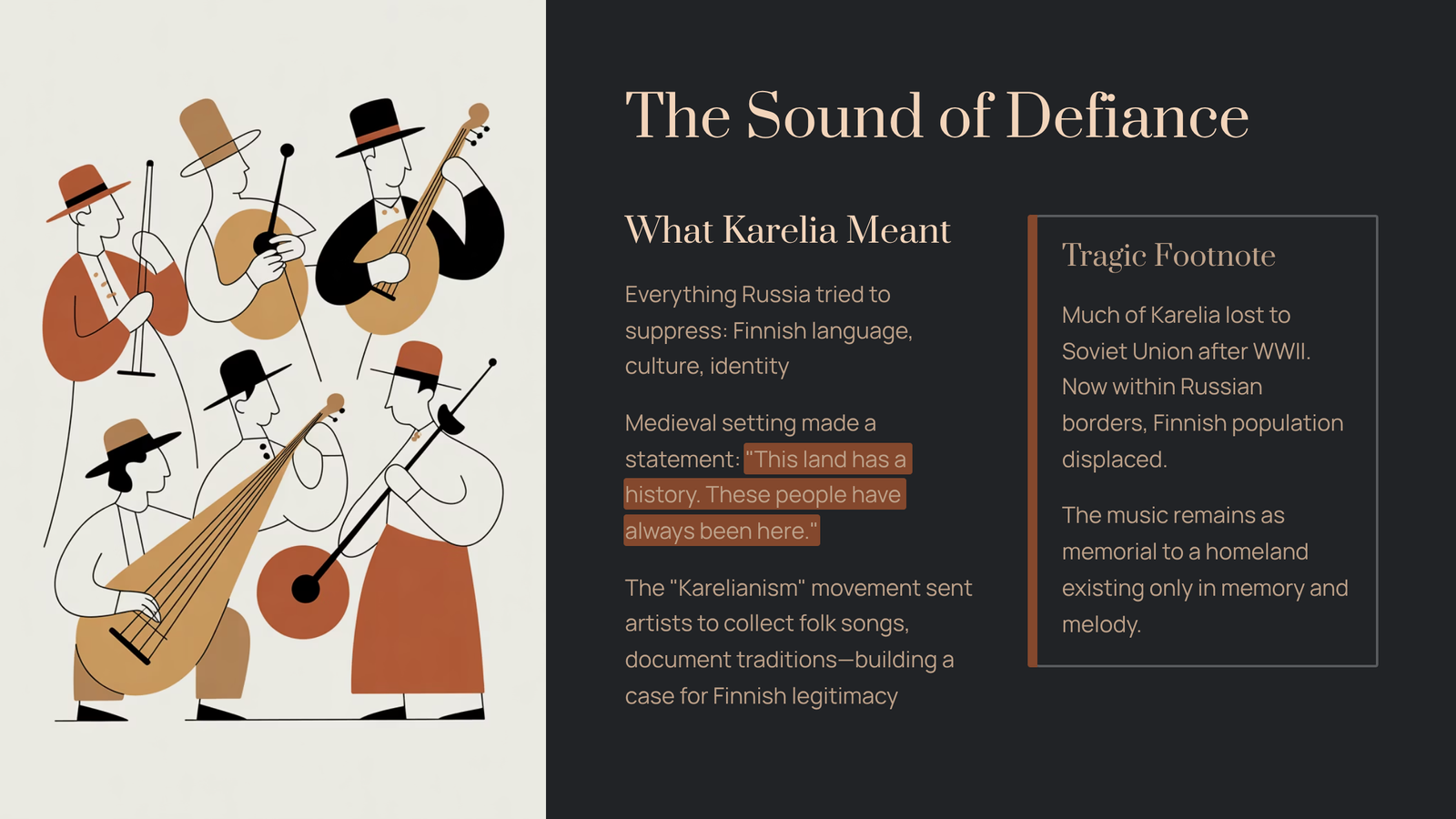
The region represented everything the Russian Empire was trying to suppress: Finnish language, Finnish culture, Finnish identity. By setting his music in medieval Karelia, Sibelius was making a statement. “This land has a history,” the music declares. “These people have always been here.”
The “Karelianism” movement of this era sent artists, writers, and composers into eastern Finland to collect folk songs, document traditions, and essentially build a case for Finnish cultural legitimacy. Sibelius himself had spent part of his honeymoon in Karelia, gathering melodies that would influence his work for years to come.
So when audiences in 1893 heard those proud horn fanfares, they weren’t just hearing a historical tableau. They were hearing their own heritage, proclaimed defiantly in the face of imperial pressure.
There’s a tragic footnote to this story. The Karelia that Sibelius celebrated would be largely lost to the Soviet Union after World War II. Today, much of the region lies within Russian borders, its Finnish population long displaced. The music remains as a kind of memorial to a homeland that exists now only in memory and melody.
Why This “Minor Work” Endures
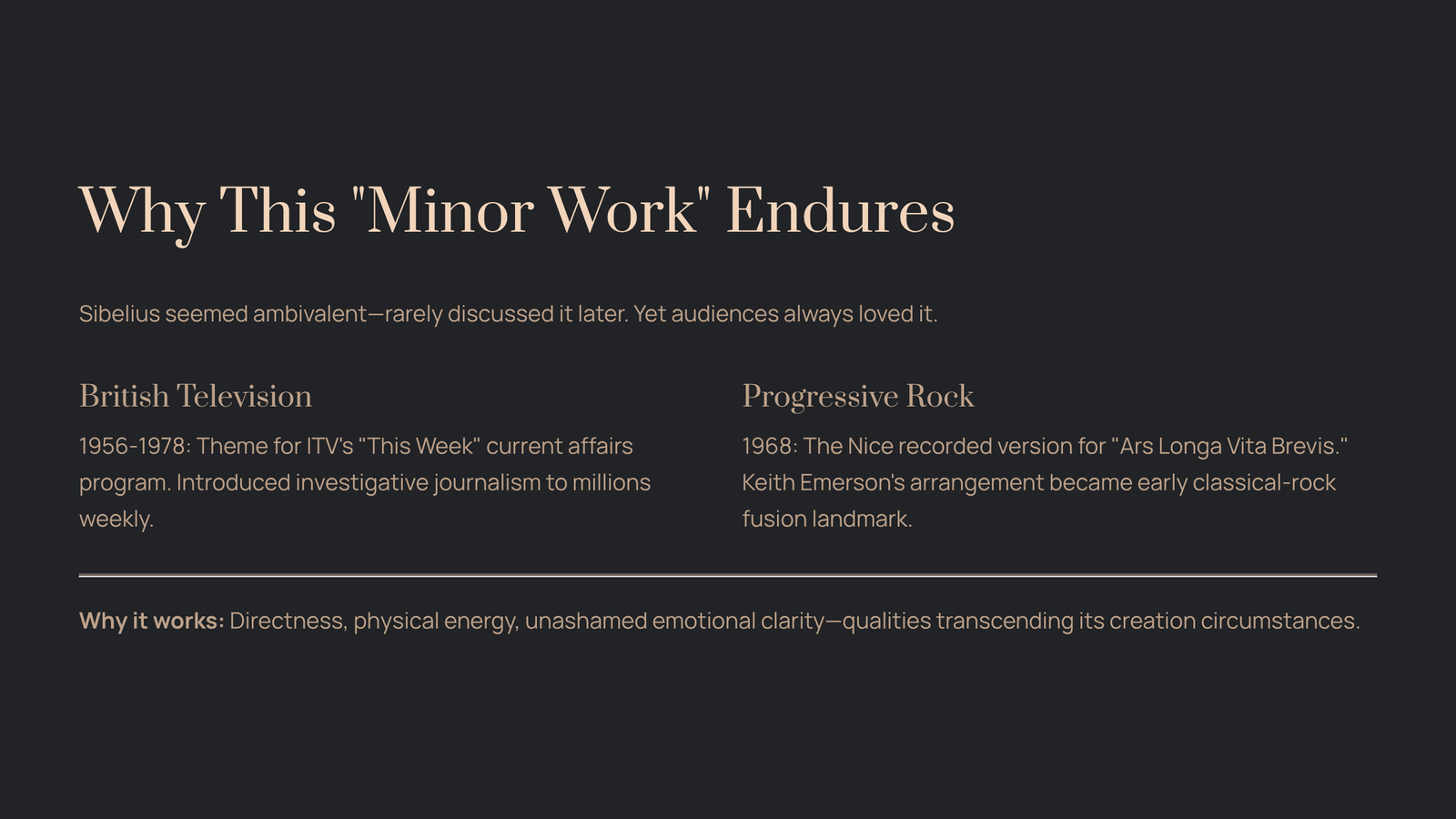
Sibelius himself seemed ambivalent about the Karelia Suite. He extracted only three movements from the much longer original pageant music, and he rarely discussed the piece in his later years. Compared to his symphonies or Finlandia, it can seem like a youthful diversion.
Yet audiences have always loved it. The Intermezzo specifically has found remarkable second lives beyond the concert hall.
From 1956 to 1978, British television viewers heard it every week as the theme for “This Week,” ITV’s flagship current affairs program. The choice was deliberate—producers wanted classical music that conveyed seriousness and weight. For over two decades, Sibelius’s march introduced investigative journalism to millions of British homes.
In 1968, the progressive rock band The Nice recorded their own version for the album “Ars Longa Vita Brevis.” Keyboardist Keith Emerson—who would later form Emerson, Lake & Palmer—led an arrangement that preserved the original’s structure while adding rock instrumentation. It became an early landmark in the classical-rock fusion movement.
Something about this music simply works. Its directness, its physical energy, its unashamed emotional clarity—these qualities transcend the specific circumstances of its creation.
How to Listen
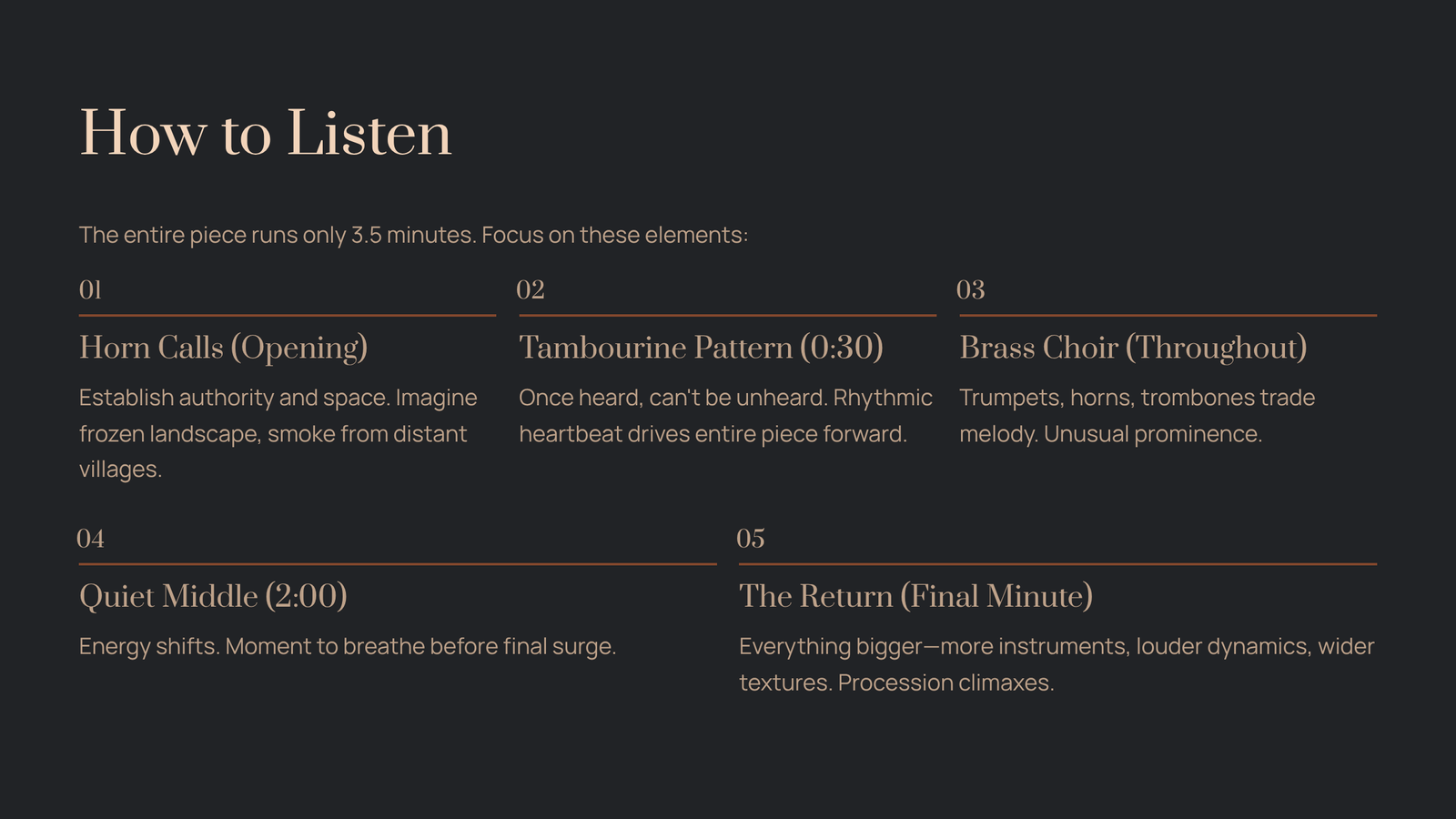
If you’re approaching the Intermezzo for the first time, here’s what to focus on:
The horn calls (opening seconds): Notice how they establish authority and space. Close your eyes and imagine a frozen landscape, smoke rising from distant villages.
The tambourine pattern (starting around 0:30): Once you hear it, you can’t unhear it. This rhythmic heartbeat drives the entire piece forward.
The brass choir (throughout): Pay attention to how trumpets, horns, and trombones trade the melody back and forth. Sibelius gives them unusual prominence.
The quiet middle section (around 2:00): Feel how the energy shifts. This is your moment to breathe before the final surge.
The return (final minute): Notice how everything gets bigger—more instruments, louder dynamics, wider textures. The procession reaches its climax.
The entire piece runs only about three and a half minutes. It asks nothing of you except attention, and it rewards that attention generously.
Recommended Recordings
For a modern interpretation with exceptional clarity, try Susanna Mälkki with the Helsinki Philharmonic Orchestra. Her reading emphasizes the piece’s “muscular spirit” while maintaining structural precision. There’s something fitting about hearing this music performed by Finnish musicians who understand its cultural weight.
Historical recordings by Herbert von Karajan offer a more grandiose approach, with full orchestral drama. Anthony Collins’s 1950s recordings with the Royal Philharmonic represent an important early stereo benchmark.
For something completely different, seek out The Nice’s 1968 rock adaptation. It’s fascinating to hear how Keith Emerson translated Sibelius’s orchestral colors into electric keyboards and drums.
The Lesson in the Music
There’s something reassuring about the Intermezzo‘s origin story. Sibelius felt he was compromising his artistic integrity by accepting a commercial commission. He wrote dismissively about being “forced to compose for money.” He couldn’t see the value in what he was creating.
And yet.
This “shameful” piece outlived countless works that Sibelius considered more serious. It brought joy to audiences who never attended the original pageant, in countries Sibelius never visited, in media that didn’t exist when he wrote it.
Perhaps the lesson is that we’re not always the best judges of our own work. The music we create reluctantly, the projects we take on just to pay the bills, the efforts we consider beneath our capabilities—sometimes these become the things that matter most.
Sibelius lived until 1957, long enough to see his Karelia music become beloved. Whether he ever made peace with its popularity, we don’t know. But the music doesn’t care about its creator’s ambivalence. It simply continues to march forward, proud horns blazing, tambourine keeping time, carrying listeners across frozen landscapes toward something that feels, for three and a half minutes, like triumph.