📑 Table of Contents

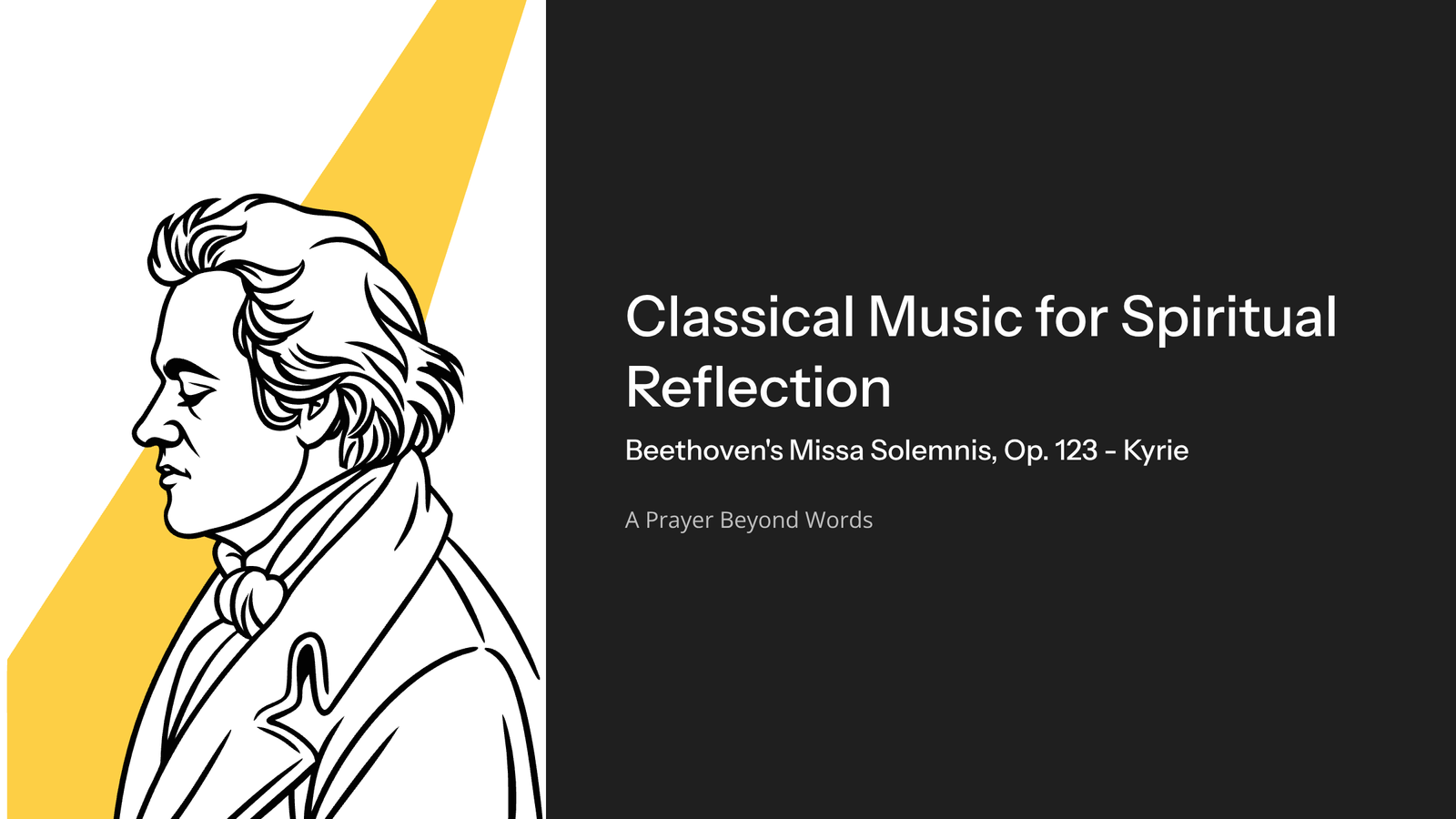
There are moments in life when words fail us. When grief sits heavy in our chest, when gratitude overflows beyond language, when we stand before something vast and unknowable—these are the moments that call for a different kind of expression. Beethoven understood this. And in his Missa Solemnis, particularly in the opening Kyrie, he created music that speaks directly to that wordless place within us.
This isn’t comfortable music. It’s not background listening for your morning coffee. The Kyrie of the Missa Solemnis is Beethoven wrestling with the divine, pouring four years of his life into what he considered his greatest work. Whether you’re religious or not, whether you’ve never heard a note of classical music or you’ve spent decades exploring it—this piece has something to offer anyone willing to sit with it.
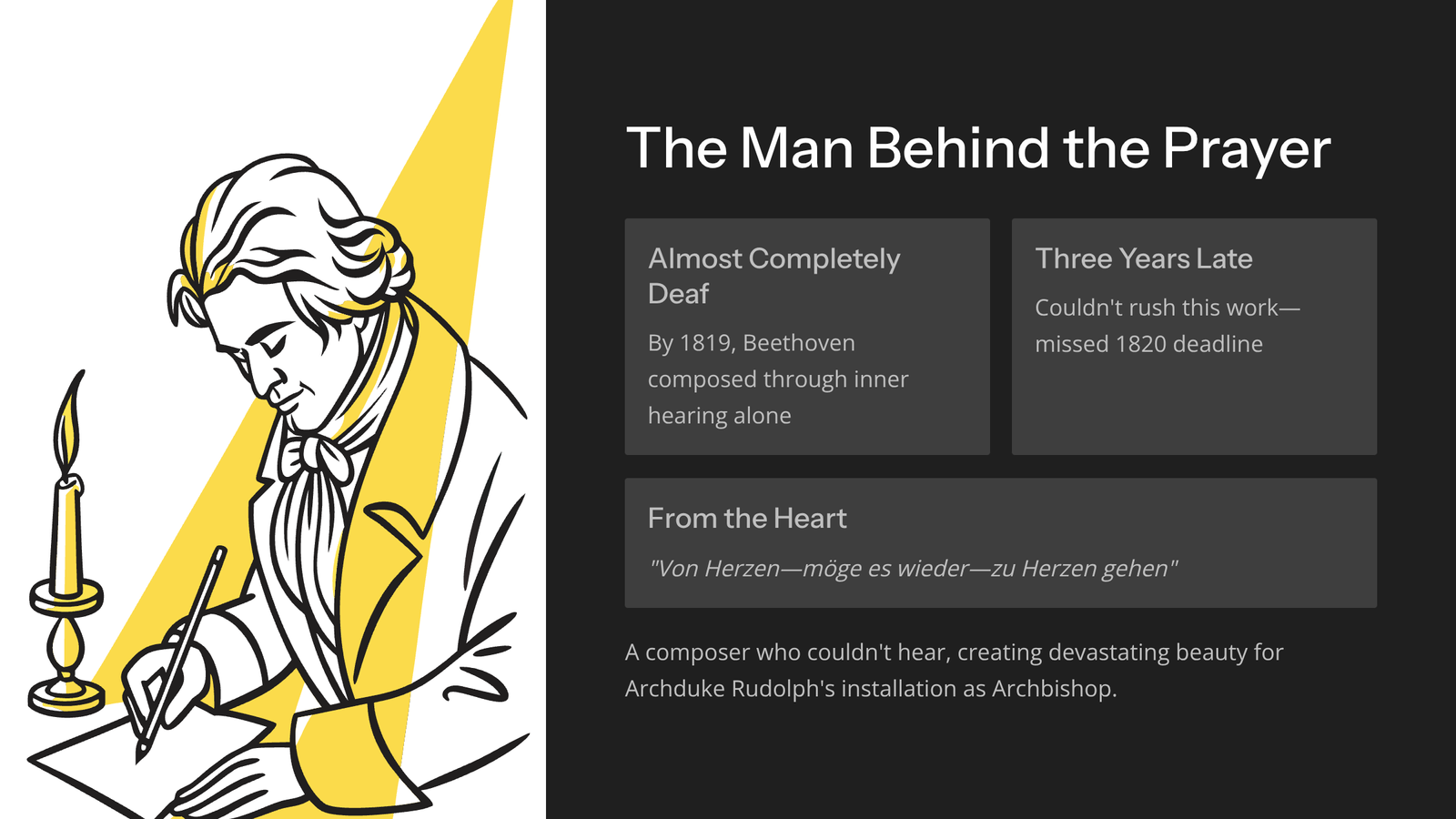
The Man Behind the Prayer: Beethoven at His Most Vulnerable
By 1819, when Beethoven began composing the Missa Solemnis, he was almost completely deaf. Think about that for a moment: a composer who could no longer hear the music he was creating, writing one of the most complex choral works ever conceived. He couldn’t hear the soprano soaring above the orchestra, couldn’t hear the timpani rumbling beneath the choir. Yet somehow, through inner hearing alone, he crafted sounds of devastating beauty.
The Missa Solemnis was originally intended for the installation of his patron and student, Archduke Rudolph, as Archbishop of Olmütz in 1820. Beethoven missed that deadline by three years. He simply couldn’t rush this work. In his sketches, he wrote above the Kyrie: “Von Herzen—möge es wieder—zu Herzen gehen” (“From the heart—may it return—to the heart”). This wasn’t a commission he was fulfilling; it was a confession he was making.
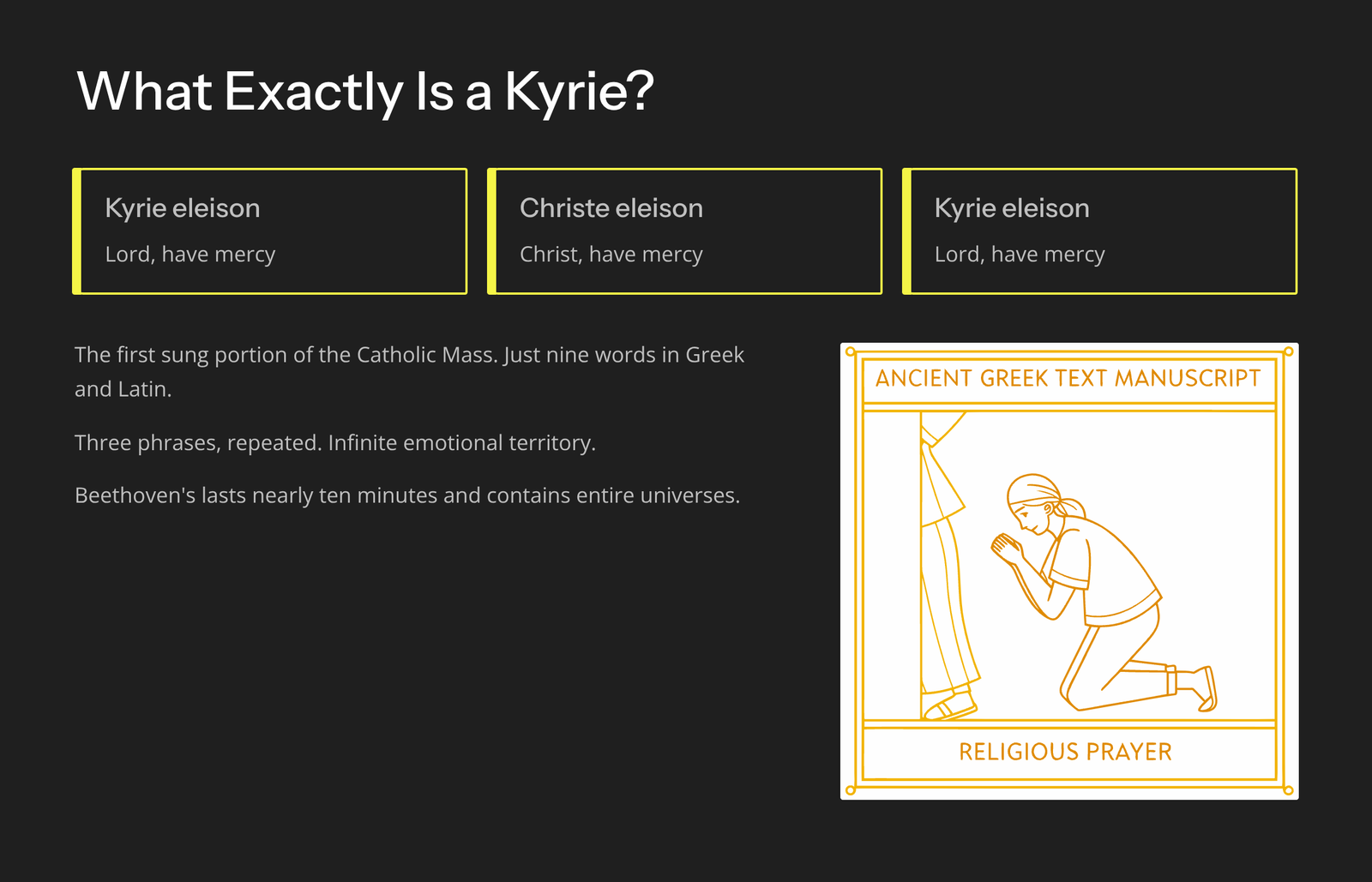
What Exactly Is a Kyrie?
If you’re new to sacred classical music, here’s the essential context: the Kyrie is the first sung portion of the Catholic Mass. The text is remarkably simple—just nine words in Greek and Latin:
Kyrie eleison (Lord, have mercy)
Christe eleison (Christ, have mercy)
Kyrie eleison (Lord, have mercy)
That’s it. Three phrases, repeated. But within these spare words, composers have found infinite emotional territory to explore. Some Kyries are brief and functional. Beethoven’s lasts nearly ten minutes and contains entire universes.
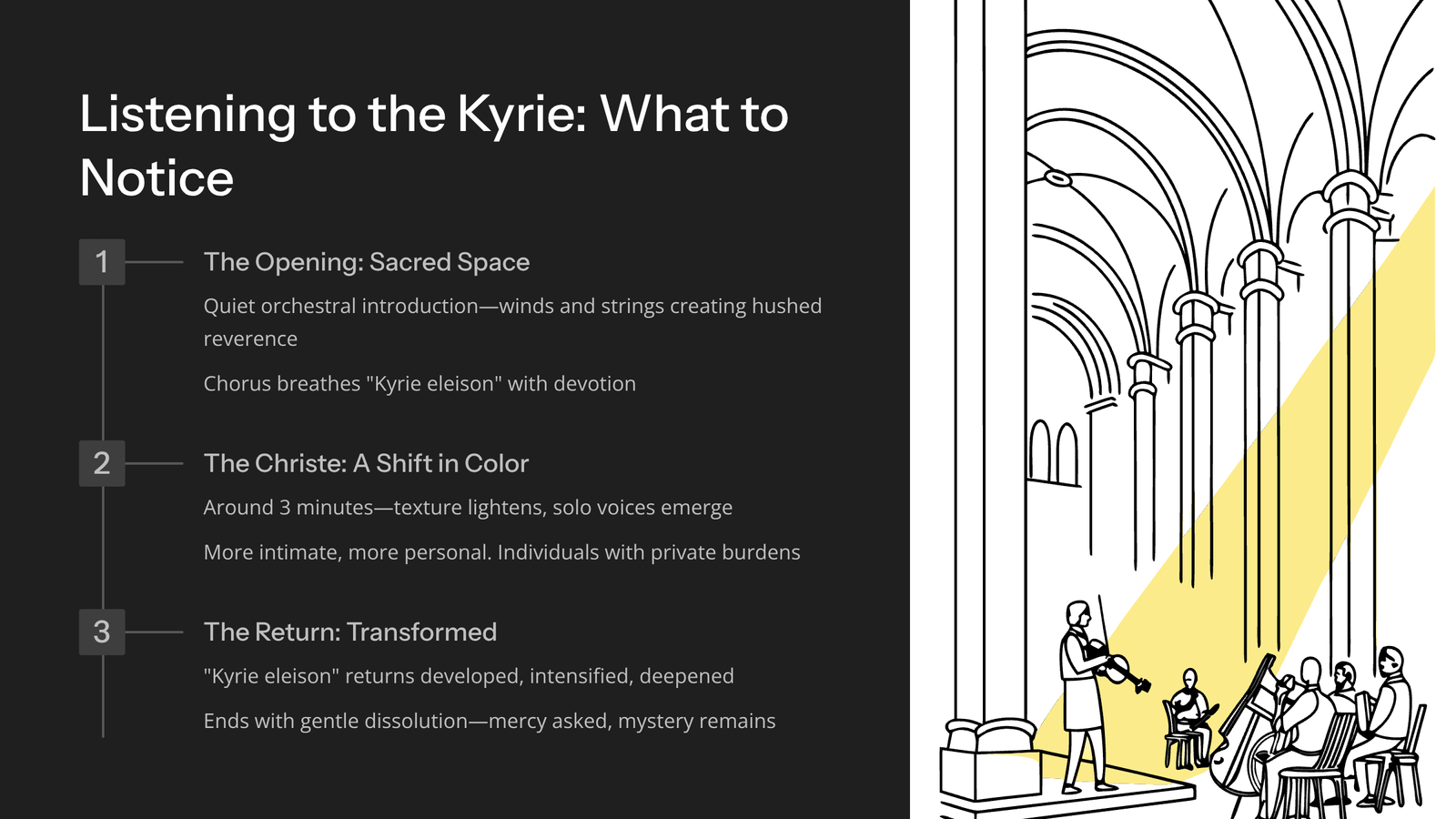
Listening to the Kyrie: What to Notice
The Opening: Establishing Sacred Space
The Kyrie begins with a quiet orchestral introduction—winds and strings creating an atmosphere of hushed reverence. There’s no dramatic fanfare here. Instead, Beethoven draws you into a sacred space gradually, as if you’re walking into a cathedral and letting your eyes adjust to the candlelight.
When the chorus enters with “Kyrie eleison,” notice how the voices don’t attack the phrase—they breathe it. The tempo marking is Assai sostenuto. Mit Andacht (Very sustained. With devotion). Beethoven rarely included emotional directions in German alongside Italian tempo markings. When he did, he meant it.
The Christe: A Shift in Color
Around the three-minute mark, the music transforms for the “Christe eleison” section. The texture lightens. Solo voices emerge from the choir—soprano, alto, tenor, bass—each taking turns with the plea for mercy. There’s something more intimate here, more personal. If the opening Kyrie feels like a congregation praying together, the Christe feels like individuals stepping forward, one by one, with their private burdens.
Listen for how Beethoven weaves the solo voices together with the orchestra. The instrumental lines don’t simply accompany—they converse, respond, embrace.
The Return: Kyrie Transformed
When “Kyrie eleison” returns, it’s not the same music we heard at the beginning. Beethoven brings back the theme but develops it, intensifies it, layers it with everything we’ve experienced in the Christe. The prayer has deepened. We’ve moved through something, and we return to our starting point changed.
The movement ends not with a triumphant resolution but with a gentle dissolution—voices and instruments fading into a reverent pianissimo. Mercy has been asked. Whether it’s been granted remains a mystery.

Why This Music Still Matters
You don’t need to be Catholic to feel the Kyrie’s power. You don’t need to believe in any god at all. What Beethoven captures here is something fundamentally human: the experience of asking for help when we’re not sure anyone is listening. The vulnerability of admitting we can’t do this alone. The strange comfort of voicing our need into the silence.
In our age of constant noise and distraction, music like this offers something rare—an invitation to sit with difficult emotions rather than scroll past them. The Kyrie doesn’t promise answers. It simply creates space for the questions.

Recommended Recordings: Where to Begin
For First-Time Listeners:
– John Eliot Gardiner with the Monteverdi Choir and Orchestre Révolutionnaire et Romantique – A historically informed performance that’s surprisingly accessible, with transparent textures that let you hear every detail.
For Deep Immersion:
– Otto Klemperer with the New Philharmonia Orchestra (1965) – Monumental, slow, and deeply spiritual. Klemperer treats this music as sacred ritual.
For Vocal Beauty:
– Herbert von Karajan with the Berlin Philharmonic (1966) – Lush, Romantic, with an all-star solo quartet. If you want to be swept away by sheer sonic beauty, start here.
For Historical Perspective:
– Nikolaus Harnoncourt with the Chamber Orchestra of Europe – A thought-provoking interpretation that emphasizes the work’s radical innovations.

A Final Thought: Music as Prayer
Beethoven spent four years on the Missa Solemnis—longer than almost any other work in his catalog. When he finally completed it, he was genuinely uncertain whether it would ever be performed or understood. He wrote to a friend that this mass, along with his Ninth Symphony, represented his highest achievements.
The Kyrie alone justifies that assessment. In less than ten minutes, Beethoven transforms three simple words into a complete emotional journey—from tentative first prayers through intimate confession to transformed understanding. It’s music that asks nothing of you except your attention and offers everything in return.
Find a quiet moment. Put on a recording. Let Beethoven’s prayer become your own.
Kyrie eleison. Lord, have mercy.
Some requests don’t need more words than that.