📑 Table of Contents

Have you ever stood before a Renaissance masterpiece and wished you could hear what the painting sounds like? In 1927, Italian composer Ottorino Respighi made that wish come true. Walking through Florence’s Uffizi Gallery with his wife Elsa, he found himself transfixed by three Botticelli paintings—and emerged with a musical vision that would bridge five centuries of artistic expression.
The second movement of his Trittico Botticelliano (Botticelli Triptych), titled L’adorazione dei Magi (The Adoration of the Magi), transforms a 15th-century religious painting into an eight-minute meditation on mystery, devotion, and transcendence. If you’re seeking classical music for Christmas contemplation or simply want to experience how sound can paint pictures, this piece offers something genuinely rare.

The Story Behind the Sound
The year was 1927, and Respighi had already conquered concert halls worldwide with his famous Roman Trilogy—those lush orchestral postcards depicting fountains, pines, and festivals. But something was shifting in his artistic soul. His wife Elsa had introduced him to Gregorian chant several years earlier, and the ancient melodies had taken root in his imagination like seeds in fertile soil.
When American patron Elizabeth Sprague Coolidge commissioned a new work, Respighi found his inspiration not in Rome’s grandeur but in Florence’s artistic heritage. Botticelli’s Adoration of the Magi, painted around 1475 for a Florentine banker’s chapel, depicts the moment when three wise men kneel before the infant Christ. The painting is remarkable not just for its religious subject but for its audacious inclusion of the Medici family as the Magi themselves—a Renaissance blend of devotion and political theater.
Respighi saw something deeper in that crowded scene of kings, scholars, and onlookers gathered around a humble stable. He heard the hush of anticipation, the weight of a long journey’s end, the shimmer of something sacred entering ordinary time.

What Makes This Music Special
Unlike his earlier orchestral spectacles, Respighi deliberately constrained himself here. The Trittico Botticelliano uses a chamber orchestra—just one of each woodwind instrument, a single horn and trumpet, and a modest string section enhanced by harp, celesta, and piano. This restraint creates intimacy rather than grandeur, as if we’re not watching a public ceremony but witnessing a private moment of worship.
The most striking musical element arrives in the opening bars: a flute and bassoon playing the same melody two octaves apart. This unusual pairing—the flute’s bright transparency against the bassoon’s woody darkness—creates an otherworldly sound that seems to emerge from some ancient, half-remembered place. Sharp-eared listeners will recognize hints of Veni, Veni Emmanuel, the medieval Advent hymn, winding through this opening like incense smoke through a chapel.
As the movement unfolds, Respighi weaves in fragments of Tu scendi dalle stelle (You Come Down from the Stars), an Italian Christmas carol from 1744. The effect is remarkable: we’re hearing not one historical moment but layers of devotion accumulated across centuries, from medieval plainchant through Baroque piety to 20th-century orchestral sophistication.
A Listening Journey Through the Movement
The First Minutes: Entering Sacred Space
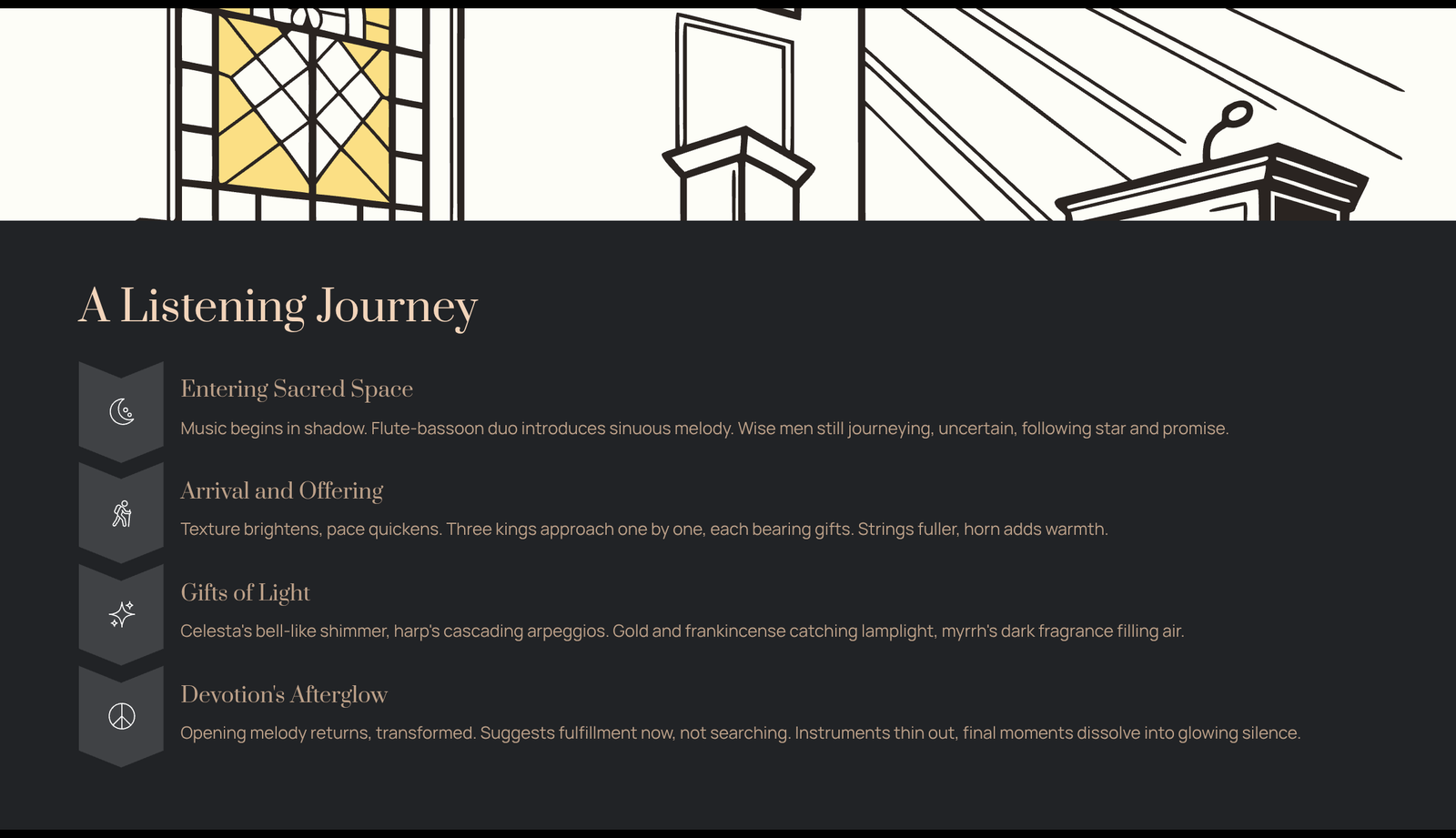
The music begins in shadow. Low strings establish a foundation while the flute-bassoon duo introduces that sinuous, almost Middle Eastern-sounding melody. There’s something unsettled here—the wise men are still journeying, still uncertain, following only a star and a promise. The oboe enters with its rich, reedy voice, deepening the atmosphere of ancient mystery.
The Middle Section: Arrival and Offering
Gradually, the texture brightens and the pace quickens subtly. Imagine the three kings approaching one by one, each bearing their gift. The strings grow fuller, the horn adds gentle warmth, and we sense the gathering weight of the moment. Respighi builds toward what feels like recognition—the travelers have found what they sought.
The Climax: Gifts of Light
Here the celesta enters with its bell-like shimmer, and the harp adds cascading arpeggios. These aren’t decorative touches; they’re the musical equivalent of gold and frankincense catching lamplight, of myrrh’s dark fragrance filling the air. The full chamber orchestra achieves a richness that belies its modest size, proof that Respighi’s genius lay not in volume but in color.
The Close: Devotion’s Afterglow
The opening melody returns, transformed. Where it once suggested searching, now it expresses fulfillment—the same notes, but heard through different ears. The instruments thin out gradually, like worshippers quietly departing. The final moments dissolve into silence, but the silence itself seems to glow.
Why This Piece Matters
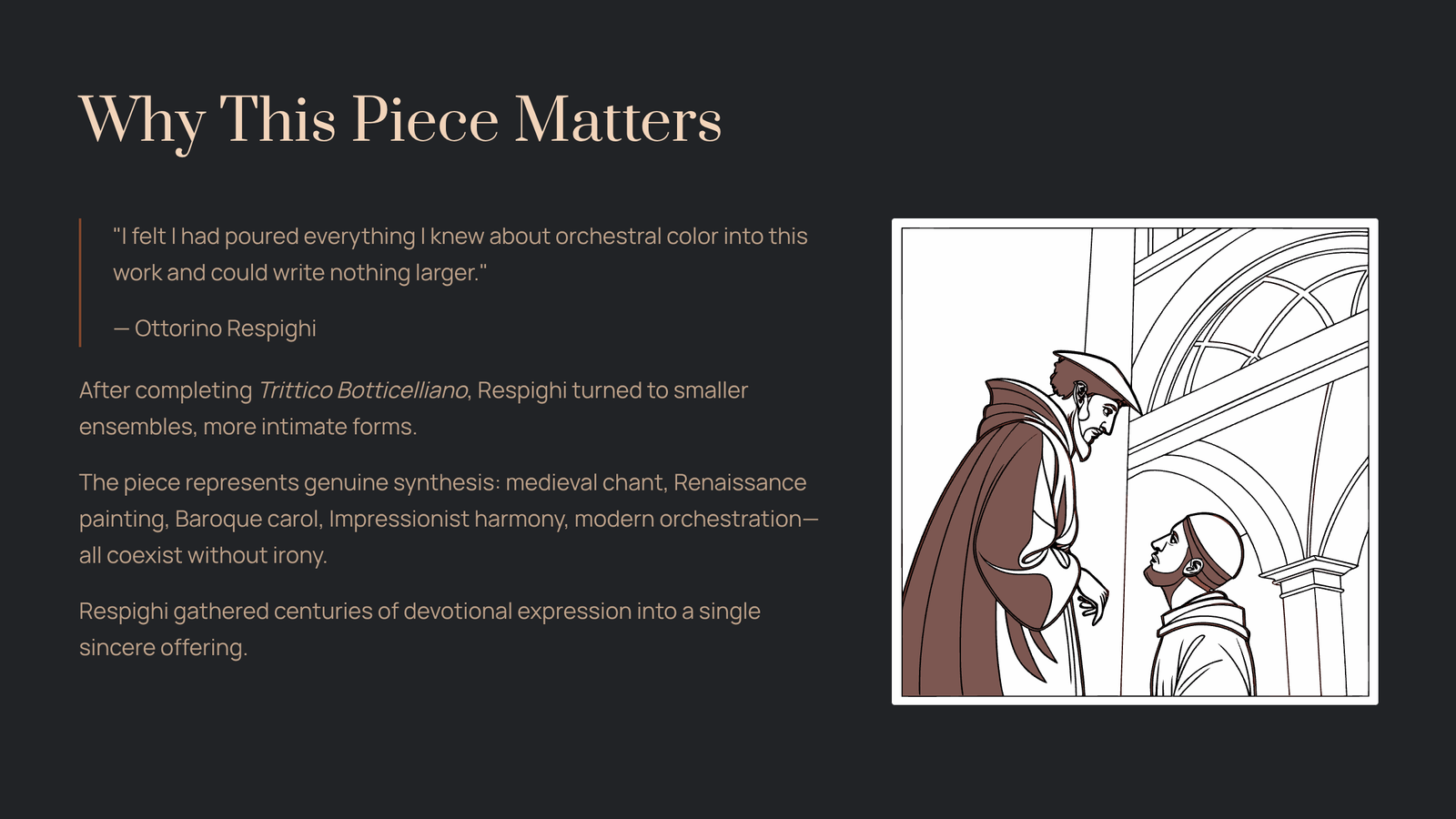
After completing the Trittico Botticelliano, Respighi made a startling admission: he felt he had poured everything he knew about orchestral color into this work and could write nothing larger. He turned afterward to smaller ensembles, more intimate forms. Whether or not we take this confession literally, it suggests how much of himself he invested in translating Botticelli’s vision into sound.
The piece also represents something valuable in our fragmented age: a genuine synthesis of traditions. Medieval chant, Renaissance painting, Baroque carol, Impressionist harmony, and modern orchestration all coexist here without irony or pastiche. Respighi wasn’t being clever; he was being sincere, gathering centuries of devotional expression into a single offering.
Recommended Recordings
Geoffrey Simon with the Philharmonia of London takes the most contemplative approach, allowing each phrase to breathe and every instrumental color to register fully. This is the recording for deep listening, best experienced with good headphones and no distractions.
Richard Hickox offers a more balanced interpretation that emphasizes the work’s architectural elegance. His reading reveals the chamber-music precision beneath the orchestral surface.
Hans Graf with the Singapore Symphony brings slightly more momentum, highlighting the narrative aspect—the sense of journey and arrival that structures the movement.
All three recordings couple the Trittico with Respighi’s Ancient Airs and Dances or The Birds, making for programs that showcase his gift for breathing new life into old music.
Final Thoughts
There’s a particular kind of December evening—when the world outside has grown dark and cold, when the rush of the season has momentarily paused—that calls for music like this. Respighi’s Adoration of the Magi doesn’t demand anything from us. It simply invites us to be still, to listen, to let five centuries of artistic devotion wash over us like candlelight.
Whether you approach it as a believer contemplating the Epiphany story, an art lover curious about ekphrasis (art about art), or simply someone seeking eight minutes of genuine beauty, this music offers something increasingly rare: a moment of sincere wonder in a cynical world.
Put on your headphones. Dim the lights. And let Respighi show you what Botticelli sounds like.
Listen on streaming platforms by searching “Respighi Trittico Botticelliano” or explore the Botticelli painting at the Uffizi Gallery’s online collection.