📑 Table of Contents
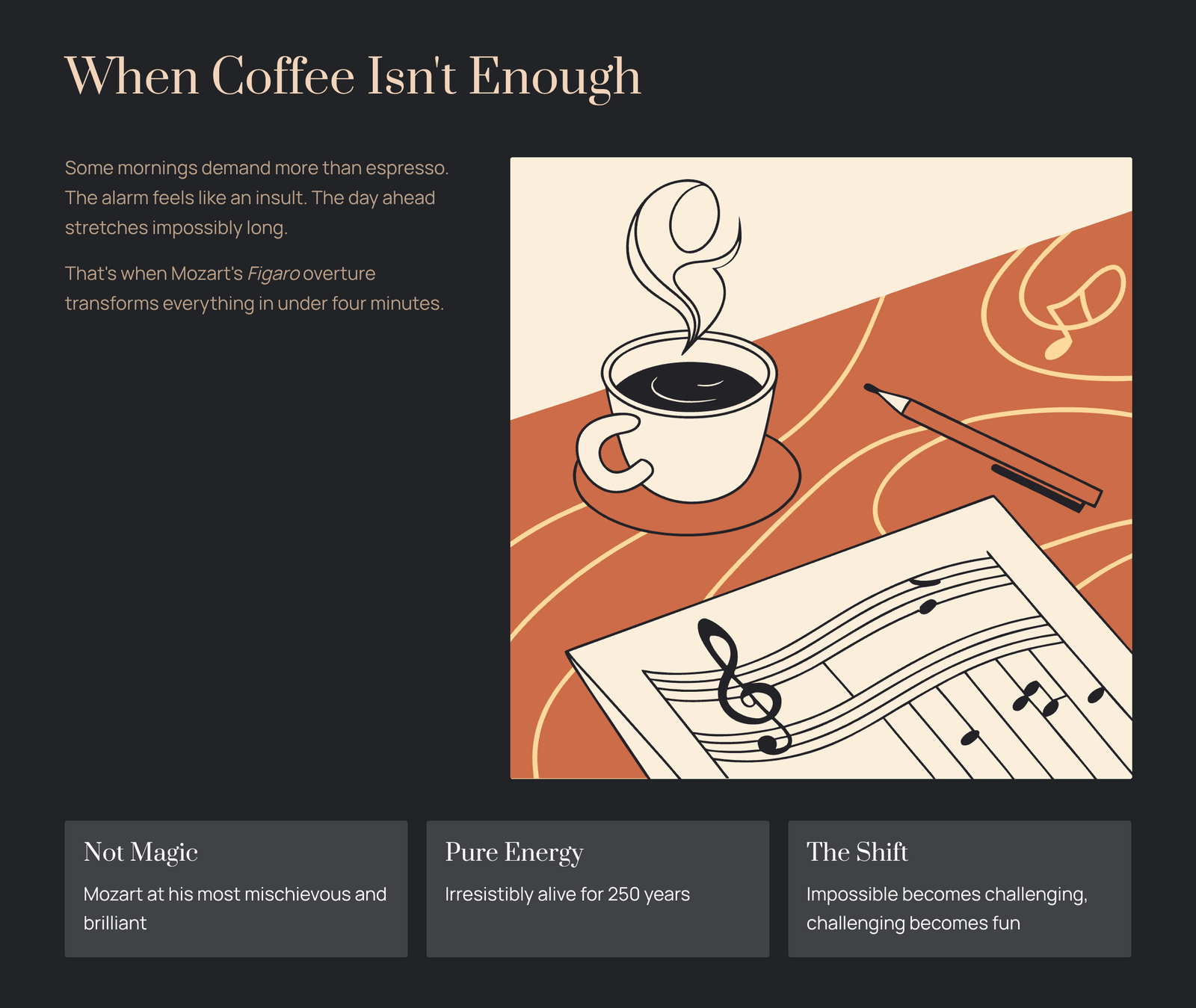
There are mornings when coffee isn’t enough. When the alarm feels like an insult, and the day ahead stretches out like an impossible marathon. On those mornings, I reach not for another espresso, but for Mozart—specifically, the overture to The Marriage of Figaro. In under four minutes, something shifts. The fog lifts. Suddenly, the impossible feels merely challenging, and challenging feels almost fun.
This isn’t magic. It’s Mozart at his most mischievous, most brilliant, most irresistibly alive. And today, I want to share why this tiny orchestral explosion has been waking up souls for nearly 250 years.
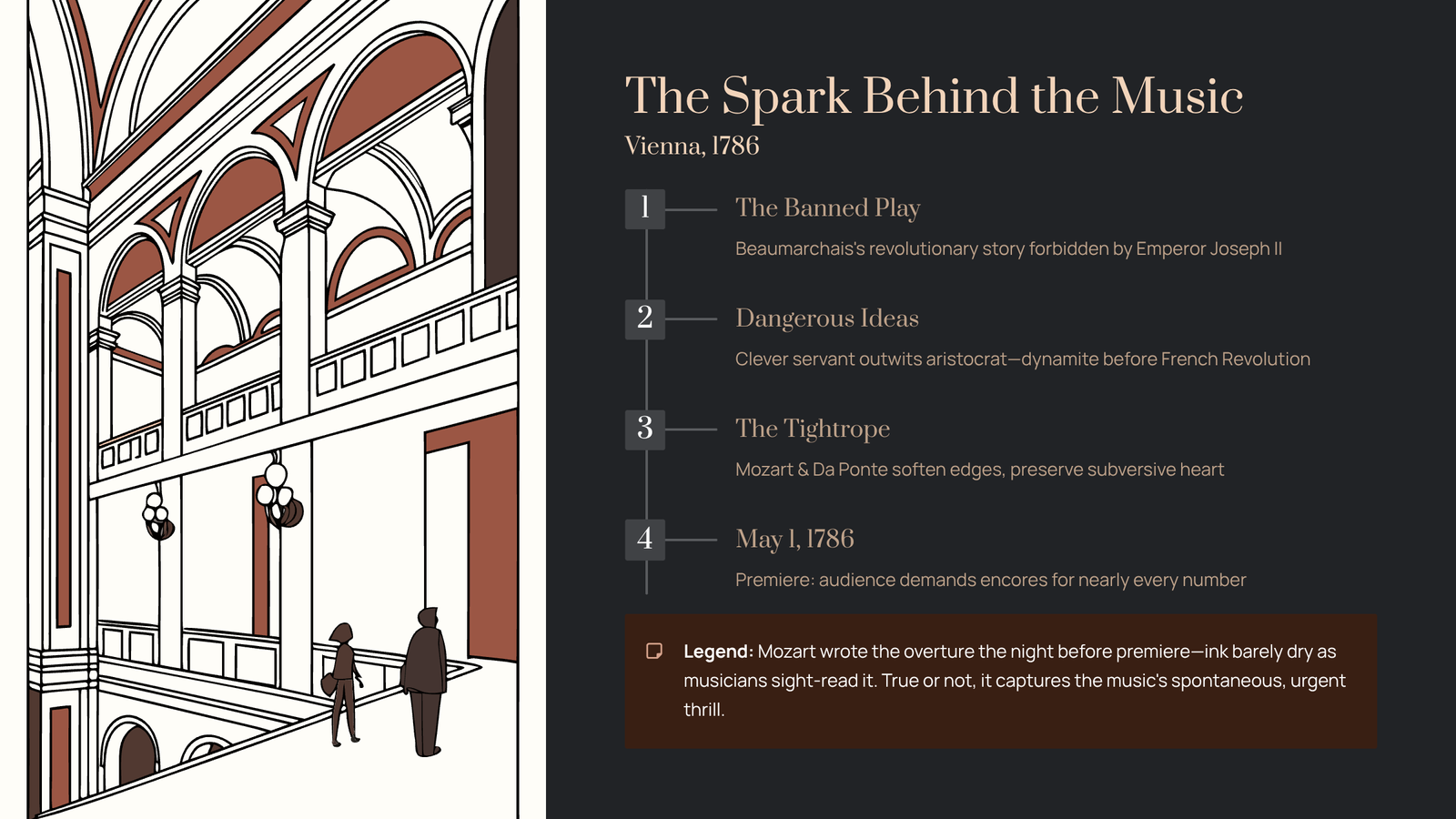
The Spark Behind the Music: Vienna, 1786
To understand why this overture crackles with such electricity, you need to know the circumstances of its birth. Wolfgang Amadeus Mozart was thirty years old, living in Vienna, and about to do something dangerous: set a banned play to music.
Pierre Beaumarchais’s original play, The Marriage of Figaro, had been forbidden in Vienna by Emperor Joseph II himself. Why? Because it was revolutionary—literally. The story features a clever servant who outwits his aristocratic master, exposing the hypocrisy of the ruling class. In the decade before the French Revolution, such ideas were dynamite.
Mozart and his librettist Lorenzo Da Ponte walked a tightrope. They softened the political edges just enough to slip past censorship while preserving the subversive heart of the story. The result premiered on May 1, 1786, and the audience went wild. Encores were demanded for nearly every number—so many that the emperor eventually had to ban mid-opera encores to keep performances from lasting all night.
The overture that opens this revolutionary comedy? Mozart reportedly wrote it the night before the premiere, the ink barely dry as musicians sight-read it for the first time. Whether this story is entirely true or theatrical legend, it captures something essential: this music sounds spontaneous, urgent, alive with the thrill of creation itself.
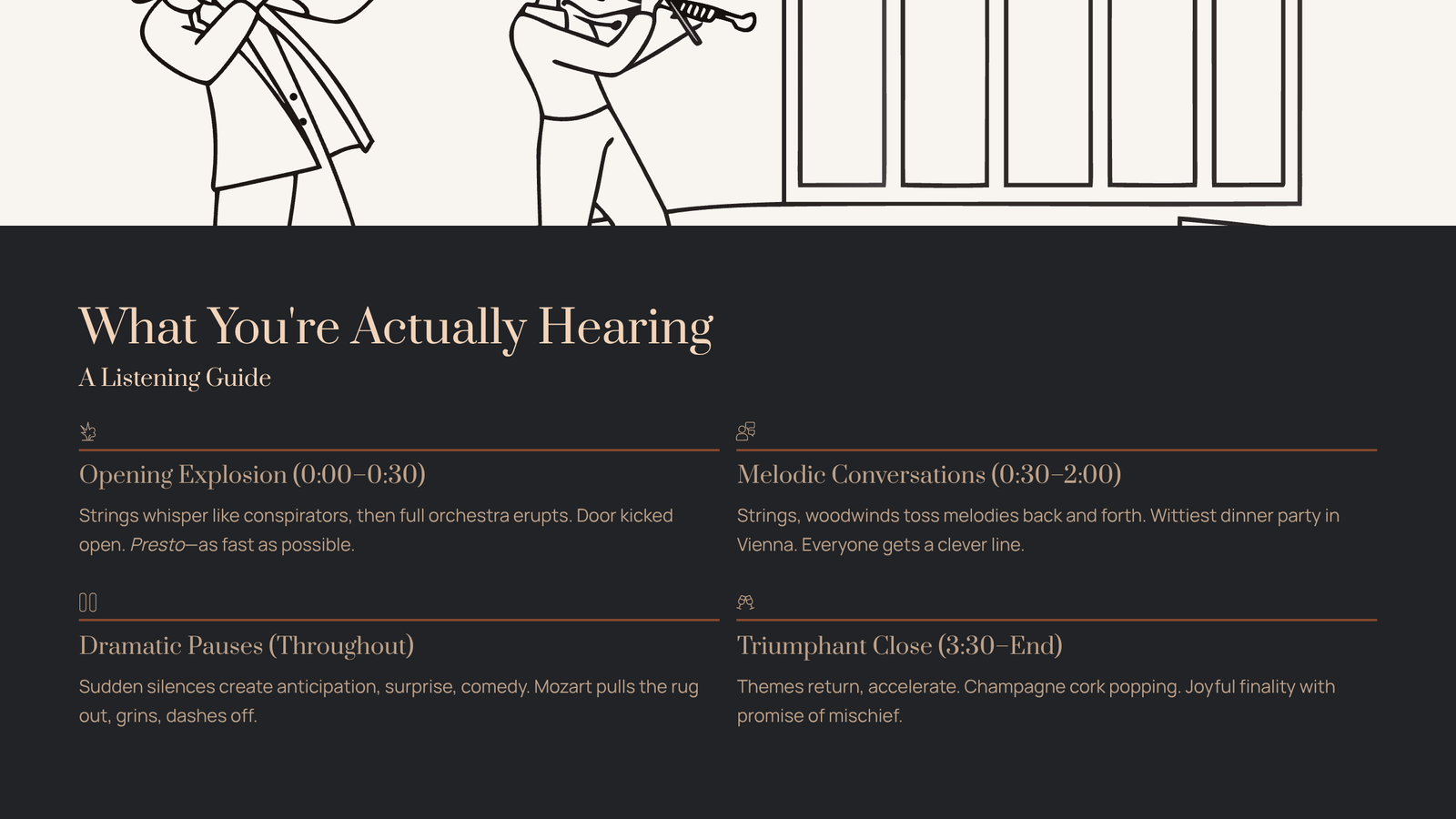
What You’re Actually Hearing: A Listening Guide
Don’t worry—you don’t need to read music or know Italian to feel what makes this overture extraordinary. Here’s what to listen for:
The Opening Explosion (0:00–0:30)
The overture begins piano (soft) but with strings already churning in rapid, whispered motion—like conspirators sharing secrets. Within seconds, the full orchestra erupts forte (loud), and we’re off. This isn’t a gradual awakening; it’s a door kicked open. Mozart wastes not a single second. The tempo marking is Presto—as fast as possible—and the musicians must sprint from the very first note.
The Melodic Conversations (0:30–2:00)
Listen for how different sections of the orchestra toss melodies back and forth. The strings introduce a theme; the woodwinds answer. It’s like eavesdropping on the wittiest dinner party in Vienna. No instrument dominates for long. Everyone gets a clever line, a quick retort. This conversational quality mirrors the opera itself, where servants and masters verbally spar with dizzying speed.
The Dramatic Pauses (Throughout)
Mozart punctuates the breathless momentum with sudden silences—tiny gaps where the orchestra collectively holds its breath. These pauses are theatrical genius. They create anticipation, surprise, comedy. Just when you think you know where the music is going, Mozart pulls the rug out, grins, and dashes off in another direction.
The Triumphant Close (3:30–End)
The final minute builds to an irresistible climax. Themes return, combine, and accelerate toward a conclusion that feels less like an ending and more like a champagne cork popping. The final chords land with joyful finality—but also with the promise of mischief to come. After all, the opera is just beginning.
Why This Music Still Works: The Science of Joy
There’s a reason this overture appears on countless “classical music for productivity” and “morning motivation” playlists. Beyond its historical significance, it’s engineered—perhaps intuitively, perhaps genius-level consciously—to produce specific physiological effects.
The rapid tempo (around 150 beats per minute) aligns with an elevated heart rate, the kind associated with excitement and anticipation rather than anxiety. The major key (D major, bright and festive) signals optimism to our pattern-seeking brains. The constant forward motion, with its lack of lingering melancholy or unresolved tension, creates a sense of momentum that’s almost physically propulsive.
But Mozart’s secret weapon is unpredictability within structure. Our brains crave patterns—and Mozart delivers them—but he also delights in subverting expectations just enough to keep us engaged without causing stress. It’s the musical equivalent of a conversation with someone brilliant and funny: you’re never bored, never lost, always delighted.

Three Ways to Experience the Overture
For First-Time Listeners: The Pure Energy Approach
Don’t analyze. Don’t try to identify themes or instruments. Just press play, close your eyes, and let the music wash over you like a wave of caffeinated sunshine. Notice how your body responds—does your foot tap? Does your heartbeat quicken? That physical response is the overture doing exactly what Mozart intended.
Recommended Recording: The Vienna Philharmonic under Karl Böhm (1968) offers a perfect balance of elegance and energy. It’s joyful without being frantic, precise without being cold.
For the Curious Mind: The Structural Listen
On your second or third encounter, try to follow the “conversations” between instruments. Can you hear when the oboe picks up a melody the violins just finished? Can you spot the moments of silence and predict when the orchestra will explode back to life? This active listening transforms the experience from pleasant background noise to interactive engagement.
Recommended Recording: John Eliot Gardiner with the English Baroque Soloists (1994) uses period instruments and performance practices that reveal details often smoothed over in modern recordings. The textures are cleaner, the wit sharper.
For the Romantic Soul: The Story Approach
Imagine the overture as a preview of the opera’s plot—even though, technically, it doesn’t quote any melodies from the opera itself. The bustling energy is the household of Count Almaviva in chaos. The whispered passages are secrets being shared. The triumphant moments are small victories for the clever servants. The overall mood is comic, human, hopeful: even when the powerful behave badly, wit and love can triumph.
Recommended Recording: René Jacobs with the Concerto Köln (2004) brings a theatrical sensibility that makes every phrase feel like dialogue. It’s an interpretation that remembers this music was written to make people laugh, gasp, and lean forward in their seats.
A Personal Confession
I’ll be honest: for years, I thought of Mozart as “easy” classical music. Pretty, pleasant, unchallenging. The kind of thing you’d hear in a hotel lobby or a period drama. It took me embarrassingly long to realize that this impression said more about my listening than about Mozart.
The Figaro overture was my gateway to hearing Mozart differently. That breathless, barely-controlled chaos; that sense of ideas tumbling over each other faster than any composer could possibly organize them; that joy that feels earned rather than naive—it changed everything. I started hearing Mozart not as polite wallpaper but as barely contained wildfire dressed in powdered wigs and formal structure.
If you’ve dismissed Mozart as too “easy,” I understand. And I gently challenge you to sit with this overture—really sit with it—and notice how demanding it actually is. It demands your full attention because it refuses to slow down. It demands your emotional engagement because it offers emotions with total generosity. It demands that you feel something, even if that something is simply: I’m glad to be alive and able to hear this.
The Revolutionary Dressed as Entertainment
There’s one more layer to this overture that I find endlessly moving. Mozart was writing music that was, at its core, about the dignity of ordinary people. The servants in The Marriage of Figaro are smarter, funnier, and more morally grounded than their aristocratic employers. In 1786, this was a radical statement.
And yet Mozart wrapped this revolutionary message in music so delightful, so purely entertaining, that even the aristocrats in the audience couldn’t help but cheer. The same emperor who banned the original play applauded the opera. The music disarmed them.
There’s something inspiring about that. Art that changes hearts doesn’t always announce itself with severity and struggle. Sometimes it sneaks in through sheer joy. Sometimes the most radical thing you can create is four minutes of music so irresistible that people forget to be defensive.

Your Morning Revolution
Tomorrow morning, before the emails and the meetings and the thousand small demands of the day, try this: find four minutes. Put on the Figaro overture. Let Mozart’s 240-year-old joke wash over you—the joke that says life is absurd and beautiful, that the powerful are often fools, that love and cleverness can triumph, that there’s always room for one more laugh before the curtain rises.
It won’t solve your problems. But it might—just might—remind you that you’re alive, that humans can create things this magnificent, and that somewhere in all the chaos, there’s room for joy.
And sometimes, that’s exactly what a morning needs.
Recommended Recordings Summary:
– Karl Böhm / Vienna Philharmonic (1968) – The classic, golden-toned reference
– John Eliot Gardiner / English Baroque Soloists (1994) – Period-instrument clarity and wit
– René Jacobs / Concerto Köln (2004) – Theatrical, vivid, full of personality
– Yannick Nézet-Séguin / Chamber Orchestra of Europe (2016) – Modern, energetic, impeccably balanced
#Mozart #MarriageOfFigaro #ClassicalMusicForBeginners #MorningMotivation #OperaOverture #UpliftingClassical #ClassicalMusic #18thCenturyMusic #ViennaClassical #MusicForProductivity #ClassicalMusicGuide #MozartOpera #OrchestralMusic #FeelGoodClassical #ClassicalMusicLovers