📑 Table of Contents
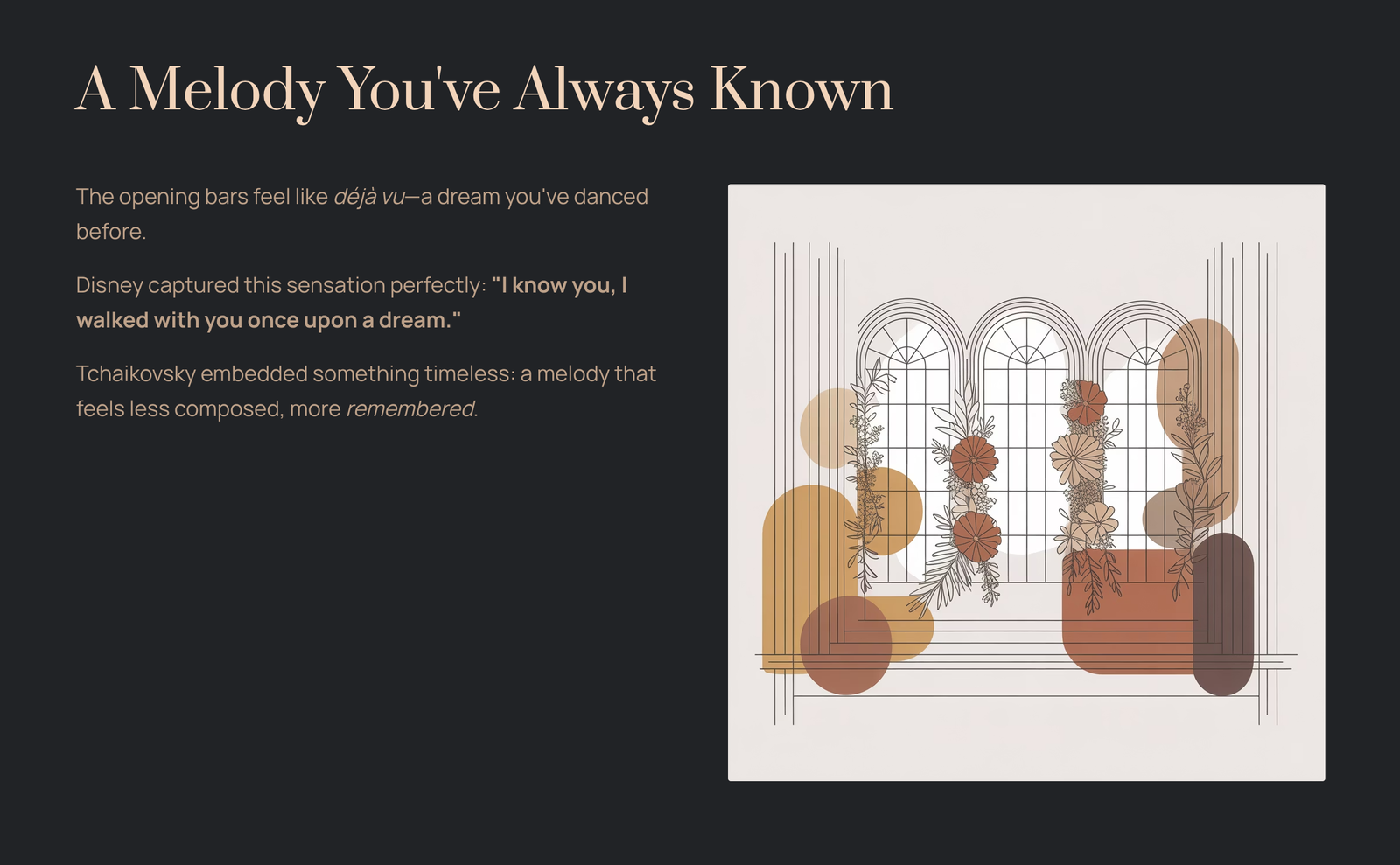
There’s something almost unsettling about the opening bars of Tchaikovsky’s Sleeping Beauty Waltz. Not unsettling in a dark way, but in the way déjà vu catches you off guard. You’ve heard this before. You’re certain of it. Perhaps in a dream where you danced through a sunlit ballroom, flower garlands swaying overhead, though you’ve never set foot in such a place.
This isn’t coincidence. When Disney adapted this very waltz for their 1959 animated film, they gave it lyrics that captured this exact sensation: “I know you, I walked with you once upon a dream.” The songwriters understood what Tchaikovsky had embedded into every phrase—a melody that feels less like something new and more like something you’re finally remembering.
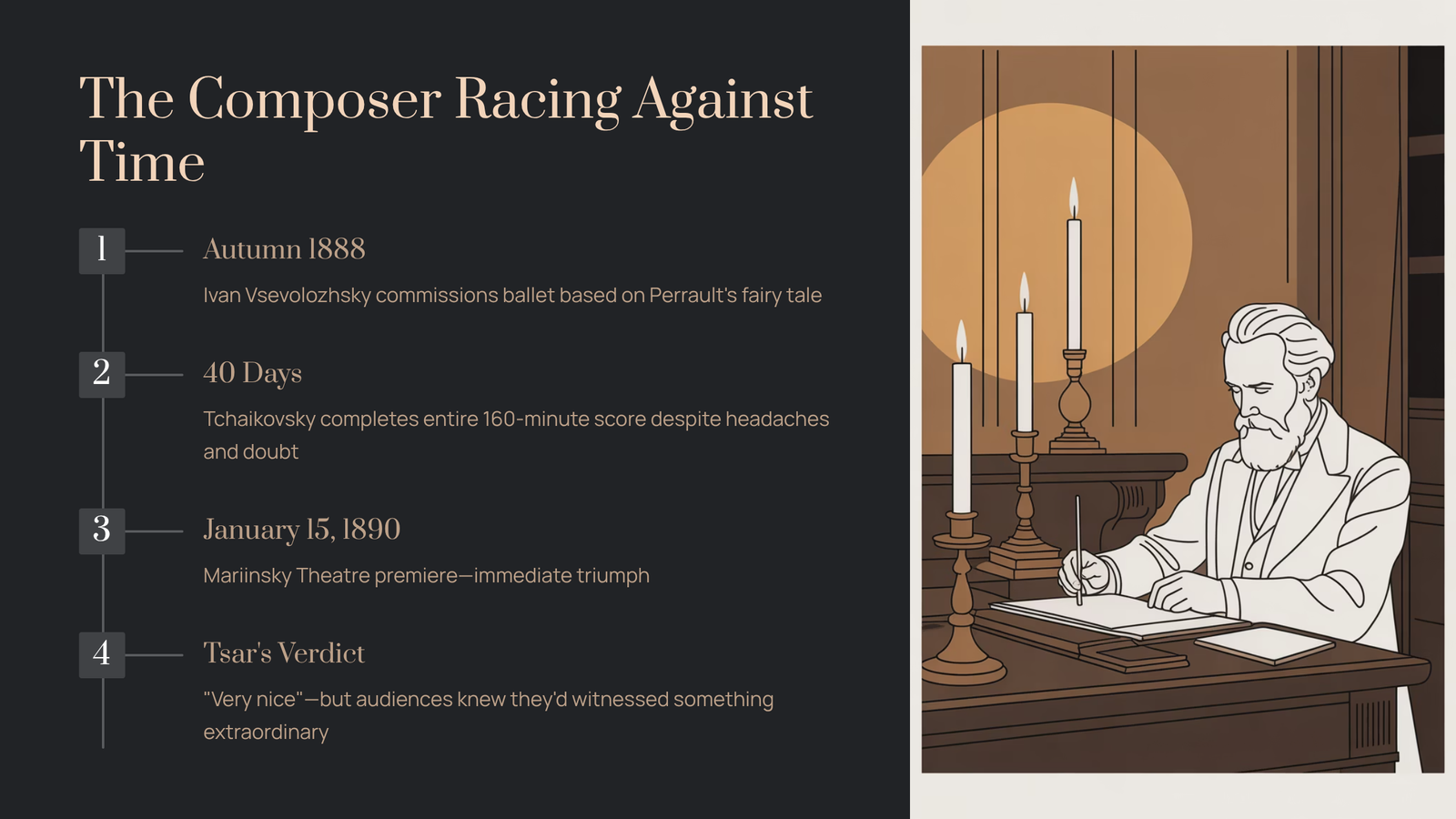
The Composer Racing Against Time
In the autumn of 1888, Tchaikovsky received a letter that would change the course of ballet history. Ivan Vsevolozhsky, director of the Imperial Theatres in St. Petersburg, wanted him to compose a full-length ballet based on Charles Perrault’s fairy tale. The Russian master had written Swan Lake a decade earlier to lukewarm reception, and this commission offered a chance at redemption.
What happened next borders on the miraculous. Tchaikovsky completed the entire score—a massive work spanning over 160 minutes of music—in roughly 40 days of focused composition. His diary entries from January 1889 reveal the physical toll: headaches, digestive troubles, moments of creative doubt. On January 11th, he wrote with three emphatic exclamation marks that the grand adagio “came with difficulty!!!” Yet somehow, the music kept flowing.
The premiere arrived on January 15, 1890, at the Mariinsky Theatre. Tsar Alexander III attended and offered just two words of approval: “Very nice.” But the audience knew they had witnessed something extraordinary. Unlike Swan Lake’s troubled debut, The Sleeping Beauty was an immediate triumph—Tchaikovsky’s only ballet to succeed from its very first performance.
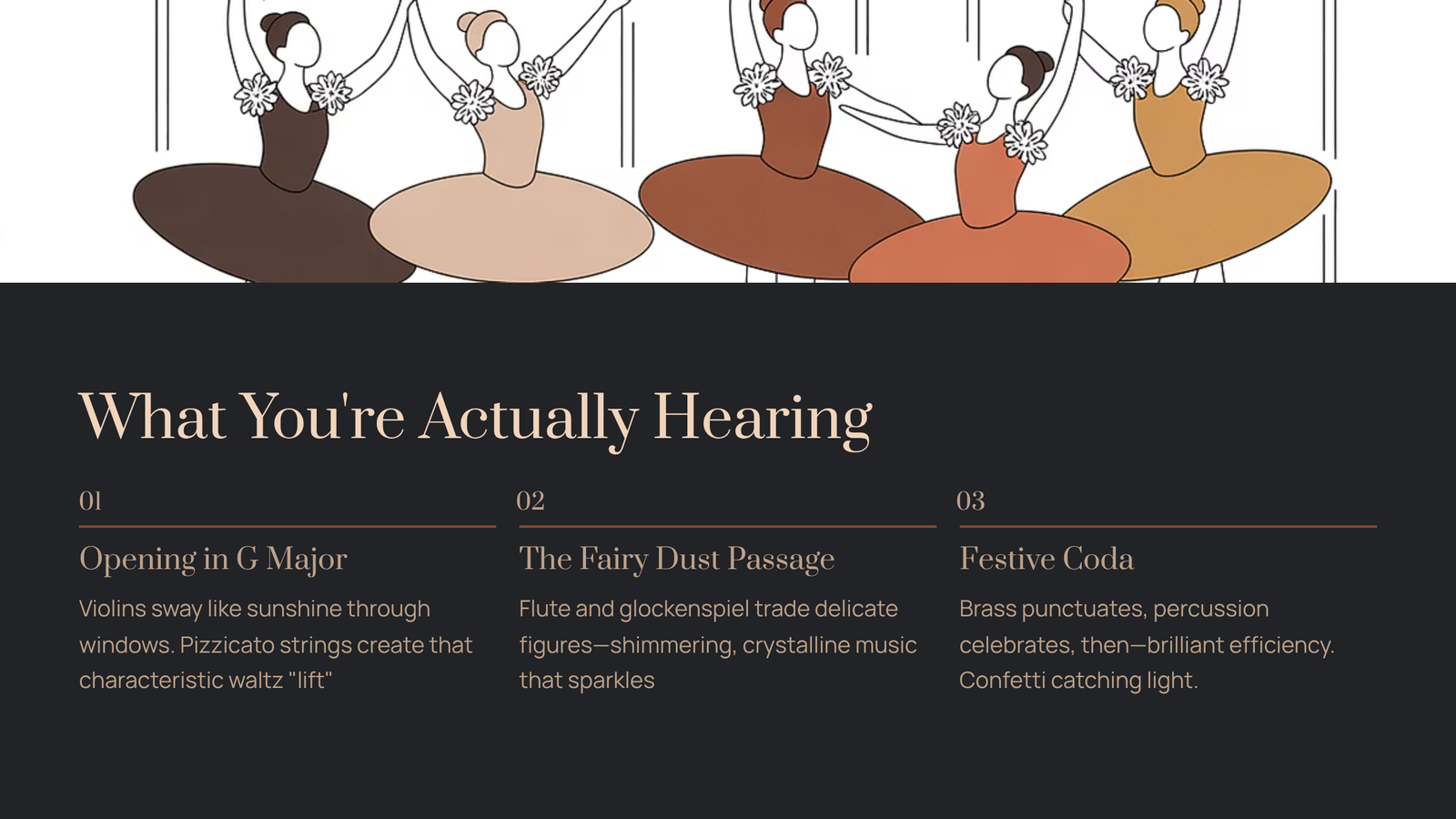
What You’re Actually Hearing
This particular waltz appears in Act I, during Princess Aurora’s sixteenth birthday celebration. The scene depicts peasant girls dancing with flower garlands, weaving in and out in joyful circles as the court celebrates. Understanding this context transforms how you hear every phrase.
The piece opens in G major, one of the brightest keys in classical music—think sunshine streaming through tall windows. The violins enter first, carrying a melody that seems to gently sway, as if the music itself is dancing. Beneath them, the lower strings play pizzicato, plucking their notes on each downbeat to create that characteristic waltz “lift” that makes you want to rise on your toes.
Listen for the middle section, where something magical happens. The full orchestral sound suddenly thins, and you hear flute and glockenspiel trading delicate, twittering figures in the upper register. This is Tchaikovsky painting fairy dust with sound—a shimmering, crystalline passage that suggests the supernatural forces watching over Aurora’s celebration. It’s music that sparkles.
The piece builds toward a festive coda, growing faster and more exuberant. Brass instruments punctuate the strings. Percussion adds celebratory accents. Then, just when you expect the excitement to stretch on forever, Tchaikovsky ends with brilliant efficiency—a conclusive flourish that feels like confetti catching the light.
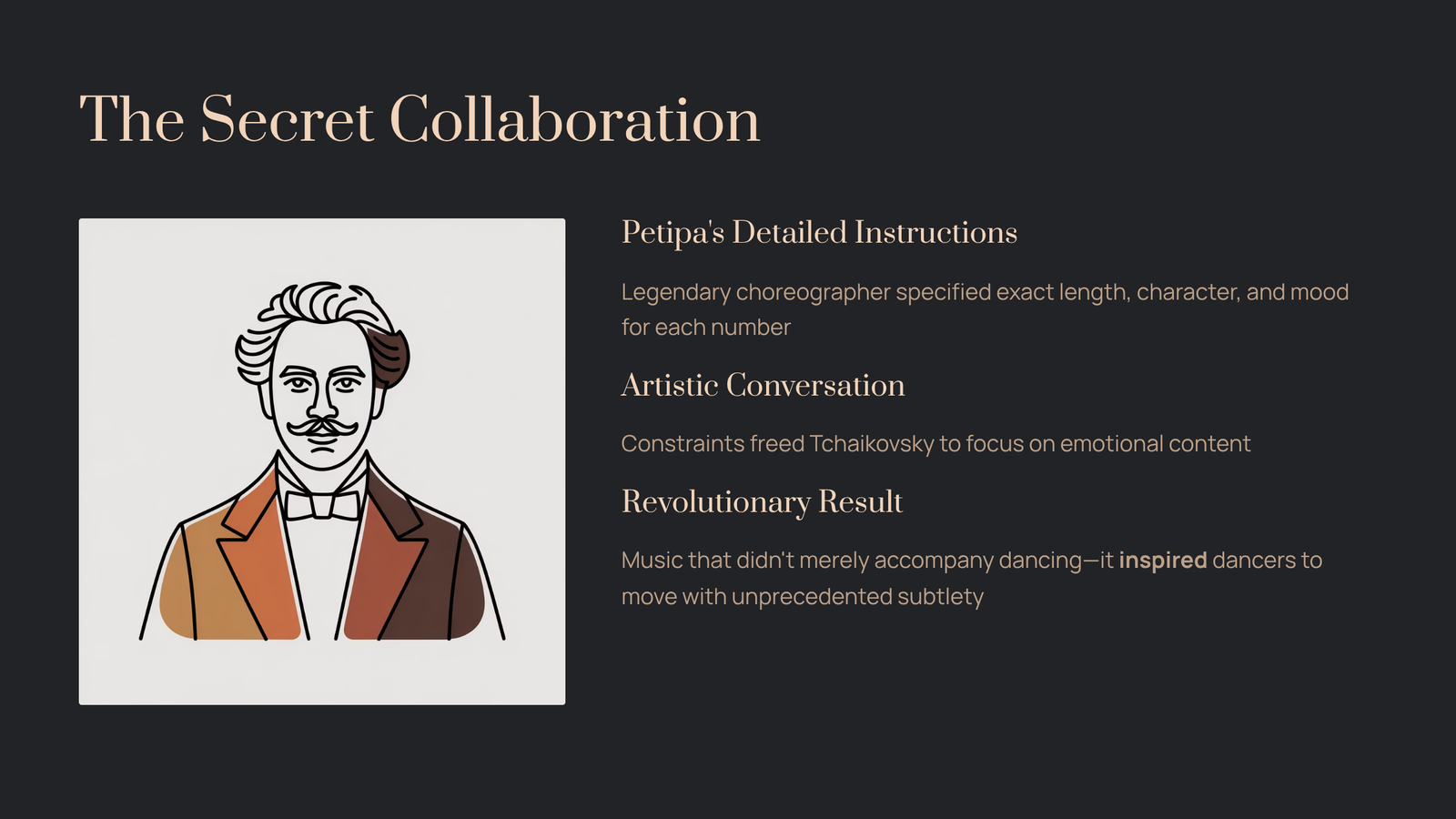
The Secret Collaboration Behind the Music
Tchaikovsky didn’t compose this waltz in isolation. The legendary choreographer Marius Petipa provided incredibly detailed instructions for each number, specifying the exact length, character, and mood required. Some composers might have bristled at such constraints. Tchaikovsky embraced them.
The result was a new kind of artistic conversation. Petipa’s specifications freed Tchaikovsky to pour all his creative energy into the music’s emotional content rather than structural decisions. Contemporary dance scholars note that this collaboration pushed ballet into new territory—music that didn’t merely accompany dancing but inspired dancers to move with unprecedented fullness and subtlety.
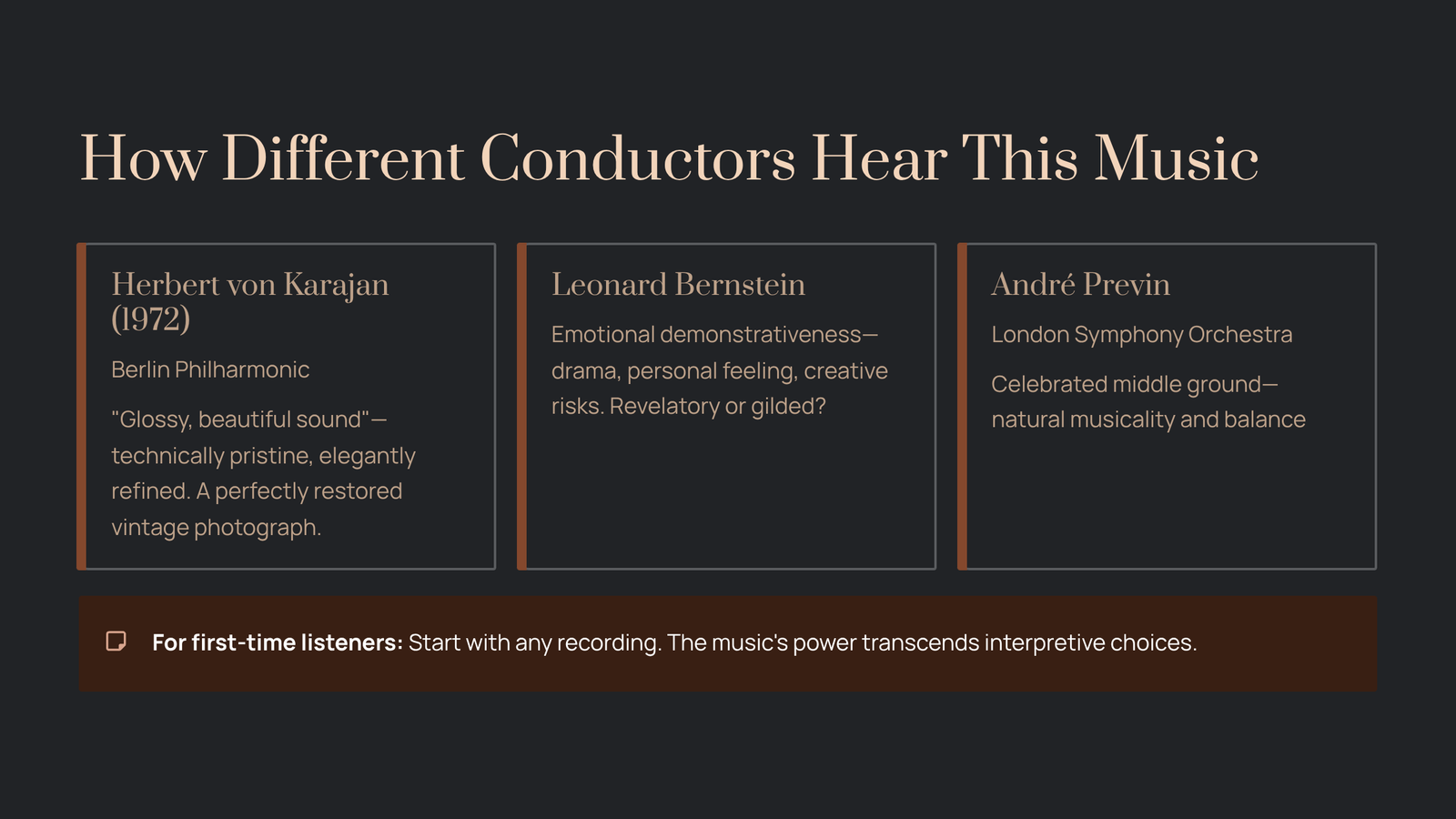
How Different Conductors Hear This Music
If you explore multiple recordings of this waltz, you’ll discover it’s almost like hearing different pieces. Herbert von Karajan’s famous 1972 recording with the Berlin Philharmonic offers what critics call a “glossy, beautiful sound”—technically pristine, elegantly refined, perhaps almost too perfect. It’s the musical equivalent of a perfectly restored vintage photograph.
Leonard Bernstein, by contrast, conducted this music with what one reviewer described as emotional demonstrativeness. His interpretations emphasize drama, personal feeling, and creative risks. Some find his approach revelatory; others feel he occasionally gilds the lily. André Previn with the London Symphony Orchestra strikes a celebrated middle ground, praised for its natural musicality and balance.
My suggestion for first-time listeners: start with any recording that’s readily available. The music’s power transcends interpretive choices. Once you’ve fallen in love with the piece, exploring different versions becomes its own adventure.
Why This Music Still Matters
More than 130 years after its premiere, The Sleeping Beauty Waltz remains what critics call “the crown jewel of classical ballet repertoire.” Every major ballet company in the world keeps this work in active rotation. Students learn its phrases. Audiences continue filling theaters.
But perhaps the truest measure of this music’s staying power is simpler: millions of people who have never attended a ballet, never studied music theory, never read a word about Tchaikovsky, can hum this melody. They learned it from a Disney movie, or from a commercial, or from some half-remembered moment in childhood. The tune lodged itself in their memory and stayed there.
That’s the real magic of this waltz. Tchaikovsky, working through headaches and self-doubt in a Russian country house, managed to write something that feels less composed than discovered—a melody that seems to have always existed, waiting for the right moment to be remembered.
Close your eyes during the flute and glockenspiel passage. Let the music thin to gossamer. For just a moment, you might understand why those Disney songwriters chose to write about walking through a dream. Because that’s exactly where this waltz takes you—to a ballroom you’ve somehow visited before, in a story you’ve always known.