📑 Table of Contents
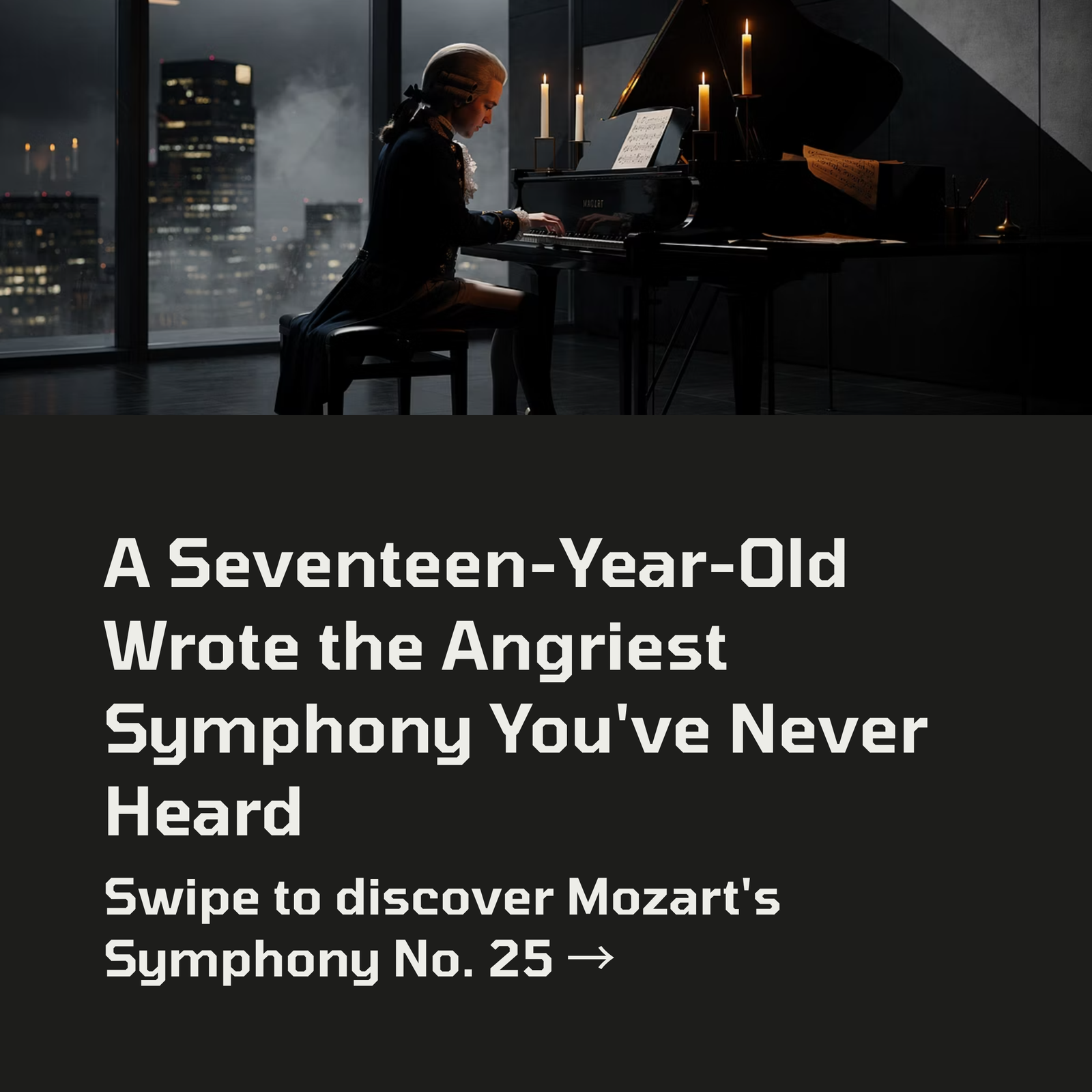
There’s no warm-up. No gentle introduction. No polite curtain-rise. The moment Mozart’s Symphony No. 25 begins, you’re thrown into a storm. Syncopated strings stab upward in urgent, breathless waves — relentless, dark, almost desperate. It feels like someone running through rain at midnight, heart pounding, unable to stop.
This isn’t the Mozart most people imagine. No powdered wigs. No charming minuets. This is raw, unfiltered urgency from a composer who was — and this is the part that makes your jaw drop — only seventeen years old.
If you’ve seen the opening scene of the film Amadeus, you already know this sound, even if you didn’t know its name. That thunderous, agitated melody playing over the credits? That’s the Allegro con brio of Symphony No. 25 in G minor, K. 183. And it remains one of the most viscerally exciting things Mozart ever put on paper.
A Teenager on Fire: Who Was Mozart in 1773?
In October 1773, Wolfgang Amadeus Mozart was living in Salzburg, freshly returned from his third trip to Italy. He was seventeen — old enough to have already composed over two hundred works, young enough to still be living under his father Leopold’s roof and professional direction.
But something had shifted. The Italian tours that once opened doors were yielding fewer opportunities. The Archbishop of Salzburg, Hieronymus Colloredo, kept a tight leash on the court musicians. Mozart was restless, ambitious, and increasingly frustrated by the limits of provincial life.
Enter the Sturm und Drang (“Storm and Stress”) movement sweeping through German-speaking Europe. This cultural wave — fueled by literature, theater, and philosophy — celebrated extreme emotion, rebellion, and the untamed human spirit. Joseph Haydn had already channeled it into a series of intensely dramatic symphonies in minor keys. Mozart, ever attuned to the currents around him, absorbed this energy and made it his own.
Symphony No. 25 is the explosive result. It’s one of only two symphonies Mozart wrote in a minor key — the other being the famous Symphony No. 40 in G minor, composed fifteen years later. That these twin dark stars share the same key is no coincidence; G minor was, for Mozart, the key of fate, turbulence, and unresolvable tension.
Inside the Storm: What Makes This Movement Tick
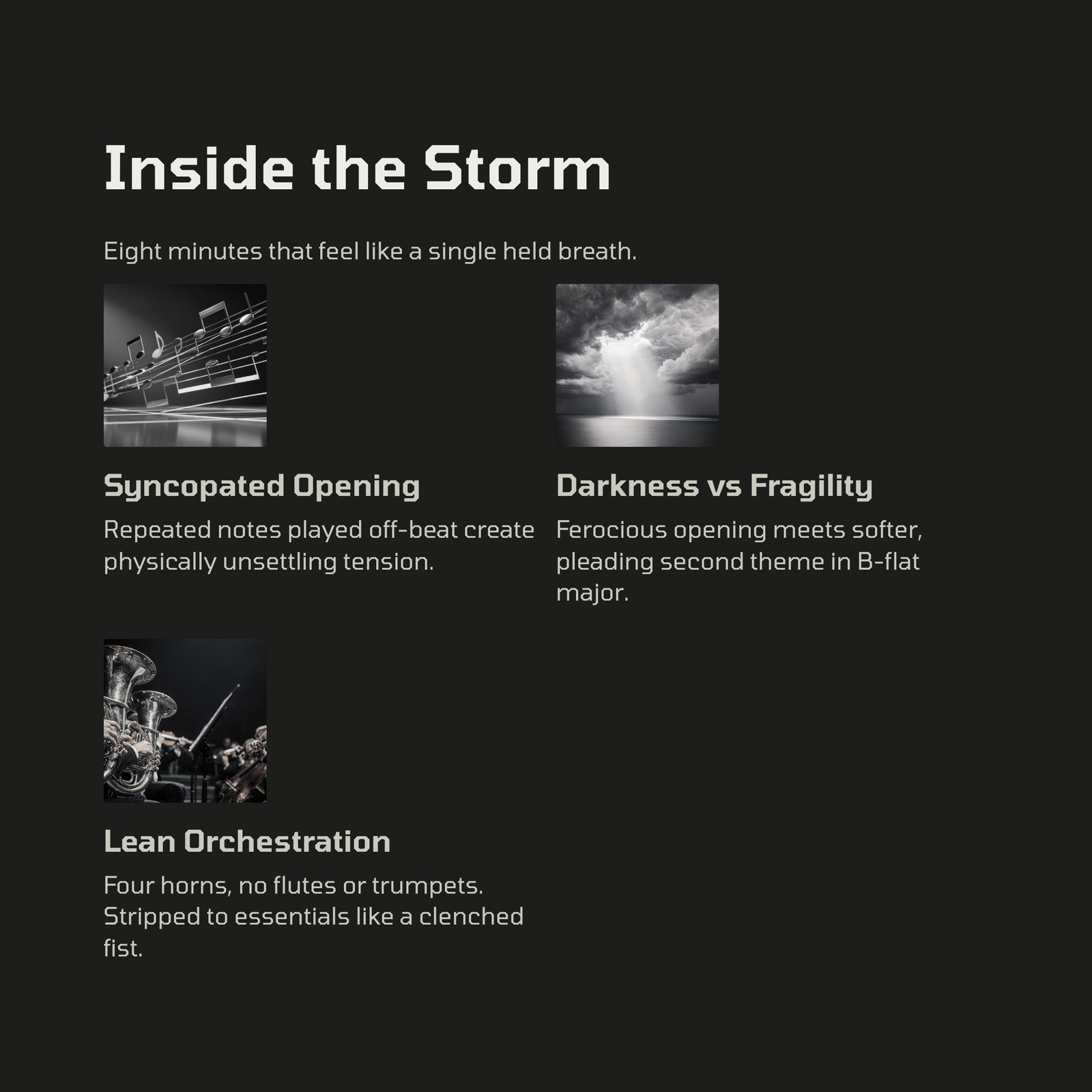
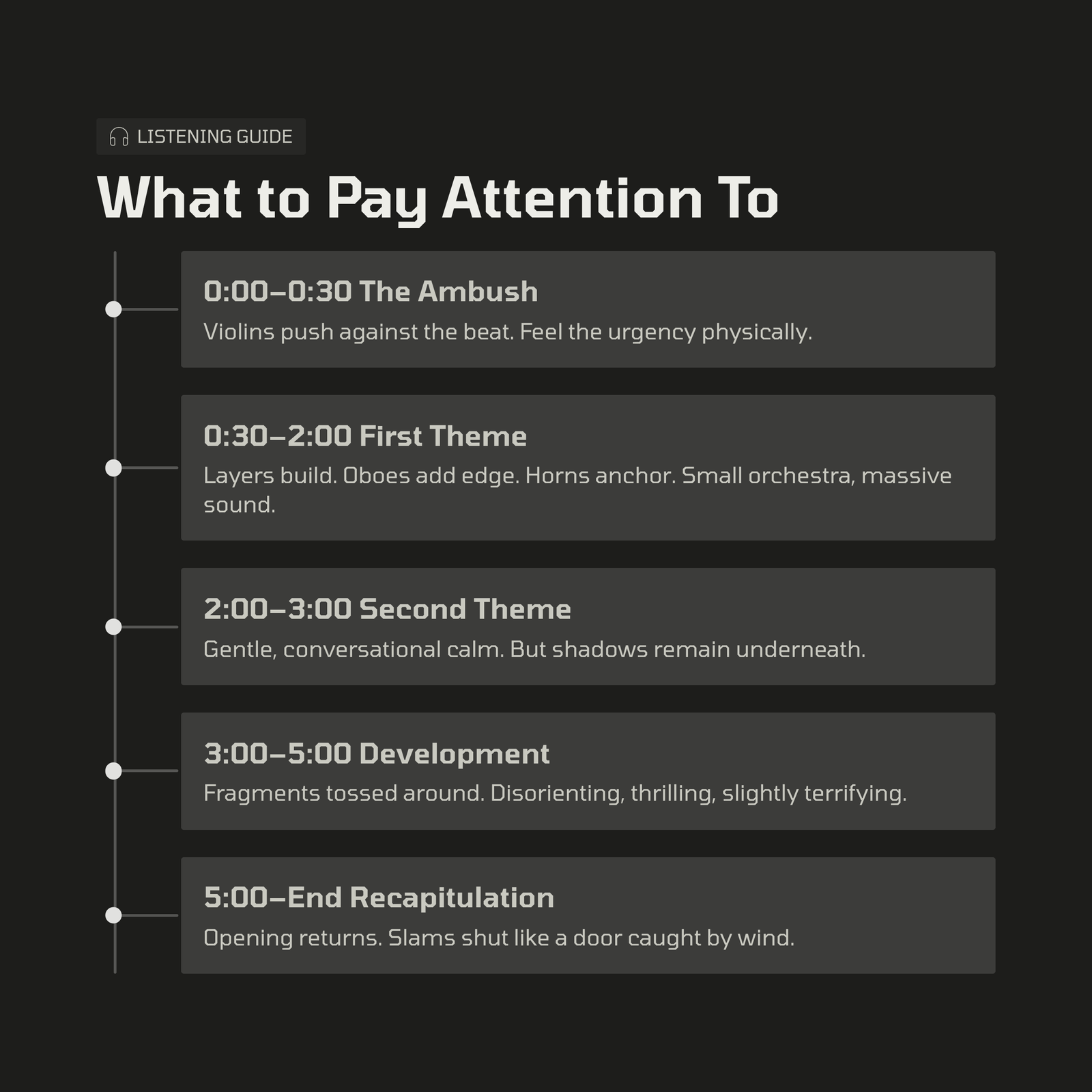
The Allegro con brio — the first movement — runs roughly eight minutes, but it feels like a single held breath. Here’s what makes it so gripping.
The syncopated opening motif is the engine of the entire movement. It’s built on repeated notes played off the beat, creating a rhythmic tension that feels physically unsettling. The strings don’t land where your ear expects them to. It’s as if the music is constantly tripping forward, unable to find solid ground.
The contrast between darkness and fragility gives the movement its emotional depth. After that ferocious opening, Mozart introduces a second theme that’s softer, more lyrical — almost pleading. It appears in B-flat major, offering a brief moment of warmth. But Mozart doesn’t let you rest there. The storm always returns, and each time it does, it feels more insistent.
The orchestration is lean and fierce. Mozart uses pairs of oboes and bassoons alongside four horns — an unusually large horn section for its time — which adds a sense of weight and darkness to the texture. There are no flutes, no clarinets, no trumpets. The sound is deliberately restricted, stripped to essentials, like a clenched fist.
The development section takes the opening motif and fractures it, tossing fragments between instruments in rapid-fire exchanges. Keys shift restlessly. The tension builds to a breaking point before the recapitulation brings the opening fury back in full force — but now in the home key, as if the storm has circled back to where it started, unresolved and unrepentant.
Listening with Fresh Ears: What to Pay Attention To
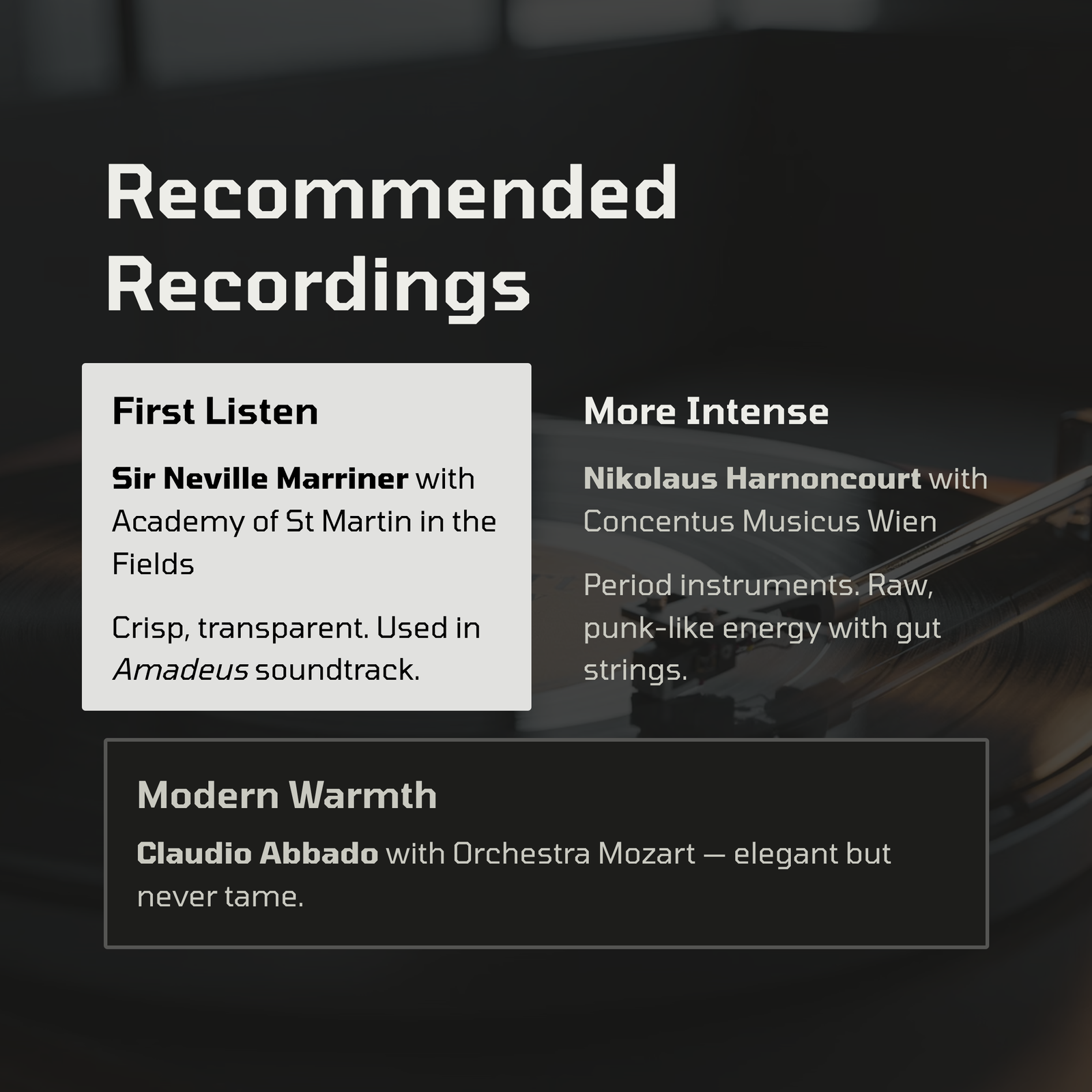
If this is your first time with Symphony No. 25, here’s a roadmap for the first movement.
0:00–0:30 — The ambush. Those opening bars are everything. Listen to how the violins push against the beat. Feel the urgency before you try to analyze it. Let it hit you physically.
0:30–2:00 — The first theme fully unfolds. Notice how Mozart layers instruments one on top of another. The oboes add a nasal edge. The horns anchor the bottom. It’s a small orchestra creating a massive sound.
Around 2:00–3:00 — The second theme arrives. This is your moment of relative calm. The melody turns gentle, almost conversational. But listen carefully: even here, there’s a shadow underneath. Mozart never fully lets go of the tension.
3:00–5:00 — The development. This is where Mozart the dramatist takes over. Fragments of the opening motif get tossed around, modulating through unexpected keys. It’s like watching a storm from inside — disorienting, thrilling, slightly terrifying.
5:00–end — The recapitulation and close. The opening material returns, but now colored by everything you’ve heard. The ending doesn’t resolve peacefully. It slams shut, like a door caught by the wind.
Recommended Recordings
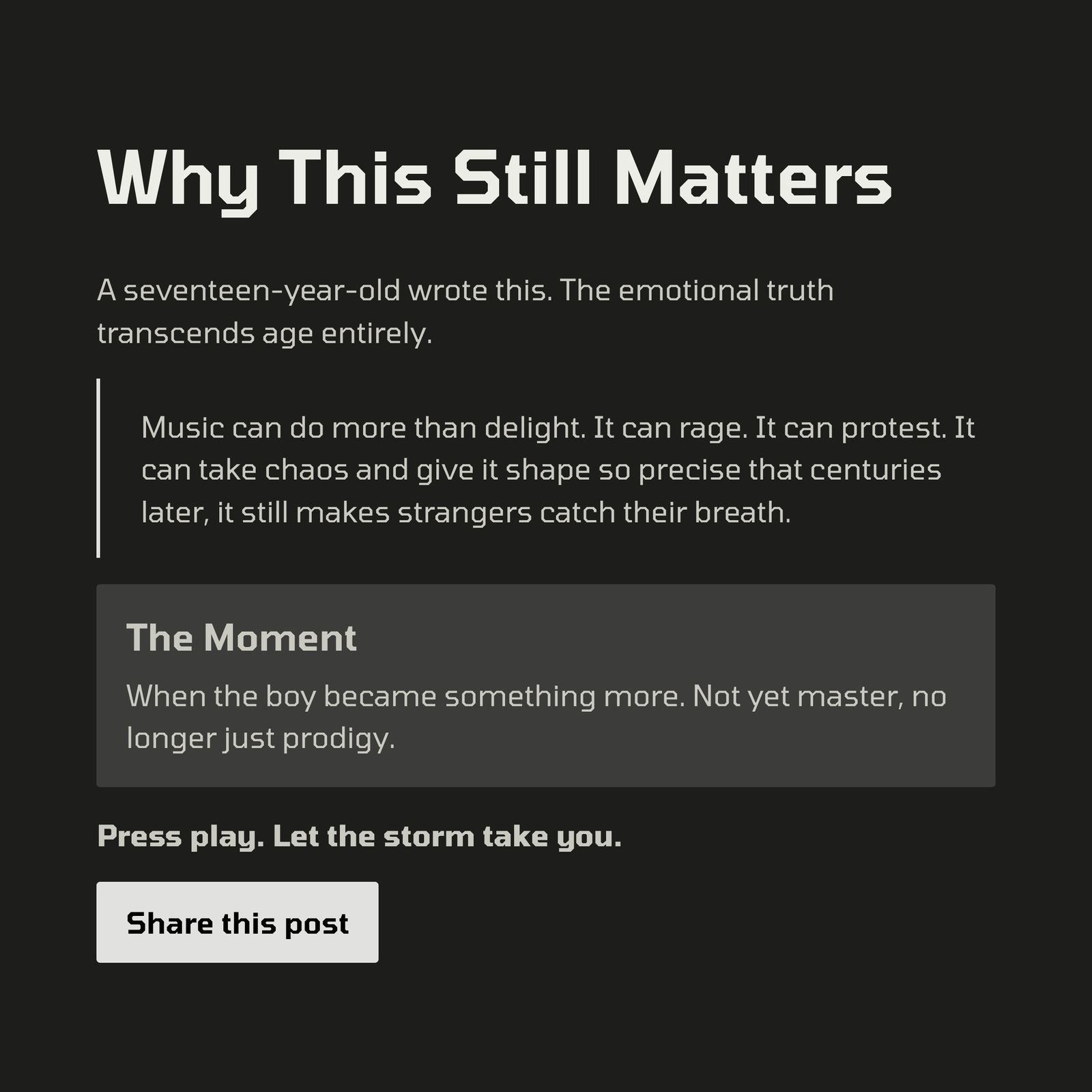
For a first listen, try Sir Neville Marriner and the Academy of St Martin in the Fields — their recording is crisp, transparent, and lets you hear every instrumental detail. It’s also the version used in the Amadeus soundtrack, which gives it a special historical resonance.
For something more intense, seek out Nikolaus Harnoncourt with the Concentus Musicus Wien. Harnoncourt uses period instruments and a more aggressive, historically informed approach that brings out the movement’s raw, almost punk-like energy. The gut strings and natural horns give the music a grittier, more dangerous quality.
If you want a modern orchestra’s warmth combined with dramatic fire, Claudio Abbado’s recording with the Orchestra Mozart is a beautiful middle ground — elegant but never tame.
Why This Piece Still Matters
There’s something endlessly compelling about the fact that a seventeen-year-old wrote this. Not because it’s impressive for a teenager — though it is — but because the emotional truth of the music transcends age entirely. This movement speaks to anyone who has ever felt trapped, restless, furious at circumstances beyond their control.
Mozart would go on to compose works of staggering beauty and complexity. Operas that redefined the art form. Piano concertos that moved audiences to tears. A Requiem left unfinished by his early death. But Symphony No. 25 holds a unique place in that journey: it’s the moment the boy became something more. Not yet the master of Don Giovanni or the Jupiter Symphony, but no longer just the child prodigy performing tricks for royalty.
In those syncopated opening bars, you hear a young man who has discovered that music can do more than delight. It can rage. It can protest. It can take the chaos inside a human heart and give it a shape so precise, so inevitable, that two and a half centuries later, it still makes strangers catch their breath.
Press play. Let the storm take you.