📑 Table of Contents

Somewhere around the early 2010s, a YouTube video began its quiet ascent through the algorithm. The title read: Chopin — Spring Waltz. The melody was luminous, aching, unmistakably romantic. Millions pressed play. Millions more pressed repeat. Before anyone thought to check, the video had crossed 34 million views — then, after its removal and subsequent reuploads, the number swelled past 160 million.
There was just one problem: Frédéric Chopin had absolutely nothing to do with it.
The true composer was a Frenchman named Paul de Senneville, and the piece was called Mariage d’Amour — “Marriage of Love.” It was written not in 19th-century Warsaw, but in 1978 Paris, intended not for a concert hall but for the fingers of a young pianist named Richard Clayderman, who would record it the following year for his album Lettre à ma Mère.
And that, perhaps, is the most poetic thing about this piece: it was so beautiful, so effortlessly classical in its phrasing, that the entire internet believed it belonged to one of the greatest composers who ever lived.

The Man Behind the Melody: Who Was Paul de Senneville?
Paul de Senneville (1933–2023) was not a concert pianist in the traditional sense. He started his career as a journalist, writing for French newspapers like France Soir, before transitioning into television production. Music was his lifelong passion, but it took a winding path to become his profession.
In 1974, together with composer Olivier Toussaint, he founded Delphine Records — named after his eldest daughter. The label would go on to sell over 100 million records worldwide, largely through the work of one artist: Richard Clayderman, a classically trained pianist whom Senneville discovered and transformed into what the press would eventually call the “Prince of Romance.”
Senneville was not interested in writing music for musicologists. He wanted to reach people — ordinary listeners who might never set foot in a symphony hall but who could still be moved to tears by the right sequence of notes on a piano. Mariage d’Amour was perhaps his most perfect expression of that philosophy.

Why Is a Wedding Song Written in a Minor Key?
Here is the question that has puzzled listeners for decades, especially in East Asia, where the piece became enormously popular under the Chinese title 梦中的婚礼 — “Wedding in a Dream.” The name suggests something wistful, even unrealized. A wedding that exists only in the imagination. And the music itself is written in G minor, a key traditionally associated with melancholy, longing, and introspection.
So why would a piece celebrating love and marriage sound so… sad?
According to Gary McCartney, a member of Clayderman’s team, the answer is simpler and more elegant than you might expect. Senneville chose the minor key deliberately because many wedding songs are slow and intimate. The minor tonality doesn’t signify sadness here — it signifies depth. It’s the difference between shouting “I love you” across a crowded room and whispering it to someone in the dark, when the words cost you something.
And if you listen closely, you’ll notice the piece doesn’t stay in minor throughout. Certain chords shift into major, creating moments of warmth and resolution that feel earned precisely because they emerge from the surrounding tenderness. It’s a conversation between vulnerability and hope — which, when you think about it, is exactly what a marriage is.
A Musical Architecture: How to Listen
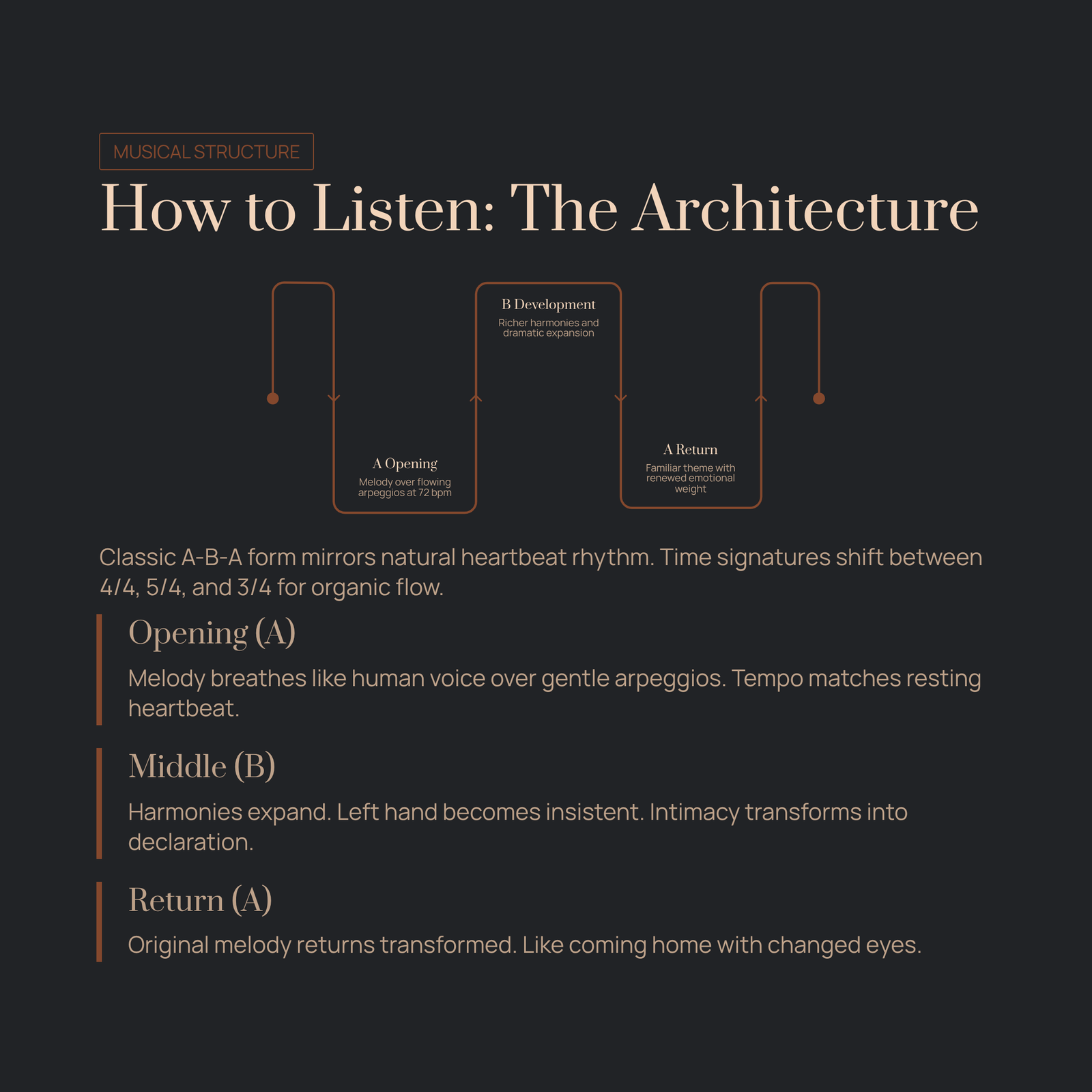
Mariage d’Amour follows a classic A-B-A structure, which makes it wonderfully accessible even if you’ve never analyzed a piece of music before.
The Opening (A section): The main melody enters gently, carried by the right hand over flowing arpeggios in the left. Pay attention to how the melody breathes — it rises and falls in long, singing phrases, almost like a human voice. The tempo hovers around 72 bpm, roughly the speed of a resting heartbeat. This is not accidental. Senneville understood that music which mirrors the body’s natural rhythms creates an almost hypnotic sense of calm.
The Middle (B section): Here the texture shifts. The harmonies become richer, the dynamics push outward. There’s a sense of expansion, as if the emotional landscape of the piece is opening up. Listen for the moments where the left hand’s arpeggios become more insistent, more dramatic. This is the section where many listeners feel the piece move from intimacy to something larger — a declaration, perhaps, or a memory.
The Return (A section): The original melody comes back, but it feels different now. After the emotional journey of the middle section, the familiar theme carries new weight. It’s like returning home after a long trip — the house looks the same, but you see it with changed eyes.
One of the most interesting technical details: the time signature actually shifts several times throughout the piece, moving from 4/4 to 5/4 to 3/4 and back. Most listeners won’t consciously notice this, but it contributes to the feeling of organic, unpredictable flow — like a conversation that doesn’t follow a script.

Whose Version Should You Hear First?
Richard Clayderman’s original (1979): This is where it all began. Clayderman’s touch is smooth, polished, and deeply romantic. His use of pedal creates a lush, sustained sound that wraps around the melody like candlelight. If you want to understand the piece as Senneville intended it, start here.
George Davidson’s arrangement: Davidson’s version became the one most people encountered online — ironically, under Chopin’s name. His interpretation is slightly different in its ornamentation and phrasing, and it’s worth hearing as a comparison. Notice how small changes in dynamics and rubato can shift the entire emotional character of the same melody.
Amateur piano covers: One of the most remarkable things about Mariage d’Amour is its life on YouTube and social media, where thousands of pianists — from beginners to advanced players — have recorded their own versions. Some of the most moving performances come from non-professionals who clearly have a personal connection to the piece. There’s something beautiful about music that invites participation rather than intimidation.

The Quiet Power of Accessible Music
There’s a tendency in classical music circles to draw a firm line between “serious” concert repertoire and “light” or “easy listening” music — and to place composers like Senneville squarely on the less respectable side. Mariage d’Amour is not a Chopin Ballade. It does not demand the same technical pyrotechnics or structural complexity. And yet.
And yet 160 million people thought it was Chopin. Not because they were foolish, but because the piece speaks a musical language that Chopin himself perfected: the language of the singing piano, of melody that seems to breathe, of harmony that aches. Senneville may not have written at Chopin’s level of complexity, but he wrote in Chopin’s emotional tradition — and he reached an audience that most contemporary classical composers can only dream of.
Paul de Senneville passed away on June 23, 2023, at the age of 89. He left behind a catalog of melodies that continue to soundtrack weddings, quiet evenings, and late-night YouTube rabbit holes around the world. Mariage d’Amour endures not because it’s technically demanding or structurally groundbreaking, but because it does the one thing that all great music must do: it makes you feel something you didn’t have words for, and it makes you feel it immediately.
Press play. Close your eyes. Let the first notes arrive like a question asked in a whisper. You’ll understand why the whole internet thought this was Chopin — and why it doesn’t matter at all that it wasn’t.