📑 Table of Contents
There is a scene in Roberto Benigni’s Life Is Beautiful where a father, starving and terrified inside a concentration camp, turns to his young son and grins. He tells the boy this is all a game. The tanks, the guards, the barbed wire — just elaborate props in a contest where the grand prize is a real tank. And underneath this impossible performance of joy, a melody plays. Light. Lilting. Almost absurdly gentle.
That melody is Nicola Piovani’s main theme for La Vita è Bella. And once you hear it, it never quite leaves you.

The Composer Who Preferred Shadows to Spotlights
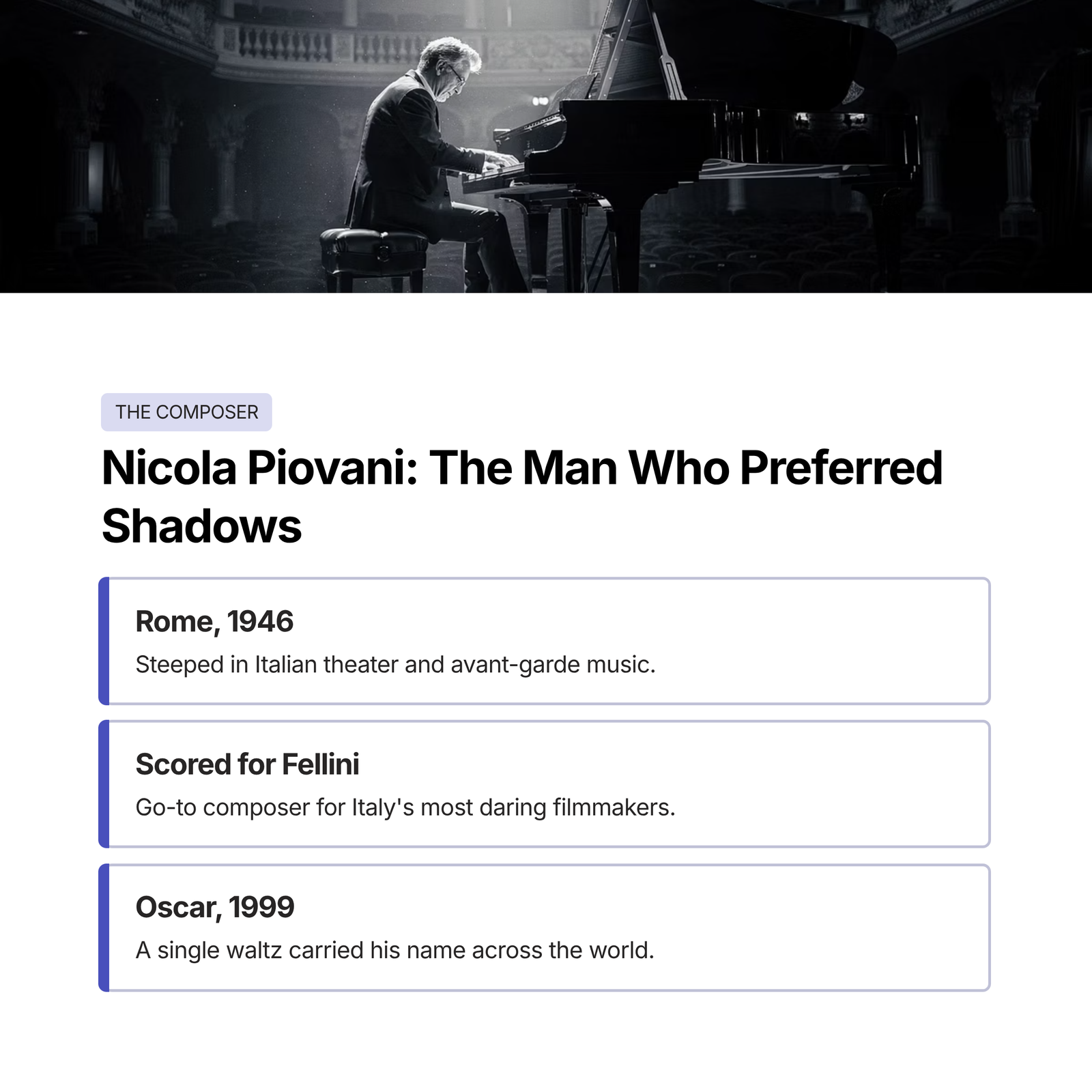
Nicola Piovani is not a household name the way John Williams or Hans Zimmer might be, and he would probably prefer it that way. Born in Rome in 1946, Piovani grew up steeped in the traditions of Italian theater and avant-garde music. He studied under the legendary Irino and later became the go-to composer for some of Italy’s most daring filmmakers, writing scores for the Taviani brothers and Federico Fellini himself.
But Piovani’s genius has always been a quiet one. Where other film composers build towering walls of orchestral sound, Piovani finds the smallest possible door into a scene and slips through it. His music never fights for attention. It simply sits beside you, like someone who knows exactly when to speak and when to be still.
Before La Vita è Bella, he had already built a distinguished career spanning decades. Yet it was this single waltz — written for a comedy about the Holocaust, of all things — that carried his name across the world and onto the stage of the Academy Awards in 1999.
Born from an Impossible Question
How do you score a film about the Holocaust that is also, somehow, a comedy?
This was the paradox Roberto Benigni handed to Piovani. The film needed music that could hold two truths at once: the unbearable weight of genocide and a father’s stubborn, reckless, beautiful insistence that life is worth living. The score could not be sentimental — that would trivialize the horror. It could not be grim — that would betray the film’s entire philosophy.
Piovani’s answer was a waltz.
Not a grand Viennese waltz, but something smaller. More intimate. A melody that sounds like it wandered out of a European café in a gentler century, carrying just a trace of melancholy in its back pocket. The main theme moves in three-quarter time with the lightness of a music box, yet every phrase seems to contain a catch in its throat — a moment where the brightness flickers and something deeper surfaces.
This was a deliberate choice. Piovani understood that the most devastating emotional weapon in cinema is not sadness played loud. It is tenderness played in a place where tenderness should not survive.
A Listening Guide: Where the Music Breaks Your Heart
If you are hearing this theme for the first time — or returning to it after years — here are the moments to listen for.
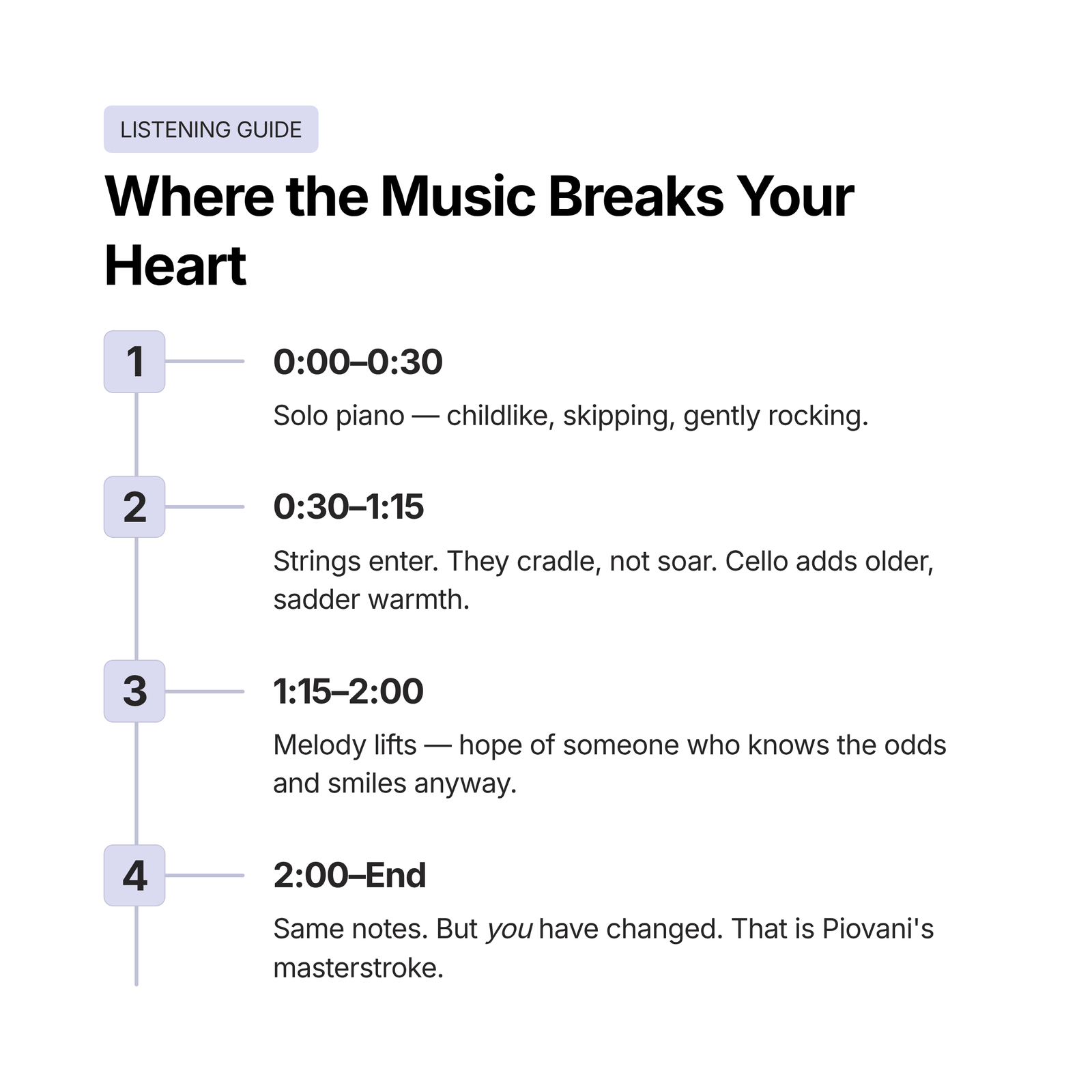
The opening phrase (0:00–0:30): A solo piano introduces the melody with almost childlike simplicity. Notice how the notes seem to skip, as though the music itself is trying to be cheerful. There is no darkness here yet, just a gentle rocking motion, like a parent swaying a child to sleep.
The orchestral entrance (0:30–1:15): Strings join the piano, and the texture warms like morning light filling a room. Piovani layers the instruments with extraordinary restraint. The strings do not soar — they cradle. Listen for the way the cello adds a low warmth beneath the melody, as if an older, sadder voice is harmonizing with the piano’s innocence.
The middle passage (1:15–2:00): Here the melody lifts slightly, reaching for a higher register. This is the moment that catches most listeners off guard. The music sounds hopeful, almost triumphant, but it is hope of a very specific kind — the hope of someone who knows the odds and chooses to smile anyway. If you close your eyes, you can almost see Benigni’s Guido marching through the camp, making his son laugh.
The final descent (2:00–end): The theme returns to its opening phrase, but now it feels different. You have heard it in context. The same notes that sounded playful at the beginning now carry the full weight of what you know. This is Piovani’s masterstroke — the melody does not change, but you do.
Why a Waltz? The Genius of the Wrong Music
Film scoring students often study the concept of “playing against the scene” — using music that contrasts with the visual emotion rather than reinforcing it. Piovani’s theme for La Vita è Bella is one of the most perfect examples ever composed.
A waltz is a dance. It belongs in ballrooms, in celebrations, in moments of grace. By placing a waltz over images of deportation, starvation, and systematic murder, Piovani achieves something that a minor-key lament never could. He makes you feel the absence of the life these characters should have had. The waltz is not commenting on the horror — it is remembering the world before the horror arrived, and insisting, stubbornly, impossibly, that the world will exist again.
This is exactly what Guido does for his son Giosuè. He does not deny the darkness. He builds a counter-reality out of imagination and love, using laughter as a shield. The music does the same thing. It is a lullaby sung at the gates of hell — not because the singer does not see the fire, but because the child must not.
Recordings Worth Your Time
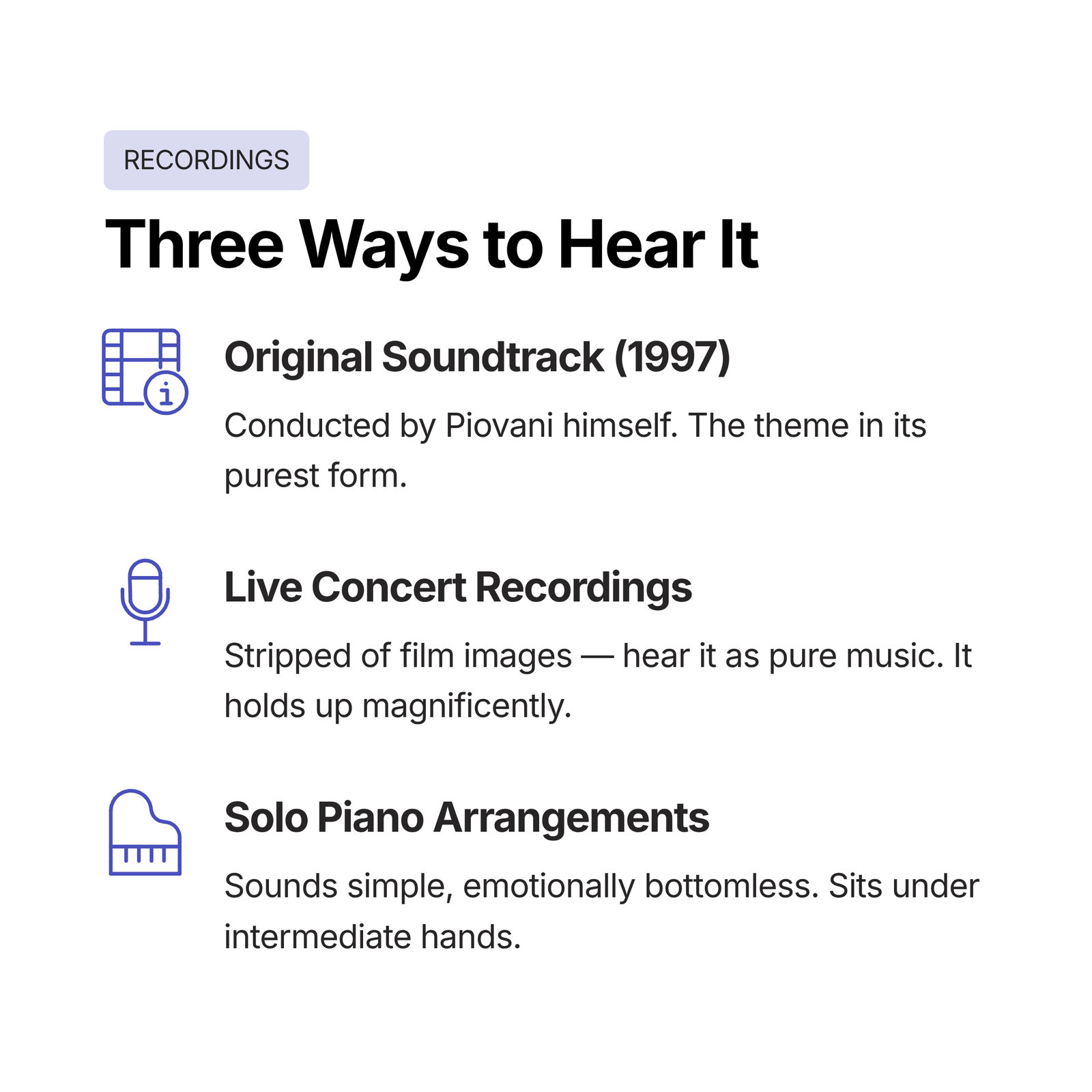
The definitive recording is, of course, the original film soundtrack (1997), performed under Piovani’s own direction. This is where the theme lives in its purest form, inseparable from the emotional architecture of the film.
For a different experience, seek out Piovani’s live concert recordings, where he often performs the theme as part of a larger suite. In a concert setting, stripped of the film’s images, the melody reveals its structure more clearly — you can hear it as pure music rather than accompaniment, and it holds up magnificently.
Piano arrangements by various artists have also become popular on streaming platforms. These solo versions strip the theme down to its skeleton and can be a beautiful entry point for anyone who plays piano themselves. The melody sits comfortably under intermediate hands, which is part of its magic — Piovani wrote something that sounds simple but is emotionally bottomless.
The Waltz That Refused to Let Go
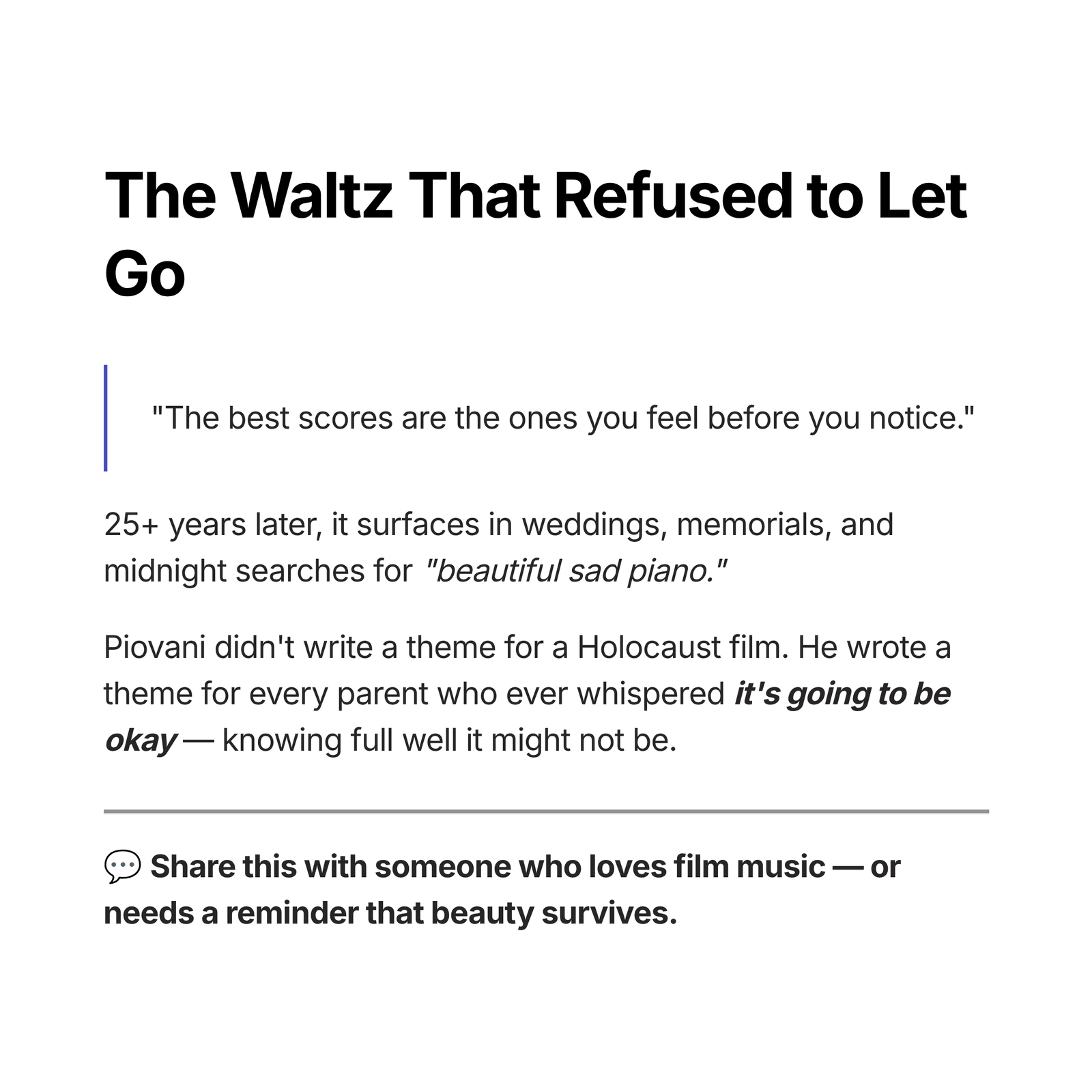
In 1999, Nicola Piovani stood on the stage at the Dolby Theatre and accepted the Academy Award for Best Original Score. Benigni, who had already won Best Actor, famously climbed over seats to get to the stage for his own award. But Piovani accepted his with the quiet composure of a man who had been making music in the background for thirty years and understood, perhaps better than anyone, that the best scores are the ones you feel before you notice.
More than twenty-five years later, the main theme from La Vita è Bella continues to surface in the most unexpected places — in wedding playlists, in memorial services, in quiet moments when someone opens a streaming app at midnight and types “beautiful sad piano.” It has become one of those rare pieces that belongs to no single genre or occasion. It simply belongs to anyone who has ever tried to find light in an impossible place.
And perhaps that is the truest measure of what Piovani achieved. He did not write a theme for a film about the Holocaust. He wrote a theme for every parent who has ever whispered it’s going to be okay to a frightened child — knowing full well it might not be, but saying it anyway, because that is what love does.
It lies beautifully.