📑 Table of Contents
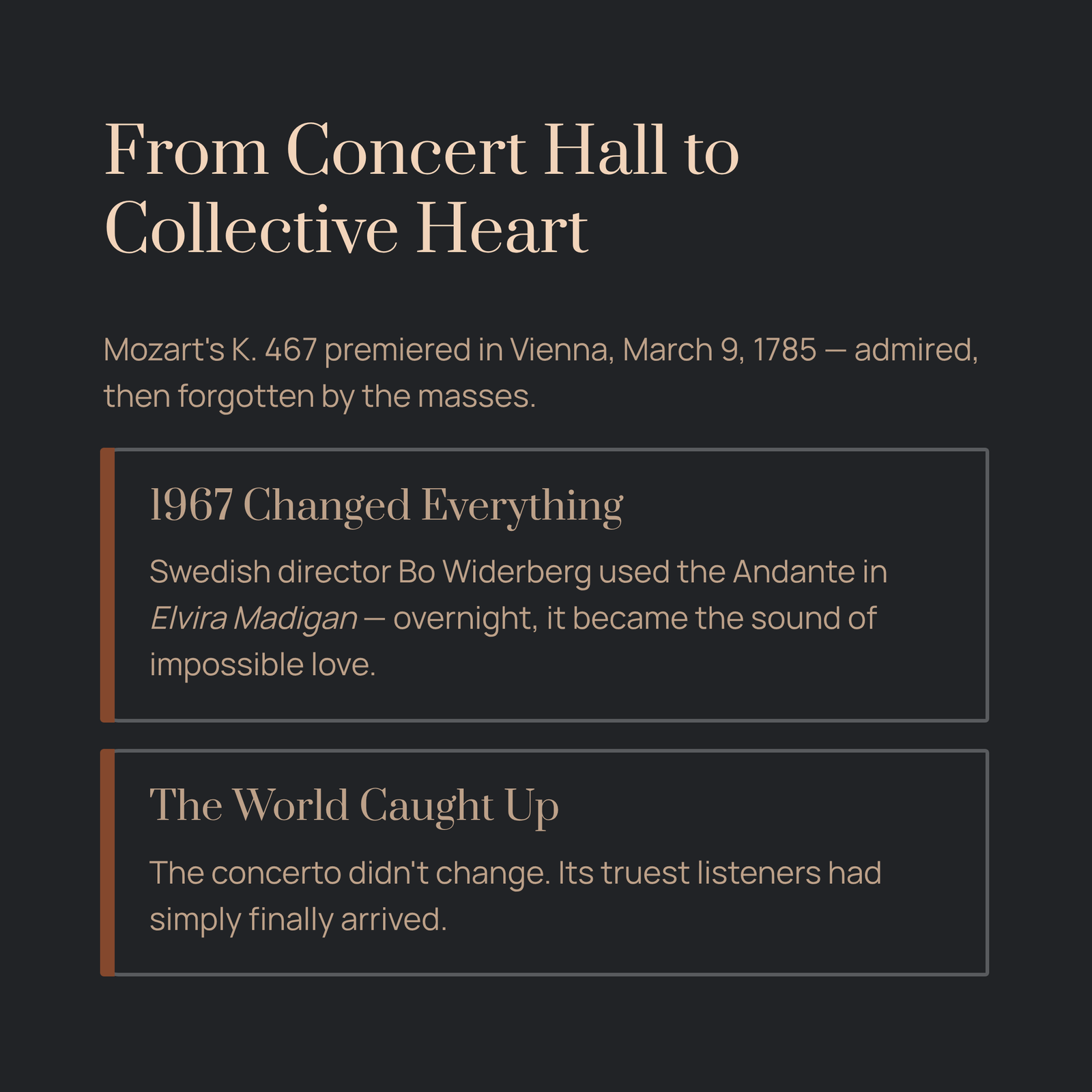
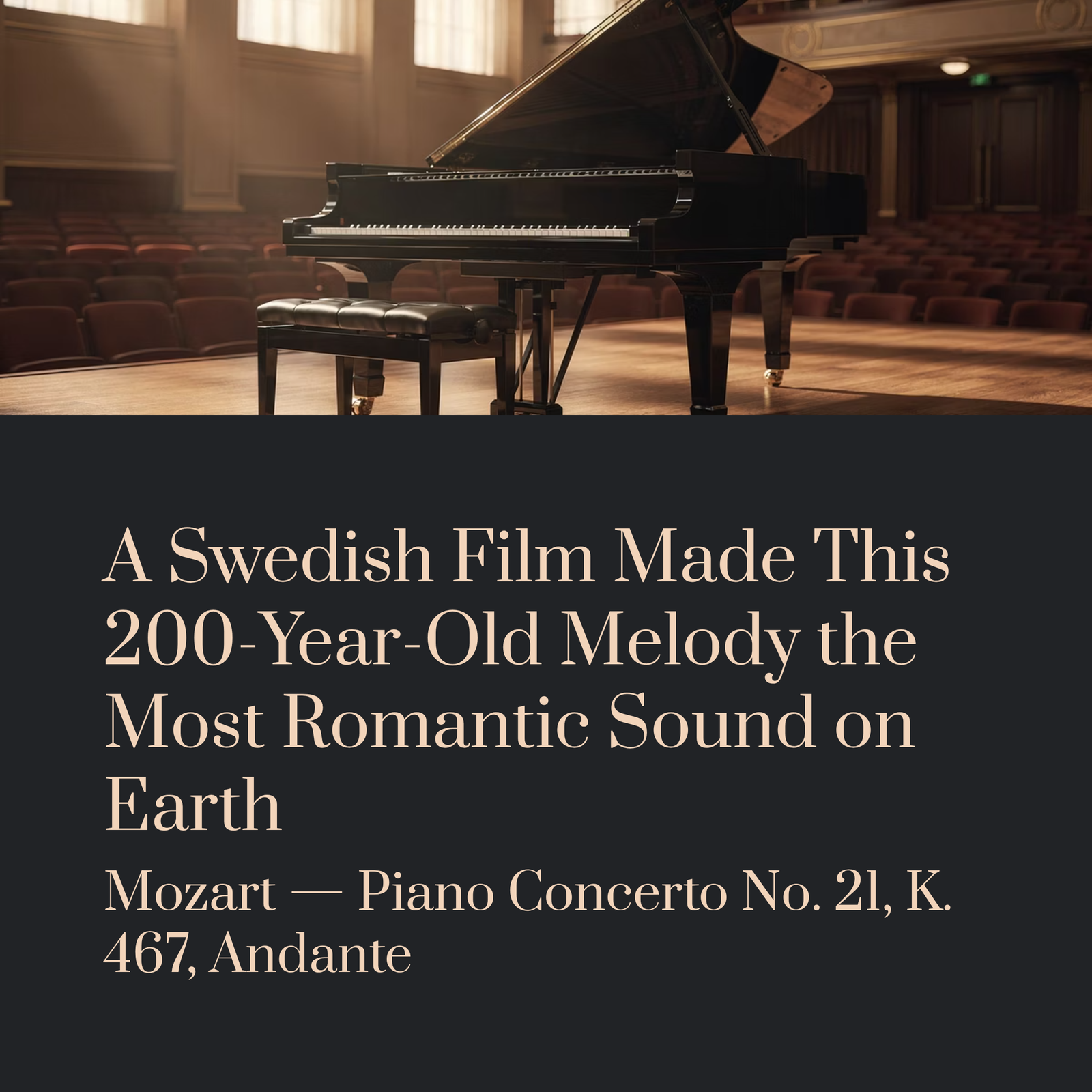
There is a strange kind of injustice in music history. Some melodies are born into a world that isn’t quite ready for them — not because they fail, but because their truest listeners haven’t arrived yet. Mozart’s Piano Concerto No. 21 in C major, K. 467, premiered in Vienna on March 9, 1785, to warm applause and generous praise. And then, for nearly two hundred years, it lived a quiet life in concert halls, admired by pianists but never quite entering the collective consciousness of ordinary people.
Then, in 1967, a Swedish filmmaker named Bo Widerberg chose the second movement — the Andante — as the emotional backbone of his tragic love story Elvira Madigan. Overnight, the melody that had been floating gently through recital programs became the sound of impossible love, of beauty that aches precisely because it cannot last. The concerto didn’t change. The world simply caught up to what Mozart had written all along.
I want to talk about that second movement today — not as a musicologist dissecting its architecture, but as someone who has returned to this piece again and again at different stages of life and found something new waiting for me every single time.
The Man Behind the Music: Mozart in 1785
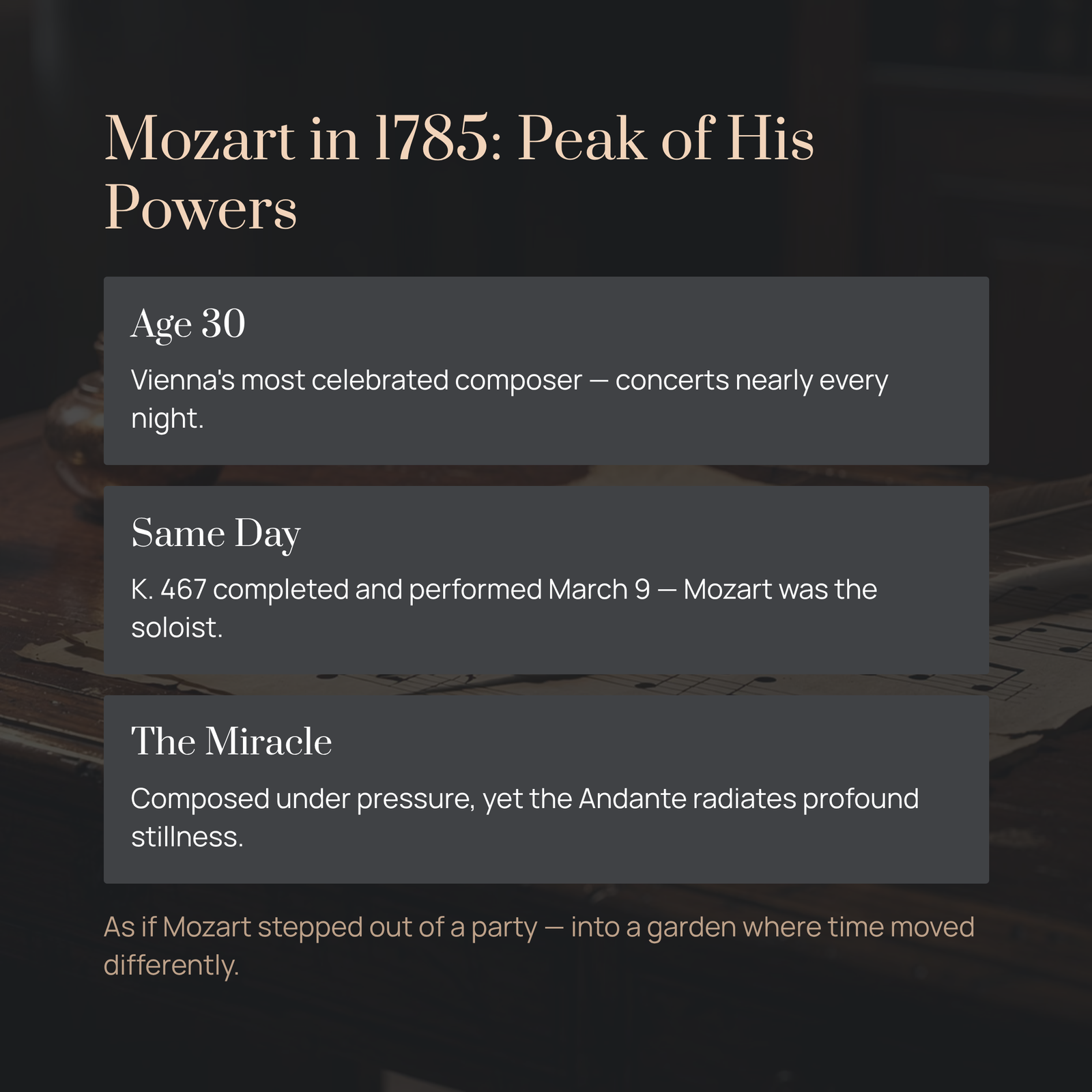
To understand the Andante, it helps to know what Mozart’s life looked like when he wrote it. In early 1785, he was thirty years old and living in Vienna at the peak of his public success. He was giving subscription concerts, teaching wealthy students, and composing at a pace that still defies comprehension. His father Leopold, visiting Vienna that winter, wrote home in astonishment at how busy his son was — concerts nearly every night, new works appearing as if conjured from thin air.
The Piano Concerto No. 21 was completed on March 9, 1785, and performed the same evening. Mozart was the soloist. He had likely finished the ink on the score that very morning. This was not unusual for him. What was unusual — what remains unusual across all of Western music — is that something composed under such pressure could contain a slow movement of such profound stillness. The first and third movements of K. 467 are brilliant and extroverted, full of the wit and energy that made Mozart the toast of Vienna. But the Andante exists in a completely different emotional universe, as if Mozart had opened a door in the middle of a party and stepped into a garden where time moved differently.
Listening to the Andante: What to Notice
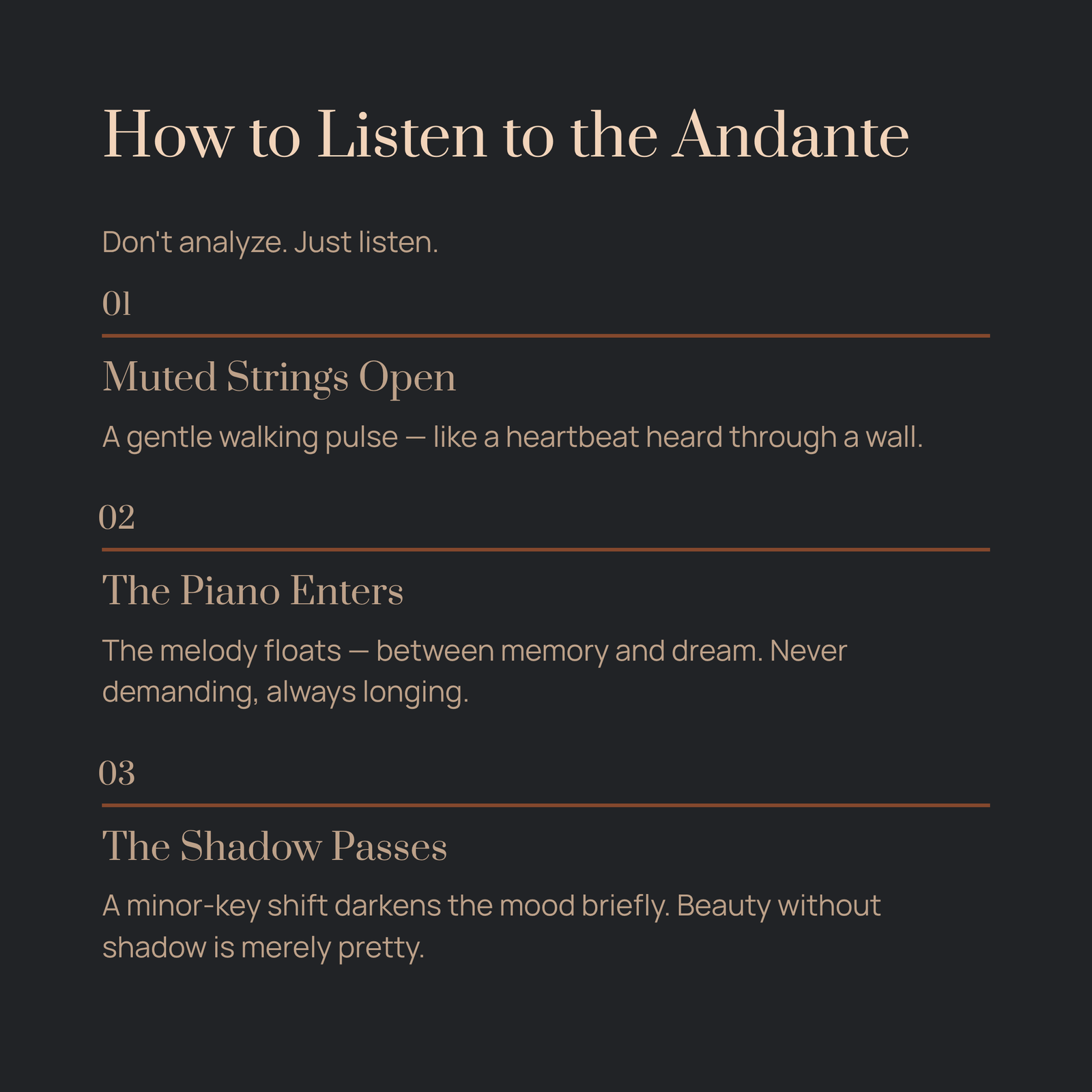
If you are hearing this movement for the first time, here is what I would suggest. Don’t analyze. Don’t count beats or try to identify themes. Just listen to the opening — the muted strings that begin with a gentle, walking pulse, almost like a heartbeat heard through a wall. They establish a rhythm that feels neither fast nor slow but simply present, the way breathing feels when you are completely at rest.
Then the piano enters. And this is where the magic lives. The melody doesn’t announce itself. It doesn’t demand attention. It floats above the strings like a thought you can’t quite hold onto — something between a memory and a dream. The right hand sings a long, lyrical line while the left hand plays delicate arpeggios that shimmer underneath, creating a texture that feels almost suspended in midair.
Pay attention to the relationship between the piano and the orchestra. They are not competing. They are not even exactly conversing. It is more like two people sitting together in comfortable silence, occasionally sharing a phrase, a glance, a breath. The orchestra provides warmth and grounding; the piano provides longing and flight. Together they create something that neither could achieve alone — a feeling of tenderness so complete it borders on sadness.
There is a passage near the middle of the movement where the music shifts into a minor key, and the mood darkens subtly, like a cloud passing over a sunlit field. This is Mozart at his most human. He understood that beauty without shadow is merely pretty, and he refused to write anything merely pretty. The shadow passes. The light returns. But you have felt its presence, and the melody that follows carries a quiet knowledge of impermanence that makes it infinitely more moving.
Why This Piece Touches Everyone
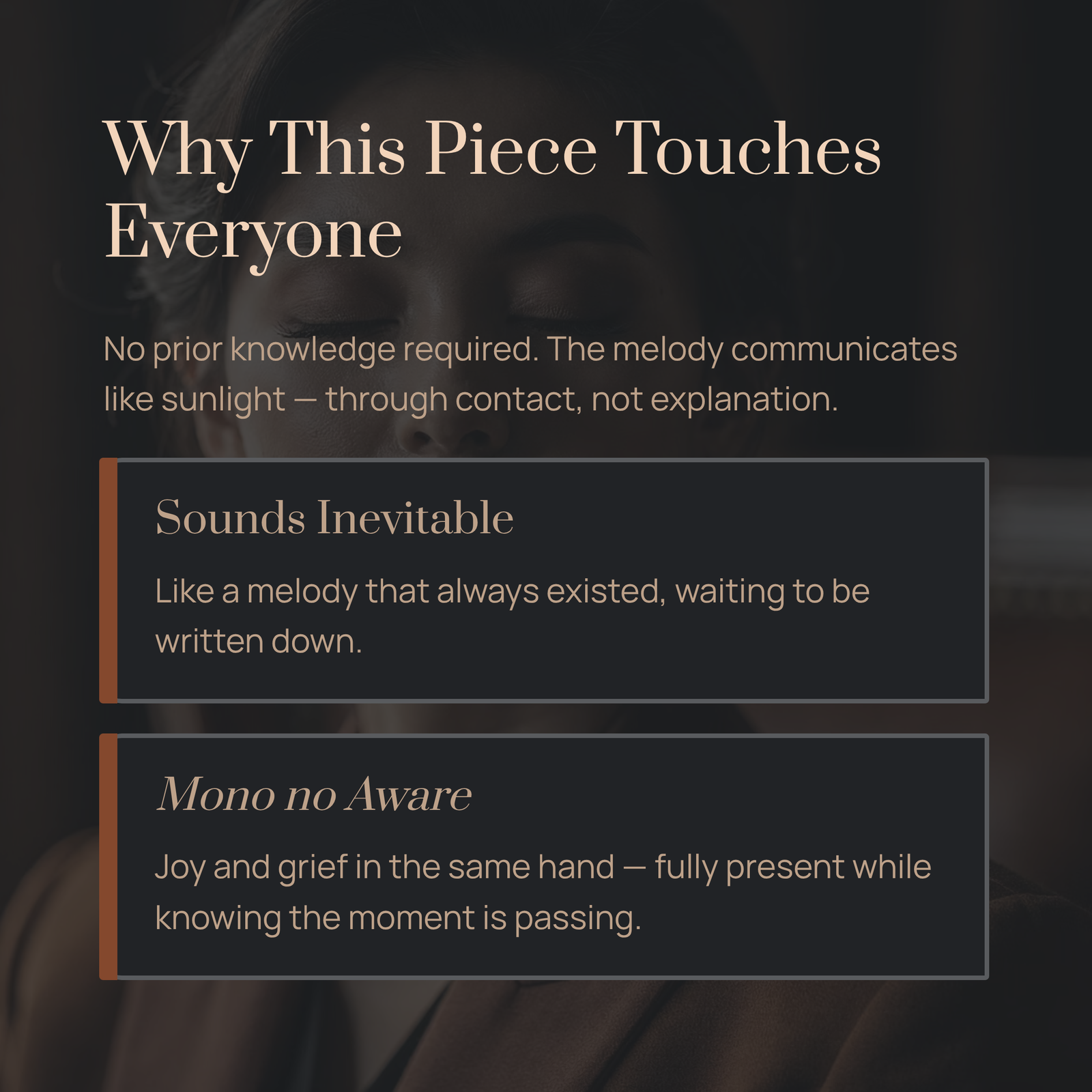
I have played this movement for people who have never listened to classical music in their lives, and I have watched their faces change. There is no barrier to entry here. You do not need to know what a concerto is, or what K. 467 means, or who Mozart was. The melody communicates directly, the way sunlight communicates warmth — not through explanation but through contact.
Part of this is Mozart’s genius for simplicity. The Andante is not technically simple — any pianist will tell you that making it sound effortless requires enormous control and sensitivity — but it sounds simple. It sounds like the most natural thing in the world, like a melody that has always existed and was merely waiting for someone to write it down. This quality of inevitability is perhaps the rarest thing in all of music, and Mozart possessed it to a degree that no other composer has quite matched.
But there is something else at work too. The Andante captures a very specific emotional state — one that most of us recognize but struggle to name. It is the feeling of being fully present in a beautiful moment while simultaneously aware that the moment is passing. It is joy and grief held in the same hand. The Japanese have a word for this: mono no aware, the bittersweet awareness of transience. Mozart, writing in Vienna two centuries before that term entered Western vocabulary, expressed it perfectly.
Performances Worth Seeking Out
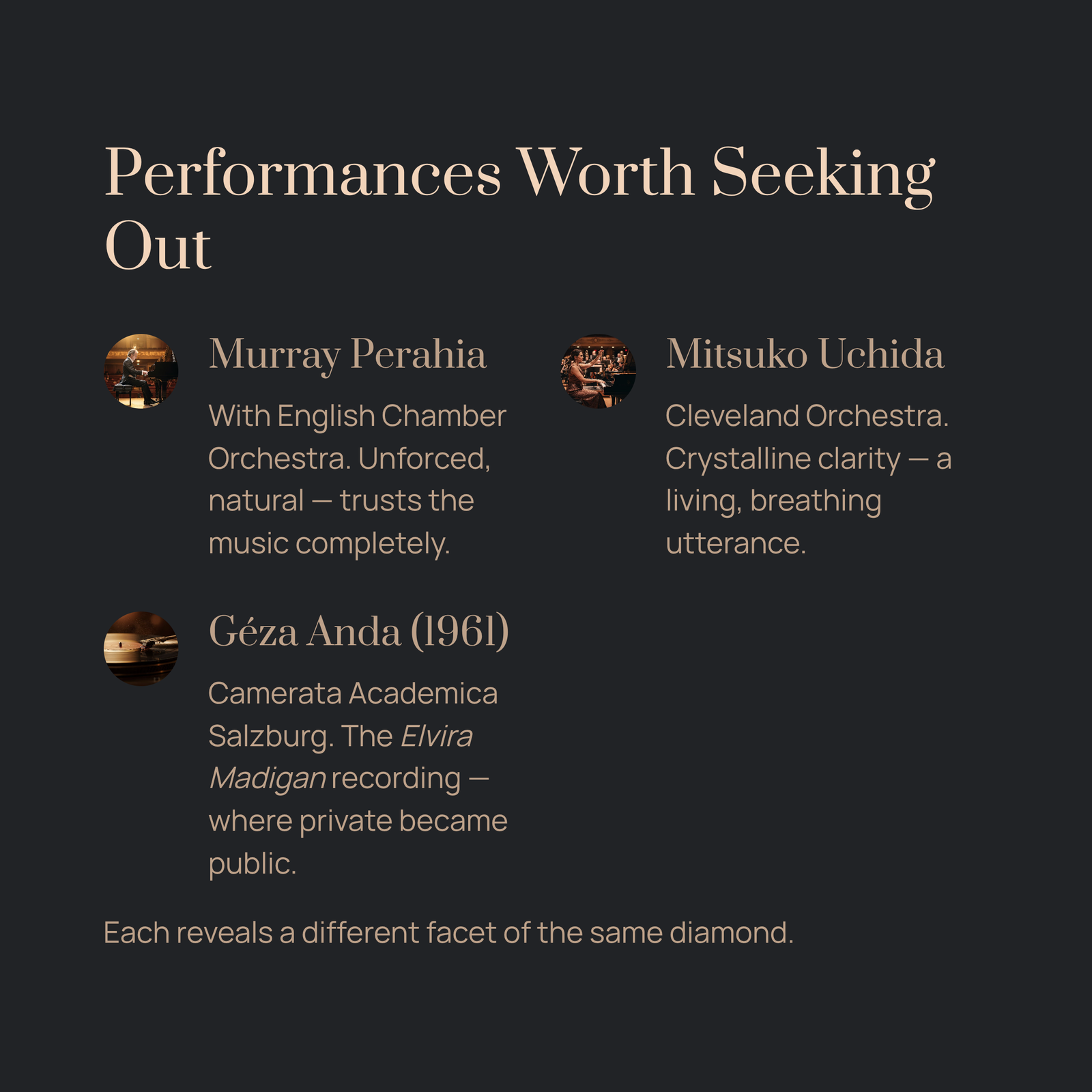
If you are exploring this movement for the first time, I would recommend starting with Murray Perahia’s recording with the English Chamber Orchestra. Perahia plays with a singing tone and an unforced naturalness that lets the melody breathe. He never sentimentalizes, never pushes, and yet every phrase feels deeply personal. It is a performance that trusts the music completely, and the music rewards that trust.
For a more historically informed approach, try Mitsuko Uchida conducting the Cleveland Orchestra from the piano. Uchida brings a crystalline clarity to every note, and her phrasing is full of subtle surprises — tiny hesitations and accelerations that keep the music alive and unpredictable. Her interpretation reminds you that this is not background music; it is a living, breathing utterance from one of the greatest minds in human history.
If you want to hear the Romantic tradition at its most eloquent, Friedrich Gulda’s recording offers a warmer, more generous approach, with a richness of tone that wraps around you like a familiar embrace. And for those curious about the Elvira Madigan connection, seek out Géza Anda’s 1961 recording with the Camerata Academica Salzburg — this is the performance used in the film, and hearing it is like stepping into the very moment when this private masterpiece became public property.
Each of these pianists reveals a different facet of the same diamond. I keep returning to all of them, depending on what I need — comfort, clarity, beauty, or simply the reassurance that such things exist.
The Music That Stays
There is a test I sometimes apply to music: does it stay with you after the sound stops? Not as a catchy tune lodged in your head, but as a feeling — a shift in your inner weather that persists even after you have returned to the noise and demands of ordinary life. The Andante from K. 467 passes this test every time. Hours after listening, I find myself moving a little more slowly, noticing a little more carefully, holding things a little more gently. It does not take me out of the world. It returns me to it, but with softer eyes.
Mozart wrote this movement in a single day, in the middle of a life that would last only thirty-five years. He could not have known that a Swedish film would one day carry his melody to millions, or that people in the twenty-first century would press play on their phones and feel, for five minutes, the same tenderness he poured into those notes on a cold Vienna morning. But perhaps he did know — in the way that all great artists know — that he was writing something true, and that true things have a way of finding the people who need them, however long it takes.