📑 Table of Contents

There is a strange kind of magic in music that finds you before you find it. You hear it in a coffee shop, in a film soundtrack, hummed by a stranger on the subway — and something in your chest tightens, just slightly, as though you’ve remembered a place you’ve never been. Dvořák’s Humoresque in G-flat Major is exactly that kind of piece. If I played the opening bars for you right now, I am almost certain you would say, “Oh, I know this one.” And yet, if I asked you who wrote it, or why, you might draw a blank. That gap between recognition and understanding is precisely where the beauty of this piece lives.
I first encountered this melody as a child, long before I knew the name Antonín Dvořák. It drifted out of a television somewhere, a lilting, swaying tune that seemed to smile and sigh at the same time. It took me years to track it down, and when I finally did, I discovered a story far richer than the melody alone.
The Bohemian in Manhattan: Where This Piece Was Born
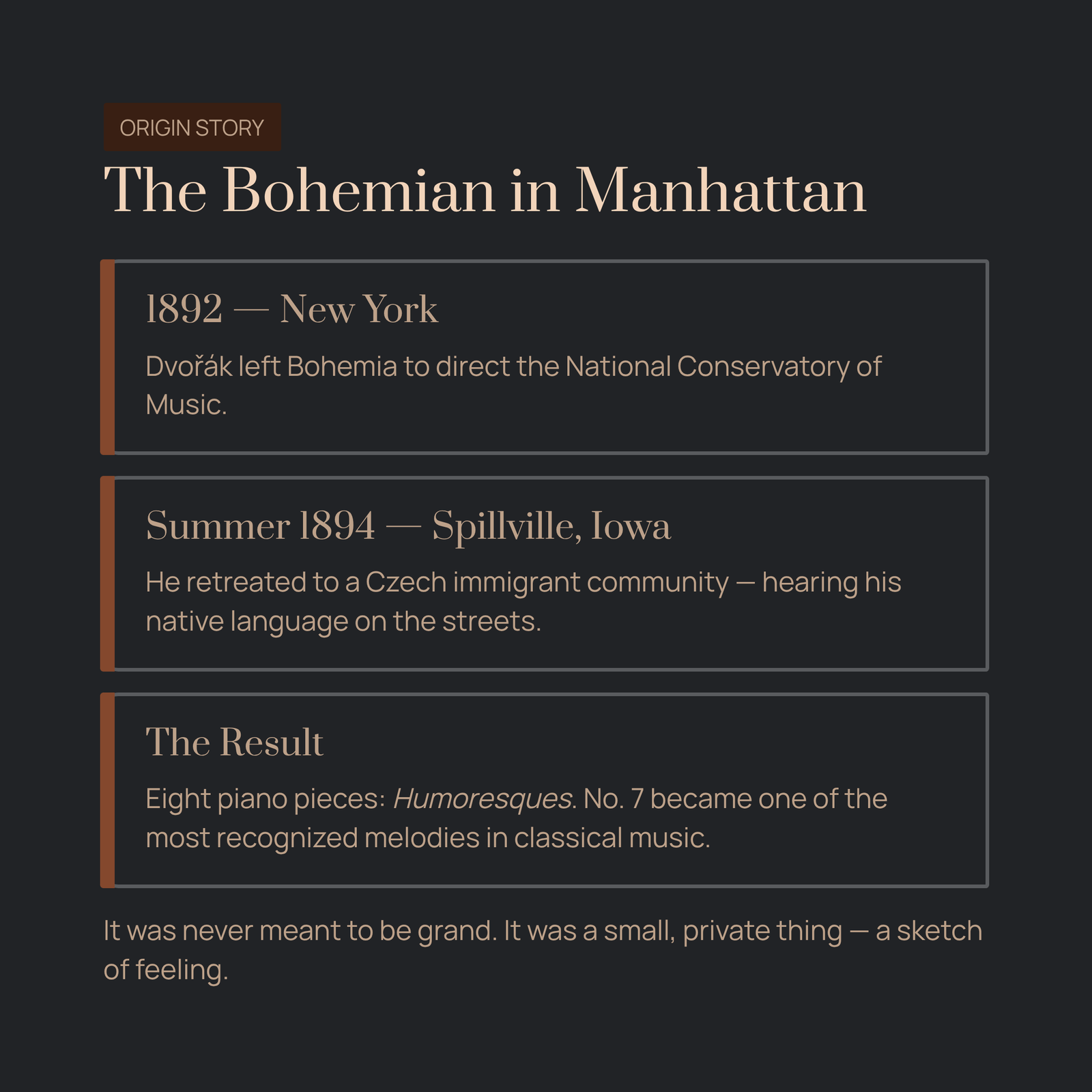
In 1892, Dvořák left his beloved Bohemia — the rolling hills, the folk songs, the particular slant of afternoon light over Prague — to become the director of the National Conservatory of Music in New York City. It was a prestigious appointment, and he accepted it with genuine enthusiasm. But homesickness is not a rational thing. It does not care about prestige or opportunity.
During the summer of 1894, Dvořák retreated to Spillville, Iowa, a small Czech immigrant community where he could hear his native language spoken on the streets. It was there, and later back in New York, that he composed a set of eight piano pieces he titled Humoresques. The seventh in the set — this one, in G-flat major — became one of the most recognized melodies in all of classical music. It was never intended to be a grand statement. It was a small, private thing, a sketch of feeling. Perhaps that is exactly why it has endured.
Smiling Through Tears: What Makes This Music So Special
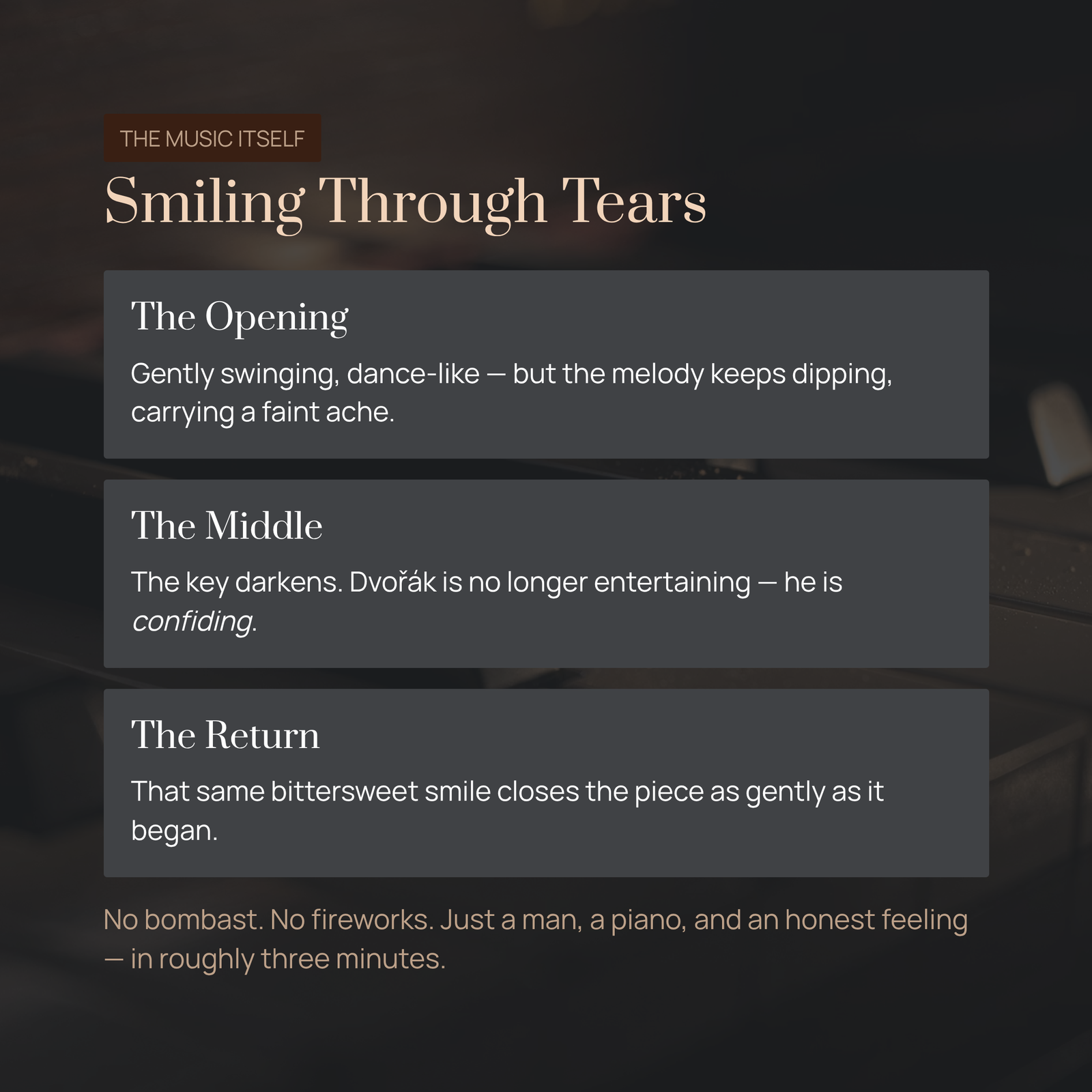
The genius of this Humoresque lies in its emotional duality. The main theme, marked Poco lento e grazioso, opens with a gently swinging rhythm that feels almost dance-like. There is lightness in it, a playfulness that could easily pass for simple cheerfulness. But listen more carefully. Beneath that buoyant surface, the melody keeps dipping downward, reaching for notes that carry a faint ache. It is the musical equivalent of smiling through tears — a feeling so universally human that it crosses every cultural boundary.
The middle section shifts to a more tender, inward mood. The key darkens slightly, the tempo breathes, and for a moment the mask slips. Here, Dvořák is no longer entertaining. He is confiding. The melody becomes more lyrical, more exposed, as though he is speaking quietly to someone who is not in the room. And then, just as the vulnerability becomes almost too much, the opening theme returns — that same swaying dance, that same bittersweet smile — and the piece closes as gently as it began.
What I find most remarkable is how much emotional territory Dvořák covers in roughly three minutes. There is no bombast, no virtuosic fireworks. Just a man, a piano, and an honest feeling, rendered with the kind of craftsmanship that makes simplicity look effortless.

My Own Listening: Finding Home in a Borrowed Melody
I return to this piece in moments when I feel caught between two places — not physically lost, but emotionally suspended. There is something about the way the melody rises and falls, never quite settling, that mirrors the feeling of longing for something you cannot name. It is not sadness, exactly. It is closer to that specific ache of remembering a happy moment and realizing, in the same breath, that it has already passed.
I once played this piece on repeat during a long train ride through unfamiliar countryside. The landscape outside the window kept changing — fields, villages, rivers — and somehow the music made every scene feel like a memory, even though I was seeing it all for the first time. That is the paradox Dvořák captured so perfectly: the Humoresque makes the unfamiliar feel nostalgic. It gives you homesickness for a home that is not yours.

How to Listen: A Practical Guide for First-Time Ears
If this is your first time sitting down with this piece intentionally, here are a few suggestions that might deepen the experience.
On your first listen, simply let the melody wash over you. Do not analyze. Do not count beats. Just notice how your body responds to the swaying rhythm. Does it make you want to rock gently, like a boat on calm water? That physical response is the heartbeat of the piece.
On a second listen, pay attention to the tiny pauses and hesitations Dvořák writes into the melody. These small silences are not gaps — they are breaths. They give the music its human quality, its sense of someone actually speaking rather than performing.
For recommended recordings, I would start with Fritz Kreisler’s legendary violin arrangement, which became so famous that many people hear the Humoresque as a violin piece first. His warm, singing tone captures the nostalgia perfectly. For the original piano version, Rudolf Firkušný’s recording is definitive — as a fellow Czech, he understood the folk-song roots of this music in his bones. For a more modern interpretation, Yo-Yo Ma’s cello arrangement brings a deep, resonant warmth that feels like being wrapped in a heavy blanket on a cool evening. And if you want to hear the piece in a completely different context, seek out Itzhak Perlman’s version — his phrasing is so natural and conversational that it sounds less like a performance and more like a confession.

The Weight of Small Things
We tend to measure greatness in classical music by scale — the longest symphonies, the most demanding concertos, the most revolutionary harmonies. But Dvořák’s Humoresque quietly argues for a different kind of greatness. It suggests that a melody of just a few bars, written in a modest form, carrying the weight of nothing more than one man’s longing for home, can travel across a century and still arrive with its emotional cargo intact.
This is a piece that asks very little of its listener. Three minutes of your attention, perhaps a quiet room, perhaps not even that. And in return, it offers something that the grandest symphonies sometimes struggle to deliver: the feeling that someone, somewhere, once felt exactly as you feel right now — suspended between joy and sorrow, between where you are and where you wish you could be — and found a way to make that feeling sing.