📑 Table of Contents
There is a moment, just a few seconds into La Campanella, when a single high note rings out from the piano like a bell struck in a distant tower. It is so delicate, so impossibly light, that it barely seems real. And yet, that tiny sound — that little bell — has haunted pianists for nearly two hundred years.
I remember the first time I heard it. I was not prepared. I expected something grand, something heavy with Romantic drama. Instead, what I got was a shimmering, almost fragile sound dancing at the very top of the keyboard, repeating and repeating like an obsession the pianist could not shake. Within thirty seconds, I understood why this piece has a reputation. Not because it is loud or overwhelming, but because it sounds like it should be impossible.
La Campanella, which simply means “The Little Bell” in Italian, is one of those rare pieces that manages to be both immediately accessible and endlessly mysterious. You do not need a music degree to feel its magic. You just need to listen.
A Violin’s Ghost Inside a Piano
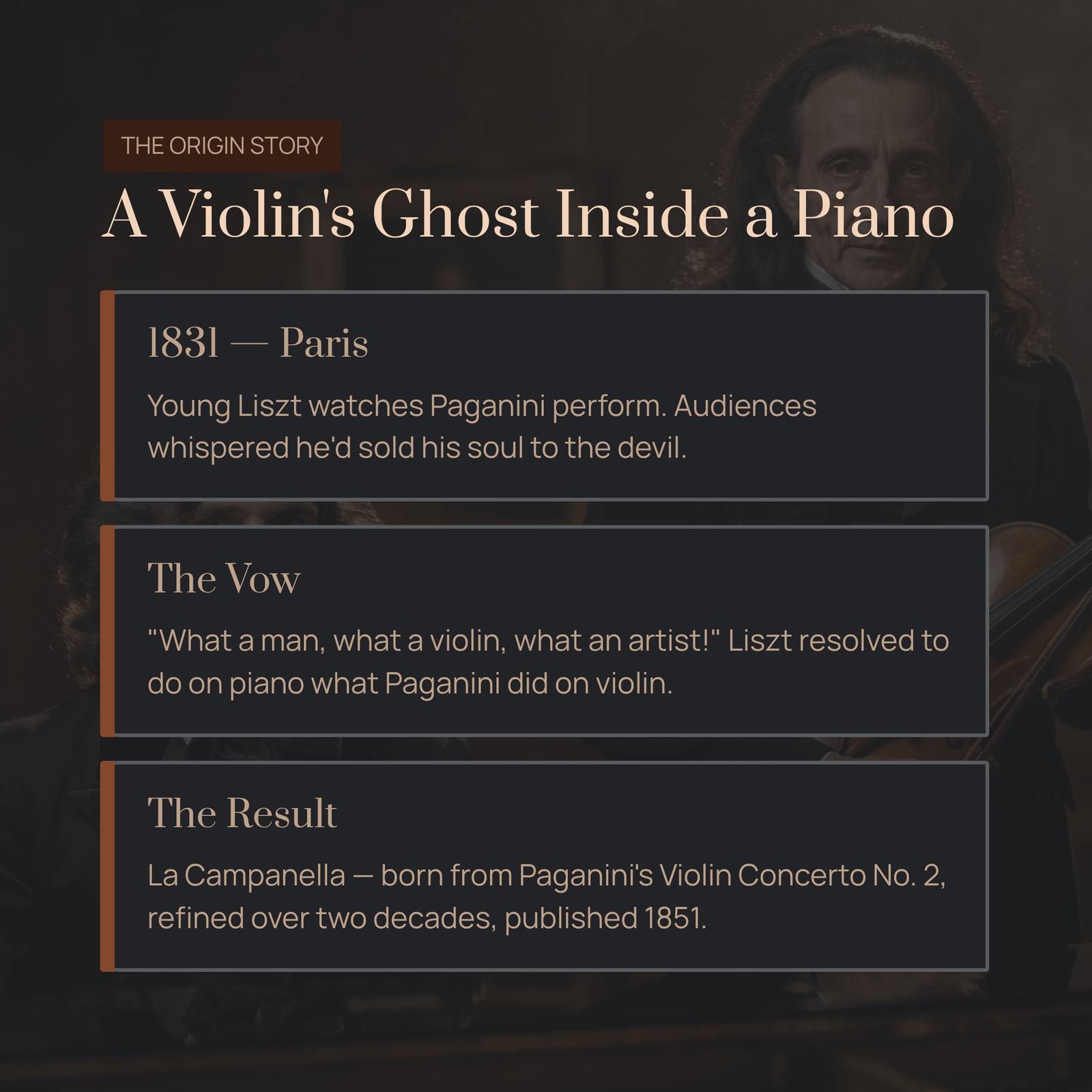
To understand La Campanella, you need to know about a meeting between two of the most extraordinary musicians who ever lived. In 1831, a twenty-year-old Franz Liszt attended a concert in Paris by the legendary violinist Niccolo Paganini. Paganini was a figure shrouded in myth — audiences genuinely whispered that he had sold his soul to the devil in exchange for his supernatural technique. His fingers moved in ways that seemed to defy the physical limits of the human hand.
Liszt walked out of that concert a changed man. He reportedly told a friend, “What a man, what a violin, what an artist! O God, what suffering, what misery, what tortures in those four strings!” From that night on, Liszt devoted himself to a single, almost mad ambition: to do on the piano what Paganini did on the violin.
La Campanella was born from this obsession. The melody originally comes from the final movement of Paganini’s Violin Concerto No. 2 in B minor, where a small bell rings alongside the orchestra. Liszt took that bell motif and reimagined it for the piano — not once, but multiple times over the years. The version we know today, published in 1851 as the third of his Grandes Etudes de Paganini, S.141, is the final and most refined result of nearly two decades of revision. It is a piece that carries inside it the ghost of a violin, the ring of a bell, and the burning ambition of a young genius who refused to accept any limits.

How a Bell Becomes a Storm
Here is what makes La Campanella so extraordinary, even if you have never studied a note of music in your life: it teaches you how to listen by making you follow a single, simple idea as it transforms before your ears.
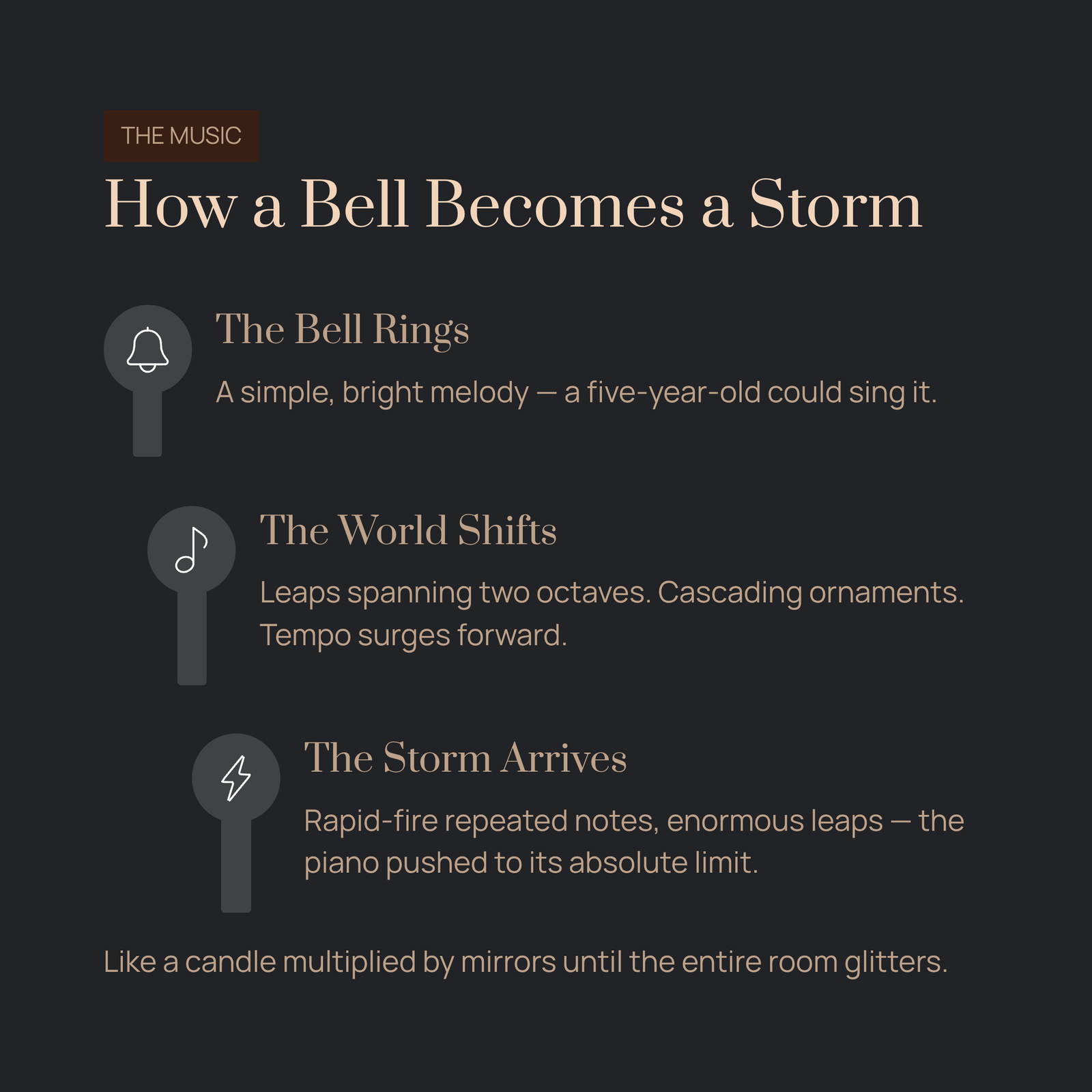
The piece begins with that bell tone — a high, bright note in the piano’s upper register. It repeats with an almost childlike simplicity. If you were to hum the main melody, you could do it easily. There is nothing complicated about the tune itself. A five-year-old could sing it.
But then, Liszt begins to play. And I mean play — in every sense of the word. The melody stays, but the world around it starts to shift. The accompaniment grows more elaborate. The jumps between notes become wider — sometimes spanning nearly two octaves in a single leap, which means the pianist’s hand must fly across the keyboard with split-second precision. The tempo pushes forward. Ornamental notes begin to cascade around the bell tone like sparks flying from a fire.
What Liszt does is essentially take a simple, memorable melody and dress it in increasingly dazzling variations, each one more virtuosic than the last. Think of it like watching a single candle flame in a room where someone keeps adding mirrors — the light itself does not change, but the reflections multiply until the entire space is glittering.
The final section is where things become almost unbelievable. The bell tone is still there, but now it is surrounded by rapid-fire repeated notes, enormous leaps, and cascading runs that push the piano to its absolute limit. The effect is not just technically impressive — it is genuinely thrilling, like watching an acrobat perform without a net.

Why This Piece Makes Me Think About Obsession
I have a confession to make. La Campanella is not the kind of piece I usually return to for comfort. It is not warm in the way a Chopin nocturne is warm. It does not wrap its arms around you. Instead, it grabs you by the collar and pulls you into its world — a world of relentless pursuit, of reaching for something just beyond your grasp.
And maybe that is exactly why it moves me so deeply. There is something profoundly human about the way this piece works. The bell keeps ringing, always the same pitch, always the same simple sound, but everything around it keeps escalating. It reminds me of the way we circle back to the same memories, the same desires, the same unresolved questions in our lives — each time with a little more intensity, a little more urgency.
Liszt himself was a man of magnificent obsessions. He was obsessed with Paganini’s virtuosity. He was obsessed with pushing the piano beyond what anyone thought possible. He was obsessed with fame, with love, with God. La Campanella is the sound of that kind of obsession distilled into six minutes — beautiful, exhausting, and impossible to ignore.
Finding Your Way In: A Listening Guide
If you are coming to La Campanella for the first time, here are a few ways to make your experience richer.
First listen — just follow the bell. Do not try to track everything happening in the piece. Simply listen for that high, bright bell tone and notice how it keeps returning no matter how wild the surrounding music becomes. It is your anchor.
Second listen — watch the hands. Find a video performance and pay attention to the pianist’s physical movement. The leaps in this piece are visually spectacular. Watching a pianist navigate them will give you an entirely new appreciation for what is happening in the music.
Third listen — feel the arc. Now that you know the bell and the physicality, listen for the emotional shape. Notice how the piece builds from delicate charm to breathless intensity. Feel how the ending arrives not as a gentle landing but as a final, dazzling burst.
For recordings, I would suggest starting with Evgeny Kissin’s live performances — his combination of crystalline clarity and raw power captures the dual nature of La Campanella perfectly. For a more poetic, introspective approach, try Jorge Bolet’s recording, which treats the piece less like a showpiece and more like a confession. And if you want to experience the absolute extreme of technical brilliance, seek out Marc-Andre Hamelin’s version, which is almost terrifyingly precise. Each pianist reveals a different face of the same piece, and comparing them is one of the great pleasures of classical music listening.
The Bell That Never Stops Ringing
There is a reason La Campanella has survived for nearly two centuries while countless other virtuoso showpieces have faded into obscurity. It is not just difficult. Difficulty alone does not sustain a piece of music across generations. What sustains it is that the difficulty serves something deeper — a melody so simple and so perfect that it lodges in your memory after a single hearing, and a structure so brilliantly crafted that it reveals new details every time you return.
The little bell keeps ringing. It rang when Paganini first played it on his violin in the 1820s. It rang when Liszt, electrified and ambitious, reimagined it for the piano. It rings today, every time a pianist sits down and dares to attempt those impossible leaps. And it will ring the first time you hear it — that bright, clear, almost innocent sound floating above the storm.
Some music asks you to think. Some music asks you to feel. La Campanella asks you to hold your breath. I suggest you let it.