📑 Table of Contents
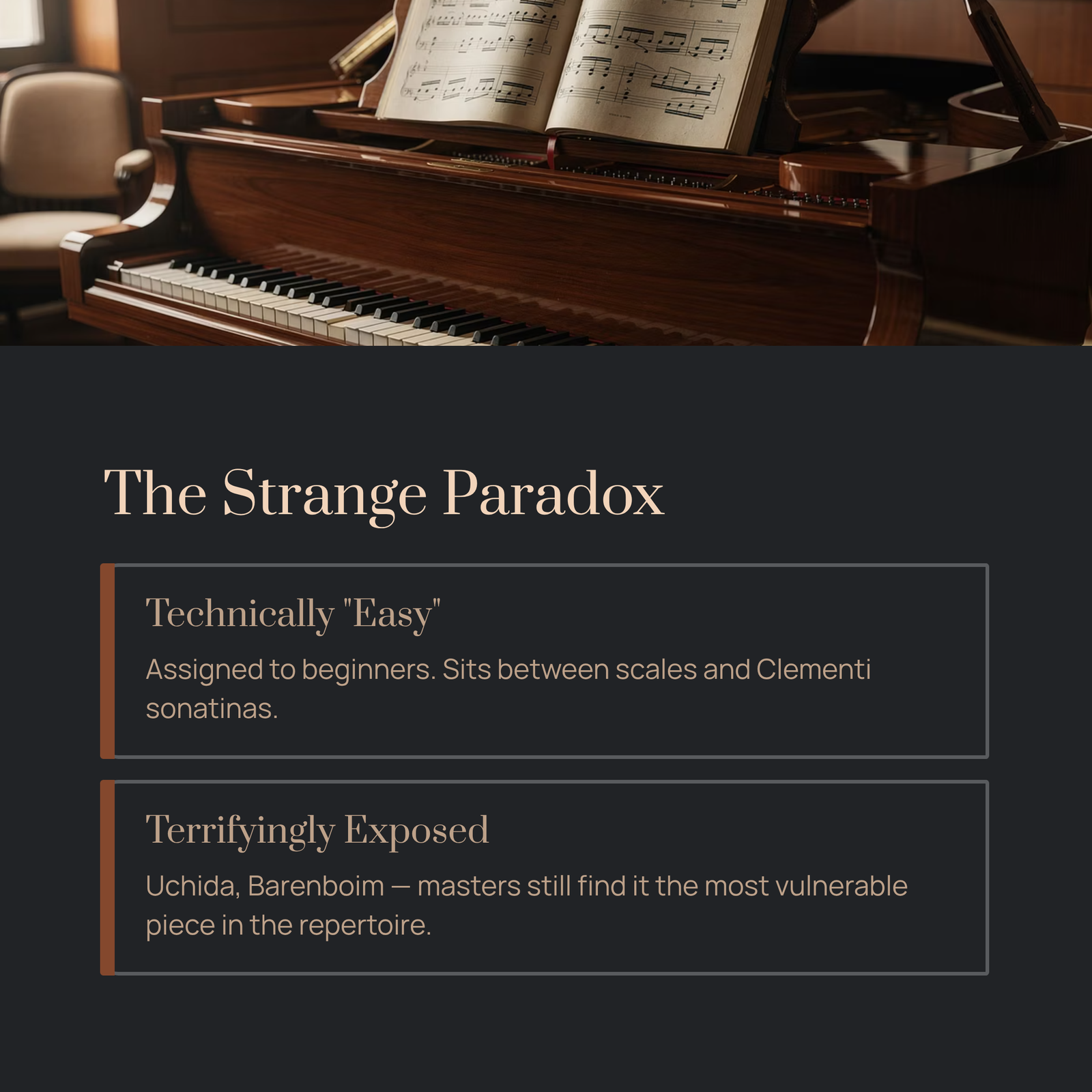
There is a strange paradox in the world of classical music. Some of the most technically demanding works — Liszt’s transcendental études, Rachmaninoff’s thundering concertos — are, in a way, easier to perform convincingly than a short, bright sonata written by a man in a powdered wig over two centuries ago.
That sonata is Mozart’s Piano Sonata No. 16 in C Major, K.545 — the piece almost every piano student encounters in their first or second year of lessons. It sits in beginner method books right between scales and Clementi sonatinas. Teachers assign it casually. Students play through it quickly. And yet, when the great Mitsuko Uchida sits down to record it, when Daniel Barenboim returns to it in his seventies, when any honest pianist confronts its translucent textures under the unforgiving lights of a concert stage — something shifts. Suddenly, this “easy” sonata becomes one of the most exposed, vulnerable, and unforgiving pieces in the entire piano repertoire.
I want to talk about why. Because understanding what makes K.545 so quietly terrifying is, I believe, one of the best doorways into understanding what makes Mozart unlike anyone else who ever lived.

A Sonata Born in the Margins
Mozart composed this sonata on June 26, 1788, in Vienna. He catalogued it in his personal notebook as “Eine kleine Klavier-Sonate für Anfänger” — a little piano sonata for beginners. That description has haunted the piece ever since, branding it with an air of disposability, as if Mozart tossed it off between more serious projects.
But consider the context. The summer of 1788 was one of the most concentrated creative periods in all of Western music. Within the span of just a few weeks, Mozart composed his final three symphonies — No. 39, No. 40, and the Jupiter. He was deep in financial trouble, writing letters begging for loans. His infant daughter had recently died. Audiences in Vienna were losing interest in his music, turning instead to lighter fare.
Into this crucible of grief and genius, Mozart wrote K.545. It arrived not as a throwaway exercise, but as something almost more remarkable — a distillation. If the Jupiter Symphony is Mozart building a cathedral, the Sonata in C Major is him folding a perfect paper crane. Every note is placed with absolute precision, and there is nowhere to hide.
What to Listen For in the First Movement
The Allegro opens with one of the most recognizable melodies in all of classical music — a bright, stepwise theme in C major that sounds as natural as breathing. It rises, pauses, then cascades down in a stream of sixteenth notes. If you have ever heard a piano playing in a hotel lobby or a movie set in Europe, chances are this melody was somewhere in the background.
But here is the thing most people miss on first listen: that simplicity is architectural. Think of it like a glass building. The fewer walls there are, the more every beam has to bear. Every note in this opening is structural. There are no thick chords to mask a wrong voicing, no thundering passages where a slightly uneven touch disappears into the texture. It is just a single melodic line and a light accompaniment, both completely naked.
Pay attention to the left hand. Beneath that famous melody, the left hand plays an Alberti bass — a broken-chord pattern that rolls continuously like a gentle current beneath a stream. It sounds mechanical in the hands of a student. In the hands of a master, it becomes a living, breathing pulse, subtly shaping each phrase the way the tide shapes sand. The difference between a good performance and a great one often lives entirely in how this left hand moves.
Around the halfway point of the movement, Mozart takes us to the dominant key, G major, and introduces a second theme — slightly more playful, slightly more ornamental. Listen for the way Mozart creates a sense of dialogue here, as if two voices are gently teasing each other. Then comes the development section, where fragments of those themes are tossed around, passing through minor keys that cast brief, fleeting shadows over the music. It is like watching sunlight move through a room: the light never disappears, but its color keeps changing.
The Courage of Transparency
What I find most moving about K.545 is something that goes beyond technique or structure. It is the emotional quality of the music itself — a quality I can only describe as courageous innocence.
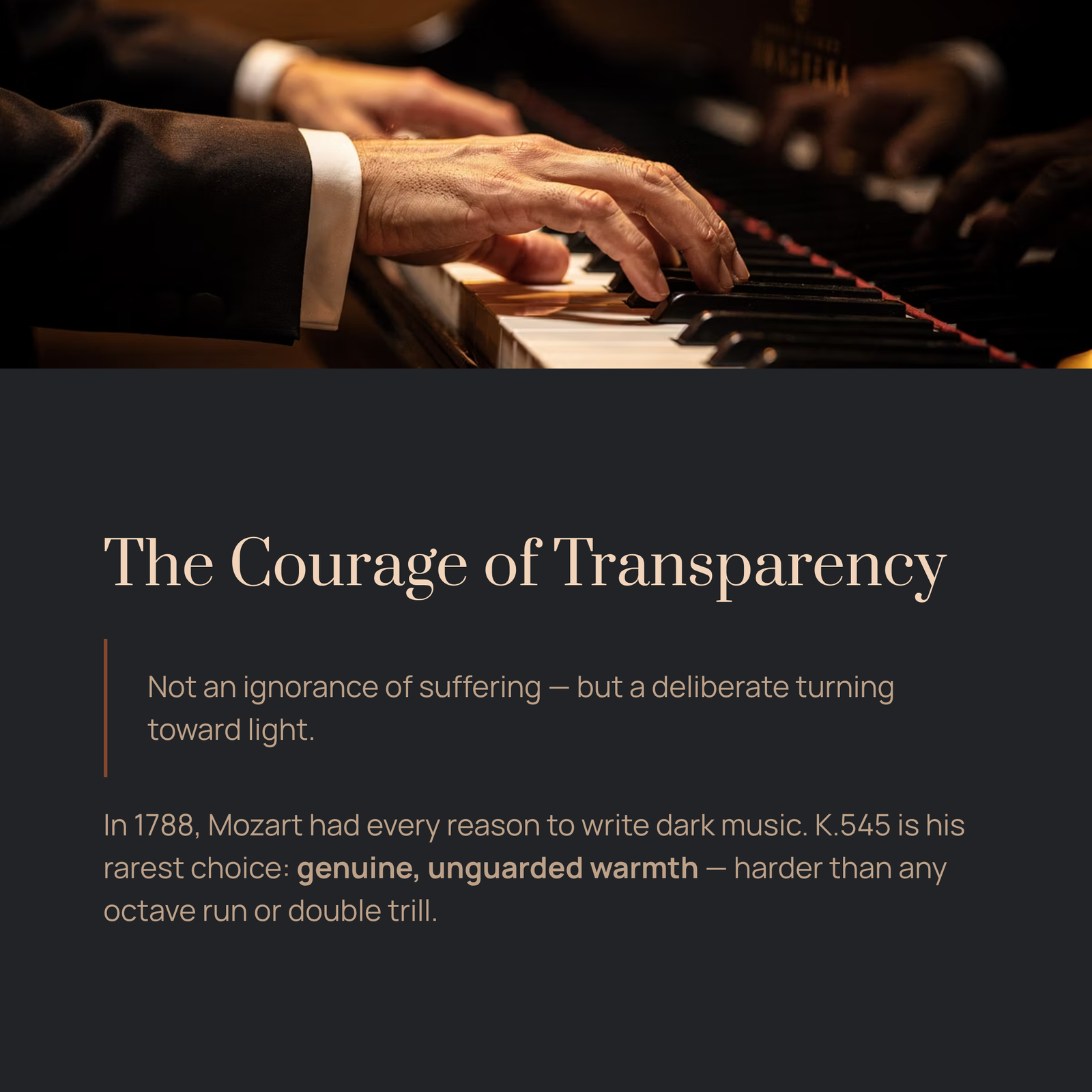
Mozart, in the summer of 1788, had every reason to write dark, brooding music. And he did — the G minor Symphony stands as proof. But in K.545, he chose a different kind of honesty. He wrote music that sounds joyful, unburdened, almost childlike in its clarity. And he meant it. This is not naïveté. It is the kind of brightness that only someone who has known real darkness can produce — not an ignorance of suffering, but a deliberate turning toward light.
I think this is why the piece remains so difficult to perform. A pianist who plays it “correctly” — clean notes, steady tempo, proper dynamics — will produce something pleasant but forgettable. A pianist who truly inhabits the music must find within themselves that same rare emotional frequency: genuine, unguarded warmth without a trace of sentimentality. It demands a kind of emotional nakedness that is far more challenging than any octave run or double trill.
How to Listen: A Practical Guide
If you are coming to K.545 for the first time — or returning to it after years of hearing it as background music — here are a few ways to deepen your experience.
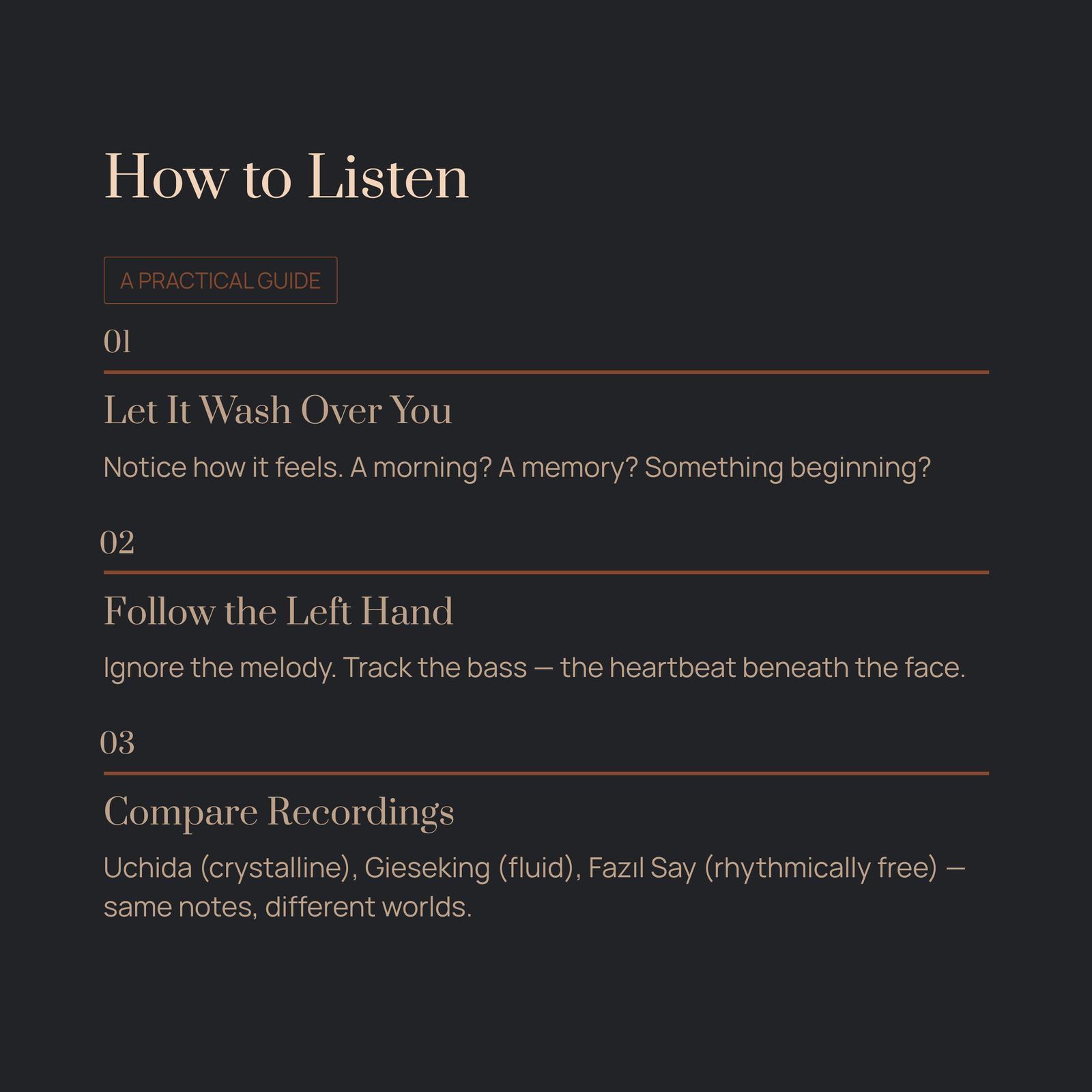
First listen: just let it wash over you. Do not analyze. Do not count measures. Simply notice how the music makes you feel. Does the opening theme remind you of anything? A morning? A childhood memory? A sense of something beginning? Mozart’s music has an uncanny ability to feel personal even on first encounter.
Second listen: follow the left hand. This changes everything. Ignore the melody entirely and track the bass patterns. Notice how they shift, how they sometimes move in unexpected directions, how they provide the harmonic foundation that gives the melody its meaning. The melody is the face of this piece; the left hand is its heartbeat.
Third listen: compare two recordings. I would recommend starting with Mitsuko Uchida’s recording for its crystalline precision and emotional warmth — she treats each phrase as if it were a line of poetry. Then try Walter Gieseking’s mid-century recording, which has a more fluid, almost improvisatory quality that reveals different colors in the same notes. For something more modern, Fazıl Say brings a subtle rhythmic freedom that makes the piece feel freshly composed. The contrasts between these interpretations will show you just how much interpretive space exists within Mozart’s seemingly simple framework.
The Weight of Weightlessness
There is a Japanese aesthetic concept called “karumi” — lightness — which the poet Bashō considered the highest achievement in art. Not lightness as in trivial, but lightness as in a bird in flight: effortless on the surface, sustained by immense hidden energy beneath.
Mozart’s K.545 is karumi made audible. It asks nothing of its listener — no knowledge of sonata form, no familiarity with classical conventions, no special preparation. A child can enjoy it. A non-musician can hum it after a single hearing. And yet it contains, in its three short movements, an entire philosophy of art: that the deepest truths are often the simplest, that clarity is harder to achieve than complexity, and that real mastery looks, from the outside, like it was never difficult at all.
The next time you hear those opening notes — in a practice room, in a concert hall, in a passing car — I hope you will pause for a moment. Not because the music demands it. But because something that light, that clear, that quietly perfect deserves at least a moment of your full attention. And in that moment, you might hear what I hear: not a beginner’s exercise, but one of the most radical acts of artistic courage ever committed to paper.