📑 Table of Contents
Close your eyes. Imagine standing in a Roman piazza at midday—sunlight pouring down, strangers chattering at café tables, church bells echoing off ancient stone. Now imagine someone managed to bottle that exact feeling and turn it into sound.
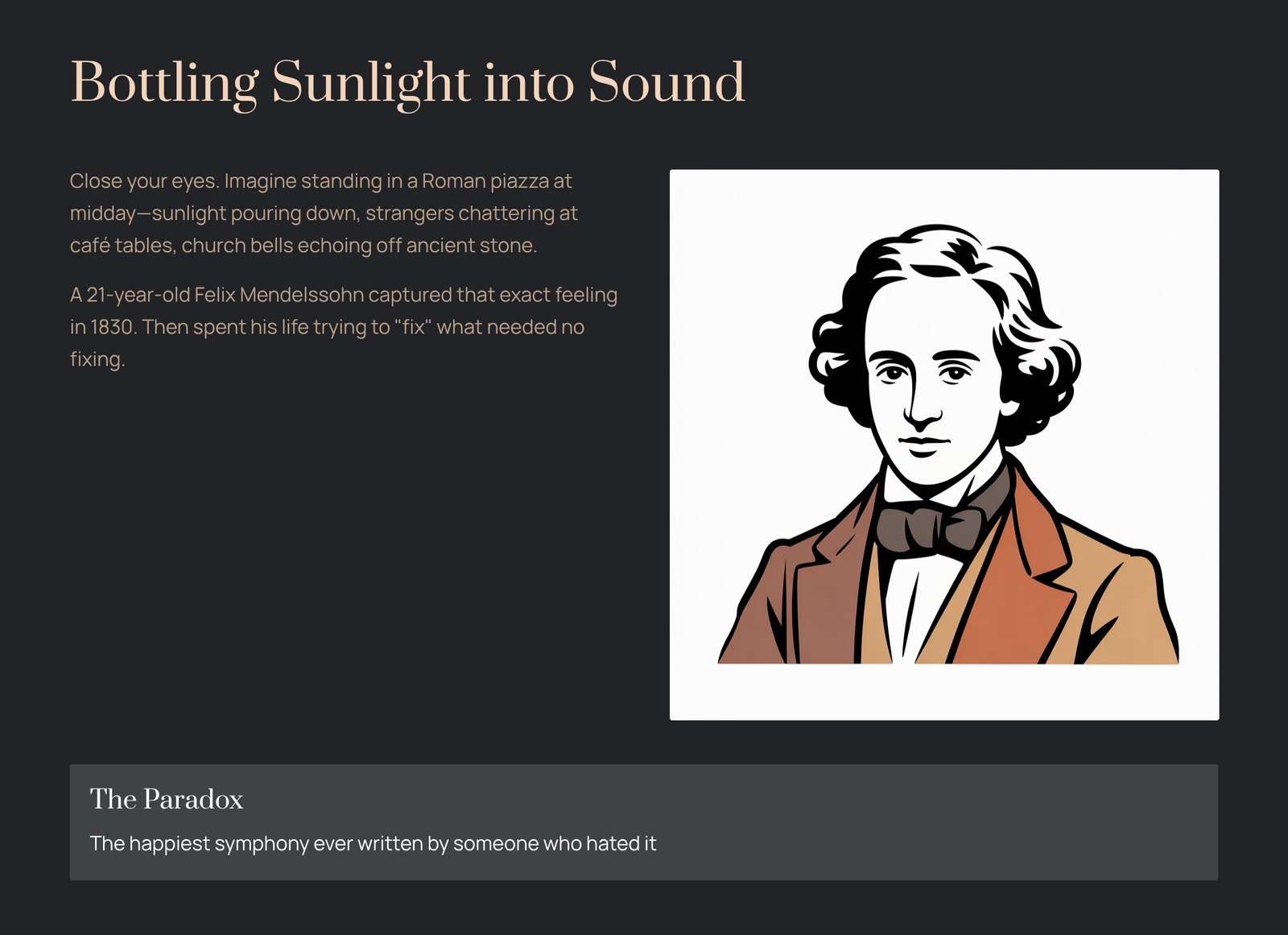
That’s precisely what a 21-year-old Felix Mendelssohn did in 1830. And then, inexplicably, he spent the rest of his life trying to “fix” what needed no fixing.
This is the story of the happiest symphony ever written by someone who hated it.
A Young Man Falls in Love with Italy
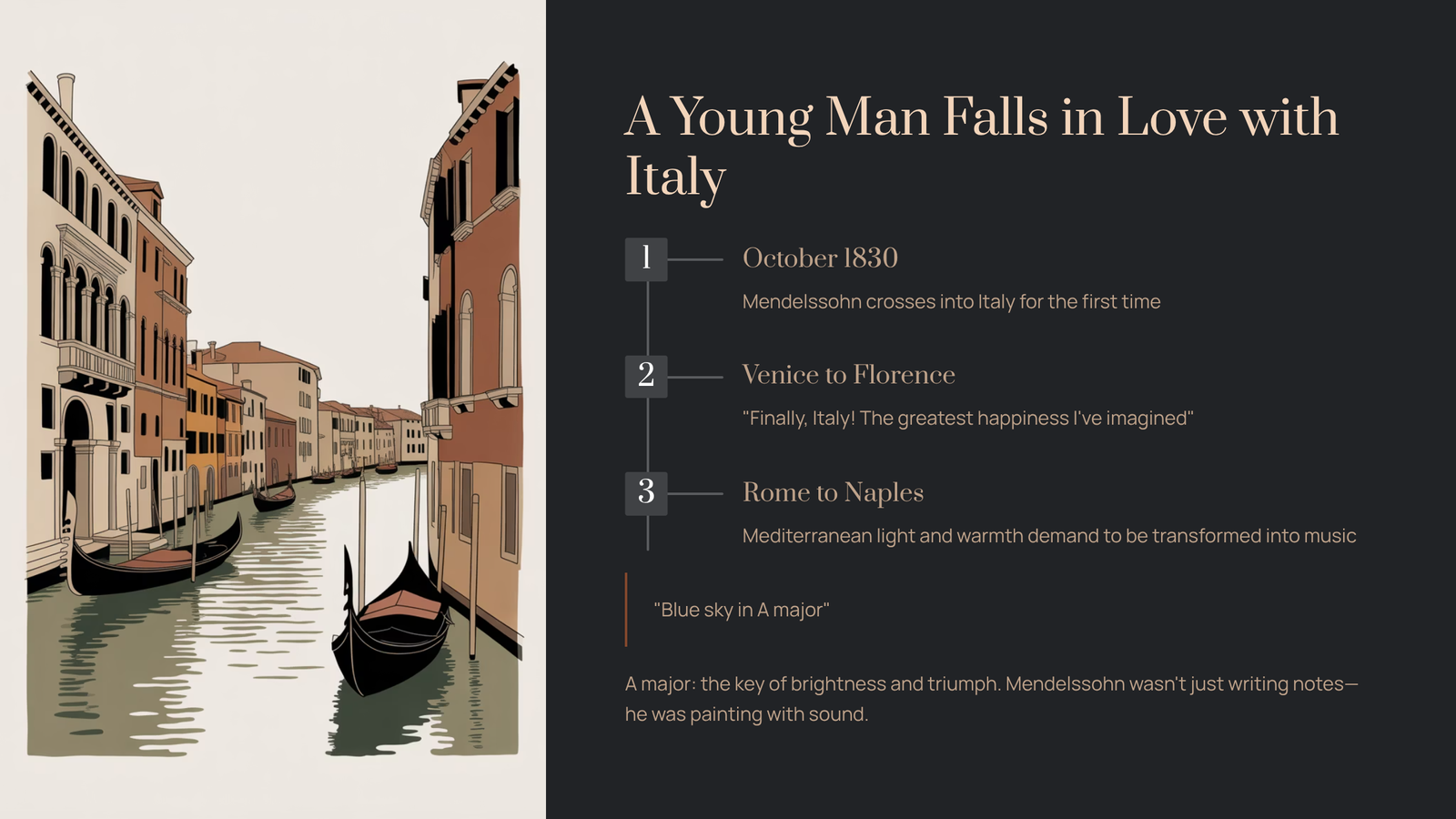
In October 1830, Mendelssohn crossed into Italy for the first time. He was young, wealthy, healthy, and wildly talented—basically living every musician’s dream. From Venice, he wrote to his parents with breathless excitement: “Finally, Italy! The greatest happiness I’ve imagined my entire life has now begun.”
And he meant it. As he traveled from Venice to Florence, from Rome to Naples, something remarkable happened. The Mediterranean light, the warmth, the vivid colors of Italian life—they demanded to be transformed into music.
He started sketching a symphony. Not just any symphony, but what he would later call “blue sky in A major.”
That phrase alone tells you everything. A major is traditionally the key of brightness and triumph—perfect for capturing endless azure skies. Mendelssohn wasn’t just writing notes. He was painting with sound.
The Opening That Changes Everything
The first movement begins unlike almost any symphony before it. No grand introduction. No slow buildup. Instead, a single pizzicato note—a plucked string—and then pure energy explodes.
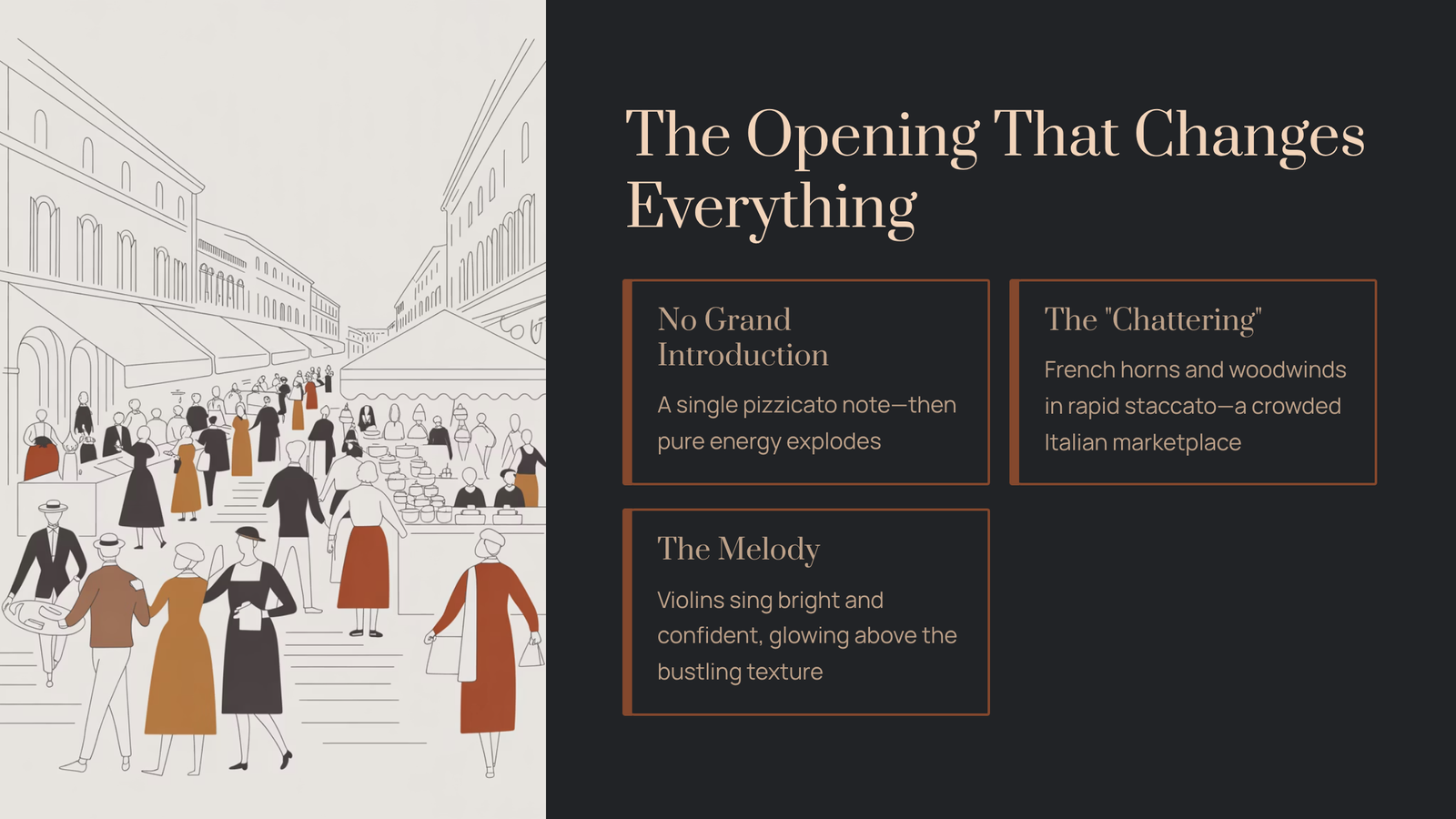
Listen for what Mendelssohn himself called the “chattering.” The French horns and woodwinds play rapid, repeated notes in sharp staccato. It’s not random noise. It’s the sonic equivalent of a crowded Italian marketplace—dozens of conversations happening simultaneously, laughter bouncing off buildings, life happening everywhere at once.
Above this bustling texture, the violins sing out a melody so bright and confident it practically glows. This is your guide through the musical piazza. Follow it.
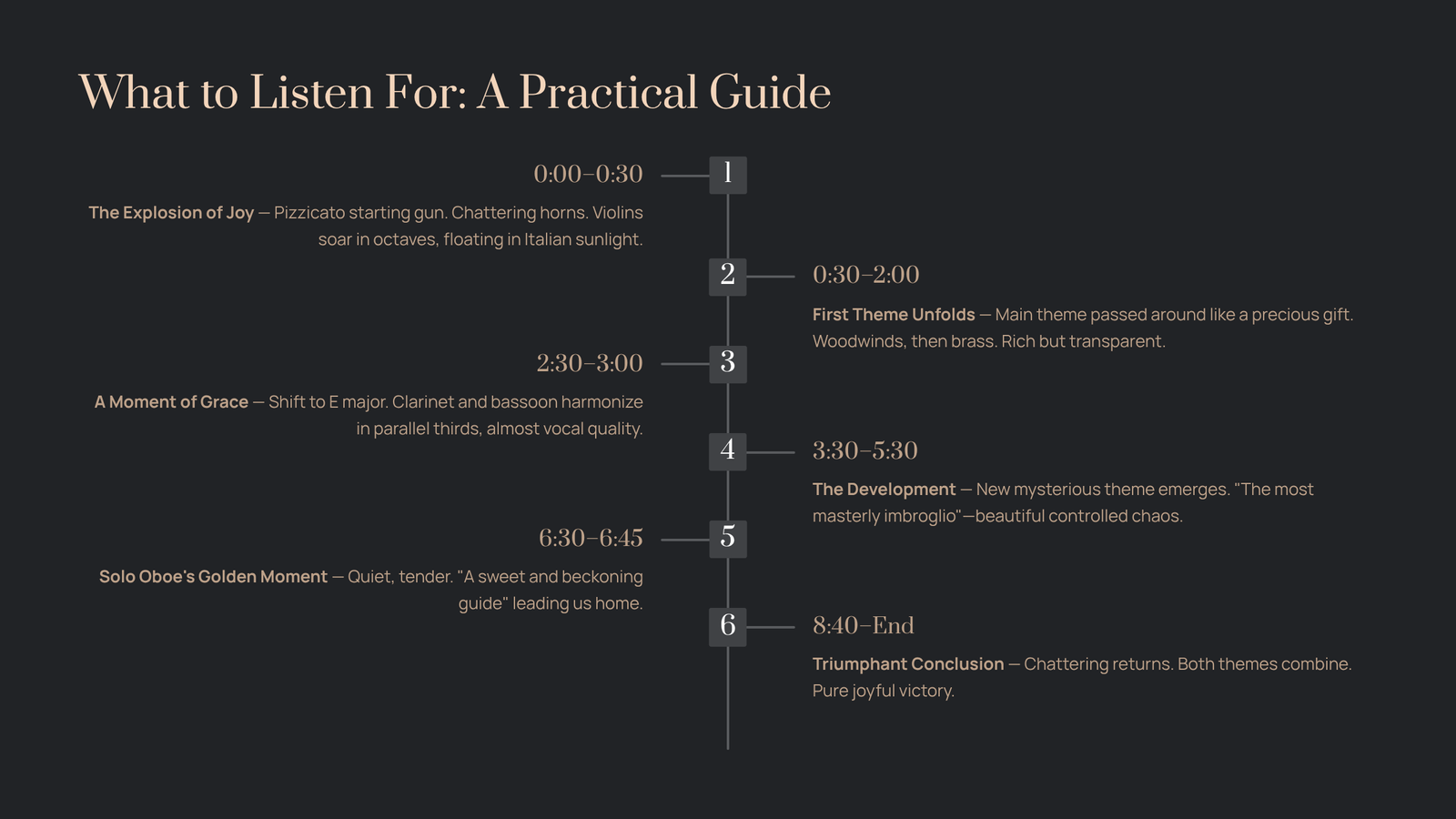
What to Listen For: A Practical Guide
0:00–0:30 — The Explosion of Joy
That opening pizzicato is your starting gun. Within seconds, you’re swept into the “chattering” horns and woodwinds. Pay attention to how the first violins soar above everything else, playing in octaves (the same note at two different heights). It creates an almost supernatural clarity, like the melody is floating in Italian sunlight.
0:30–2:00 — The First Theme Unfolds
The main theme gets passed around the orchestra like a precious gift being shared. Woodwinds take it. Then brass joins in. The sound grows richer and fuller, but never loses its transparency. Mendelssohn was a master of orchestration—you can hear every instrument clearly, nothing muddy or cluttered.
2:30–3:00 — A Moment of Grace
The music shifts to a new key (E major), and something beautiful happens. The clarinet and bassoon play together in parallel thirds—a technique that creates an almost vocal quality, like two singers harmonizing. This second theme is more flowing and elegant, a contrast to the energetic first theme.
3:30–5:30 — The Development: Controlled Chaos
Here’s where Mendelssohn shows his genius. A completely new theme appears out of nowhere—soft, mysterious, starting in the second violins. The famous musicologist Donald Tovey called this section “the most masterly imbroglio” (a fancy word for a beautiful mess). Different themes pile on top of each other, weaving in and out. It sounds complex but never loses its forward momentum.
6:30–6:45 — The Solo Oboe’s Golden Moment
After all that intensity, the music suddenly becomes quiet and tender. A solo oboe emerges, singing a sweet, almost seductive melody. Music writer Michael Steinberg called this “a sweet and beckoning guide,” gently leading us back home. It’s one of the most magical moments in the entire symphony.
8:40–End — The Triumphant Conclusion
Everything comes together for the finale. The “chattering” returns in full force. Both themes combine. The energy builds and builds until the whole orchestra blazes with fanfare-like calls. The ending is pure victory—not aggressive, but joyful. Like the perfect end to a perfect Italian day.
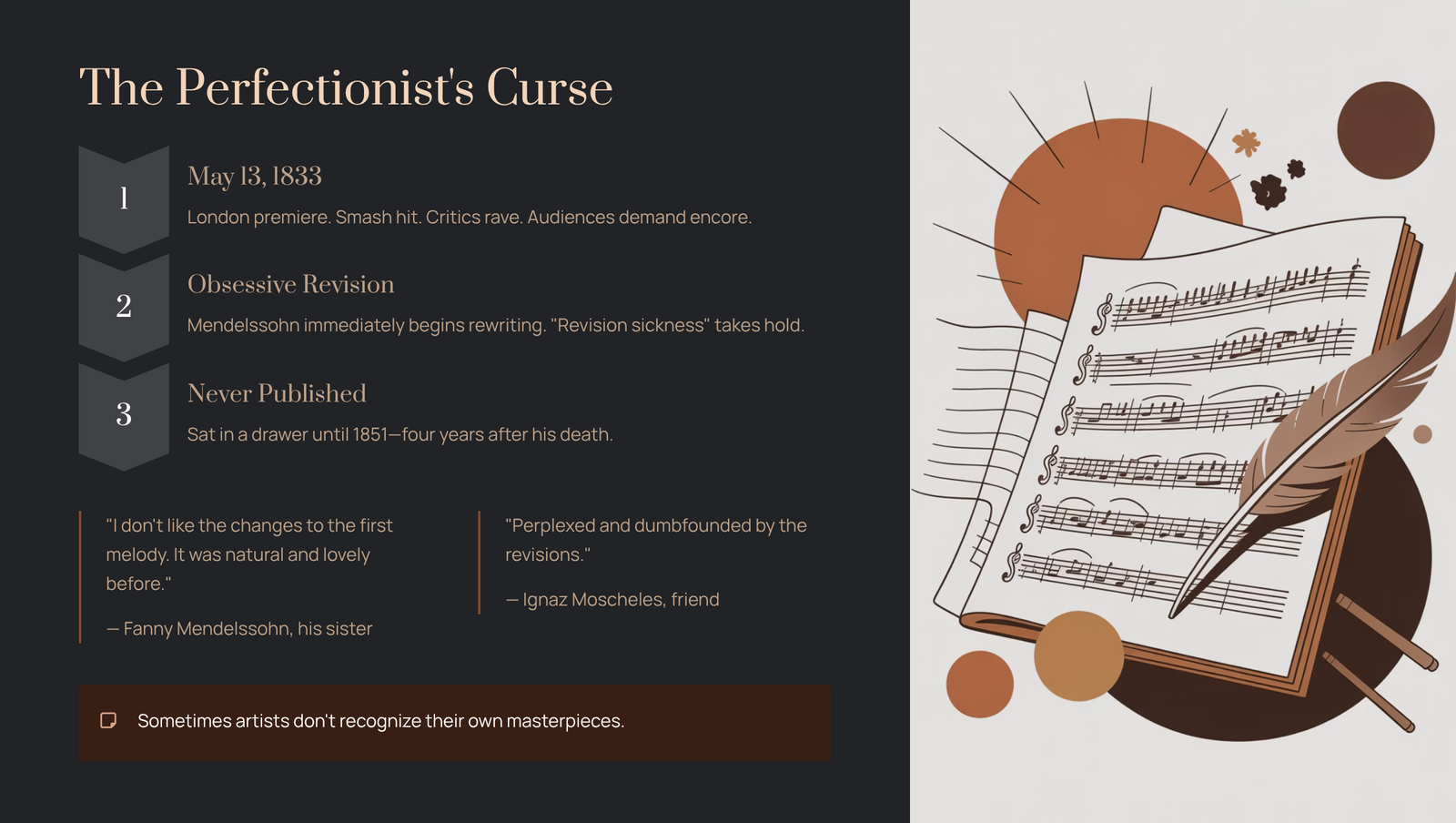
The Perfectionist’s Curse
Here’s where the story gets strange.
The symphony premiered in London on May 13, 1833, with Mendelssohn himself conducting. It was a smash hit. Critics raved. Audiences demanded an encore performance. By any measure, it was a triumph.
But Mendelssohn wasn’t satisfied.
Almost immediately after the premiere, he began obsessively revising the piece. He rewrote the second, third, and fourth movements extensively. He even admitted the first movement—the very movement that had audiences cheering—was something he “couldn’t fix.”
His sister Fanny pushed back: “I don’t like the changes to the first melody. It was natural and lovely before.” His friend Ignaz Moscheles was “perplexed and dumbfounded” by the revisions.
Mendelssohn didn’t listen. He kept revising. And revising. He called it his “revision sickness.”
The result? He never published the symphony during his lifetime. This gorgeous, universally beloved work sat in a drawer because its creator couldn’t accept its perfection.
It was only published in 1851, four years after Mendelssohn’s death. The version we hear today is the original 1833 score—the “flawed” version the composer spent years trying to replace.
Sometimes artists don’t recognize their own masterpieces.
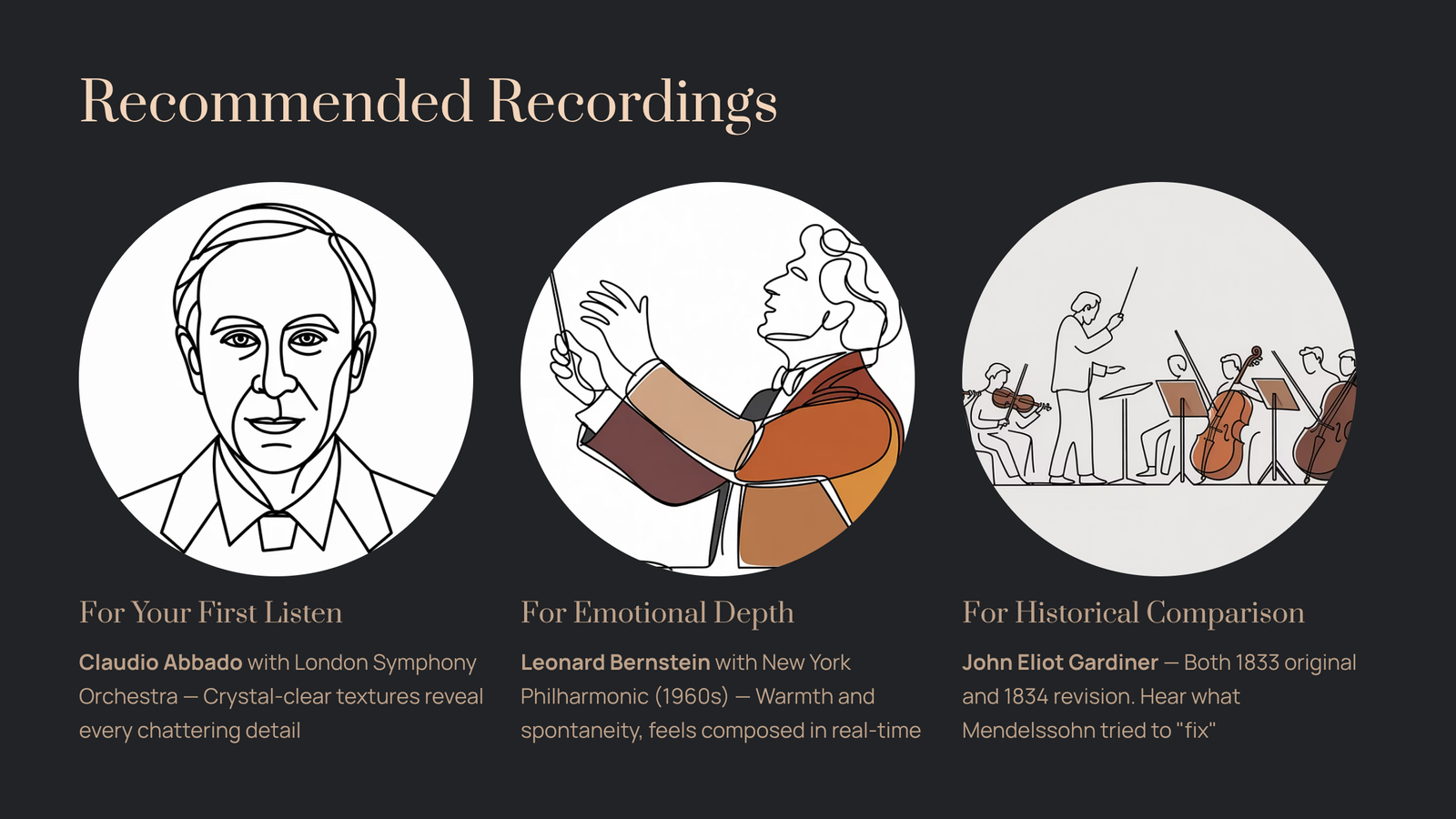
Recommended Recordings
For Your First Listen:
Claudio Abbado with the London Symphony Orchestra offers crystal-clear textures that let you hear every “chattering” detail. Perfect for following along with the guide above.
For Emotional Depth:
Leonard Bernstein’s 1960s recording with the New York Philharmonic brings a warmth and personal touch that makes the music feel spontaneous, like it’s being composed in real-time.
For Historical Comparison:
John Eliot Gardiner recorded both the original 1833 version and Mendelssohn’s 1834 revision. Listening to both is fascinating—you can hear exactly what the composer was trying to “fix” and decide for yourself whether it needed fixing at all.
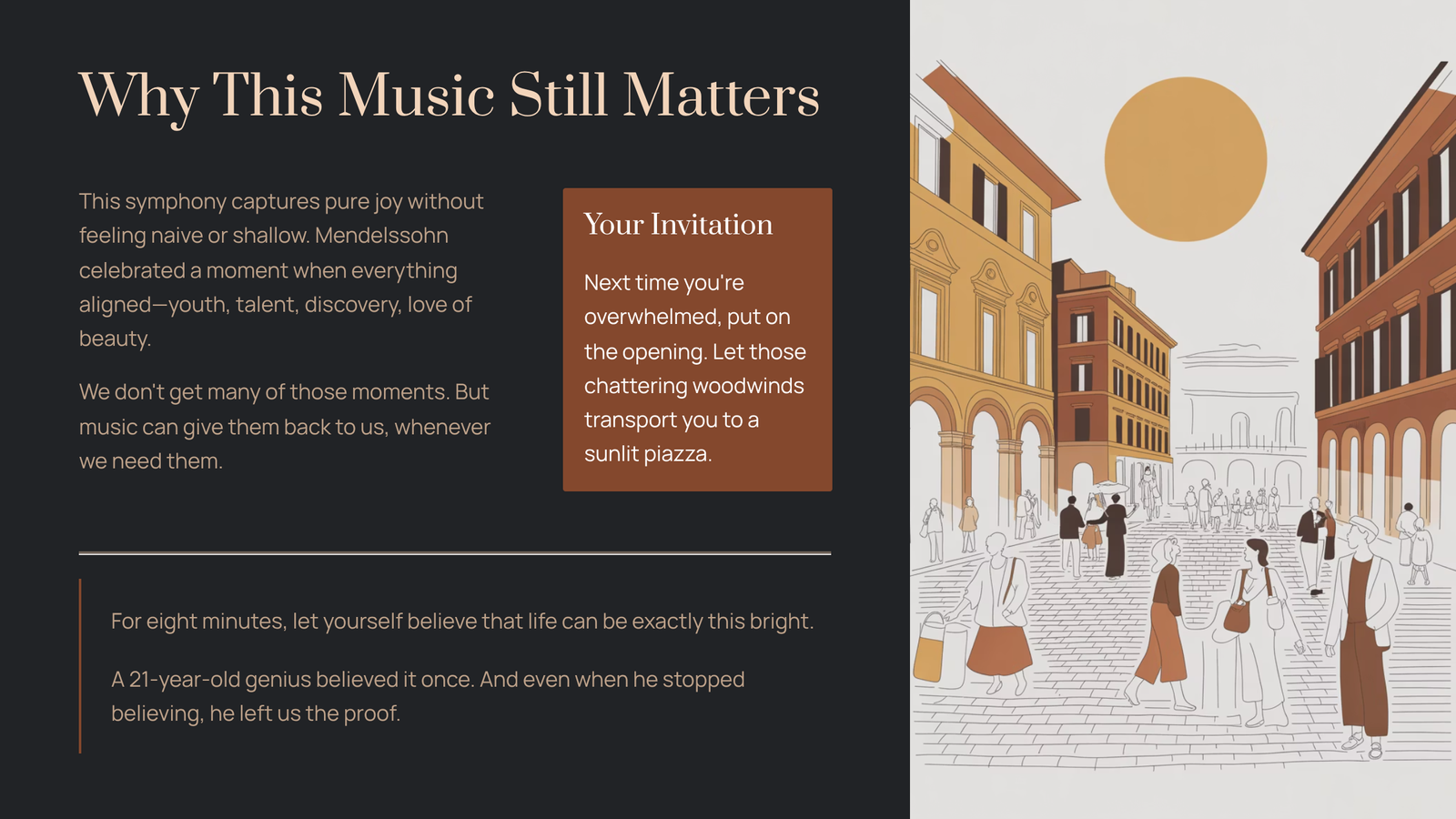
Why This Music Still Matters
There’s something almost magical about how this symphony captures pure joy without ever feeling naive or shallow. Mendelssohn wasn’t ignoring life’s difficulties. He was celebrating a moment when everything aligned—youth, talent, discovery, love of beauty.
We don’t get many of those moments. But music can give them back to us, whenever we need them.
The next time you’re feeling heavy, overwhelmed, or stuck in gray routine, try this: put on the opening of Mendelssohn’s Italian Symphony. Let those chattering woodwinds and soaring violins transport you to a sunlit Roman piazza.
For eight minutes, let yourself believe that life can be exactly this bright.
After all, a 21-year-old genius believed it once. And even when he stopped believing, he left us the proof.