📑 Table of Contents

Here is a strange and beautiful fact about art: sometimes, the things that fail the hardest leave the deepest mark.
In the summer of 1999, Warner Bros. released an animated film called The Iron Giant. It earned roughly $31 million against a $50 million budget. By Hollywood’s ruthless arithmetic, it was a disaster. Theaters emptied. Marketing had barely tried. The film sank without a trace — or so it seemed.
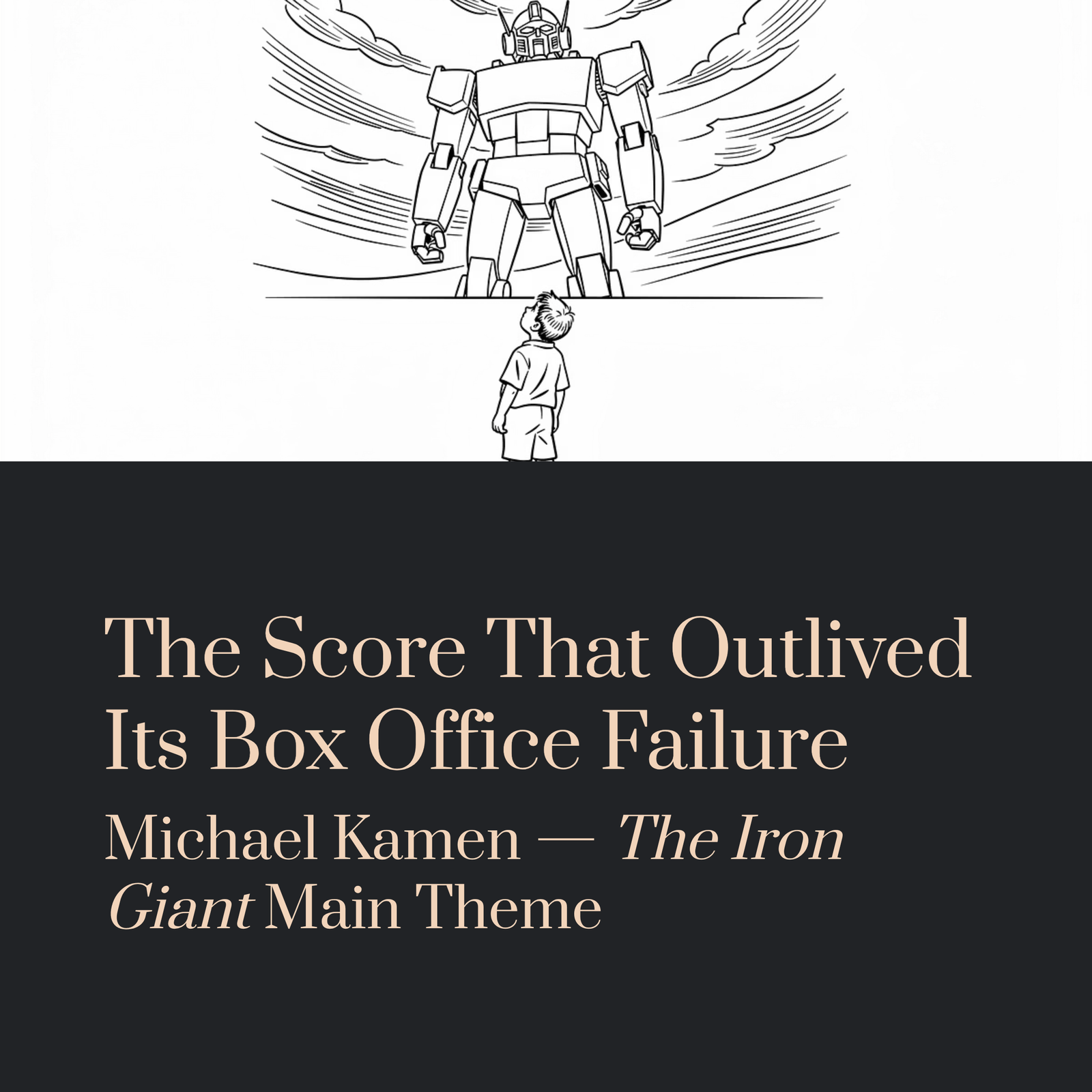
And yet, if you mention The Iron Giant to anyone who has actually seen it, something remarkable happens. Their eyes soften. Their voice drops. They might even say, quietly, that a scene near the end made them cry harder than almost anything else in cinema. Not a Pixar film. Not a Miyazaki masterpiece. A forgotten Warner Bros. cartoon about a boy and a robot in Cold War Maine.
At the heart of that emotional devastation is a score by Michael Kamen — a composer who understood, better than most, that the truest heroism lives not in spectacle but in sacrifice.
Michael Kamen: The Man Who Made Orchestras Rock
To understand why The Iron Giant sounds the way it does, you need to understand the man who wrote it.
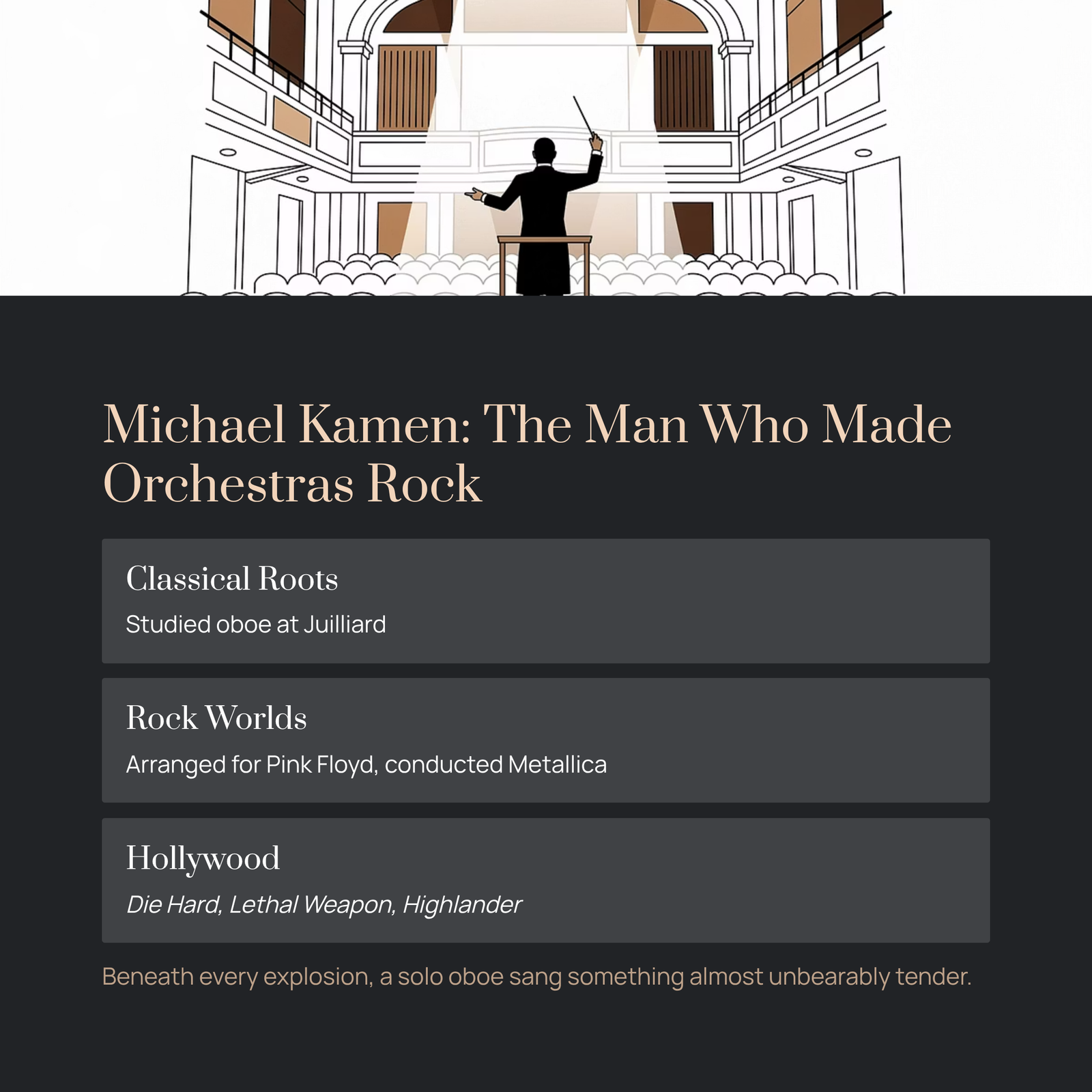
Michael Kamen was born in New York City in 1948, and his life was a continuous act of bridge-building between worlds that weren’t supposed to mix. He studied oboe at Juilliard, one of the most rigorous classical conservatories on earth. Then he turned around and formed a rock band. He arranged orchestral parts for Pink Floyd’s The Wall, conducted strings behind Metallica at sold-out arenas, and co-wrote “(Everything I Do) I Do It for You” with Bryan Adams — a ballad that topped charts worldwide in 1991.
In Hollywood, Kamen became the go-to composer for action franchises. The Die Hard series, the Lethal Weapon films, Highlander — he scored them all with muscular, propulsive energy. But beneath the explosions and car chases, there was always something more tender happening in his music. Listen carefully to any Kamen action score and you will find moments of unexpected gentleness, passages where the brass retreats and a solo oboe — his first instrument, his oldest love — sings a melody so vulnerable it almost hurts.
That duality — power and fragility, spectacle and intimacy — is what made him the perfect composer for The Iron Giant.
Prague, One Week, and a Telephone Call from Brad Bird
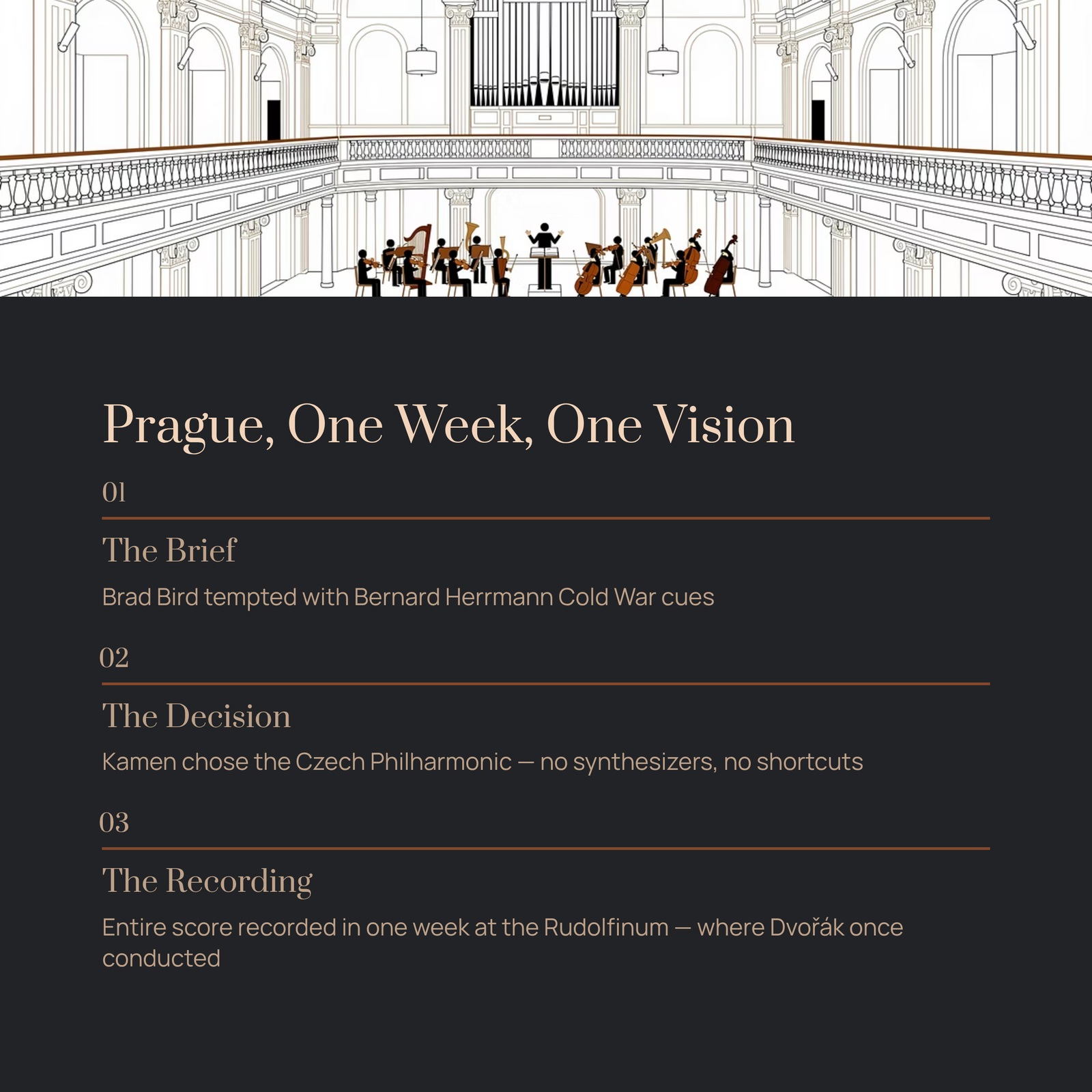
Director Brad Bird, making his feature debut, initially tempted the score with Bernard Herrmann cues from 1950s science fiction films. It was a bold temp track, rooted in the paranoid atmosphere of Cold War America. When Kamen heard it, he was reportedly intimidated — Herrmann is sacred ground for any film composer.
But Kamen had a vision. He believed the score should sound old-fashioned in the best sense: warm, acoustic, played by real human beings breathing together in a room. No synthesizers. No digital shortcuts. He traveled to Eastern Europe to find the right orchestra and eventually settled on the Czech Philharmonic, one of the world’s most storied ensembles. The recording took place at the Rudolfinum in Prague — a concert hall where Dvořák himself once stood on the podium.
What happened next was extraordinary. Kamen recorded the entire score in a single week, conducting the Czech Philharmonic without conventional sync methods. The musicians played the music as if it were concert repertoire, not a film score. That approach gave the recording a quality you can hear in every bar: organic breath, subtle rubato, the kind of collective musical intuition that no amount of studio technology can replicate.
Listening to the Main Theme: What to Hear and How to Hear It
The Main Theme of The Iron Giant does not announce itself with fanfare. There is no triumphant brass call, no sweeping violin statement of the kind you might expect from a story about a hundred-foot robot. Instead, Kamen begins with something close to a whisper.
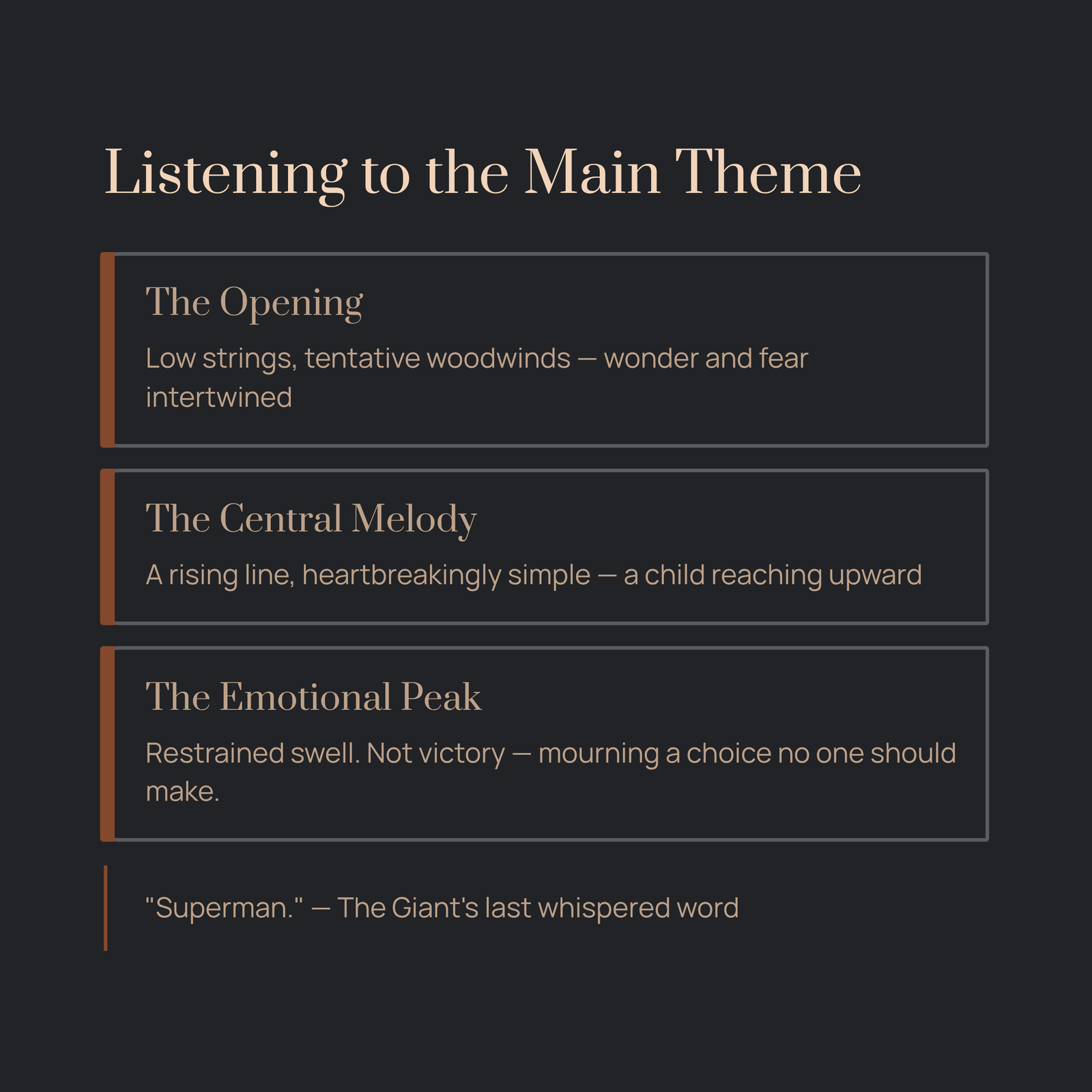
The Opening — Wonder and Fear Intertwined. The first sounds you hear evoke the vastness of space and the smallness of a child looking up at something he cannot understand. Low strings create a bed of harmonic uncertainty. Woodwinds enter tentatively, as though testing whether it is safe to speak. There is wonder here, but also apprehension — the same mix of emotions a nine-year-old boy named Hogarth would feel standing before an alien machine in the Maine woods.
The Central Melody — Innocence Reaching Upward. When the main theme finally emerges, it is heartbreakingly simple. A rising melodic line, carried first by strings, then passed to the full orchestra. It does not try to be clever. It does not modulate into unexpected harmonic territory. It simply reaches upward, the way a child reaches for something just beyond his grasp. Kamen understood that the most powerful musical gestures are often the most elementary — a stepwise ascent, a held note, a moment of silence before resolution.
The Emotional Peak — Sacrifice Without Words. The theme builds toward a climax that Kamen structures like a slow exhale. The orchestra swells, but not in the way blockbuster scores typically swell. There is restraint here, a sense that the music is holding something back even at its loudest moment. If you know the film’s ending — the Giant’s whispered “Superman” as he flies toward a nuclear missile — you will understand why. The score is not celebrating victory. It is mourning a choice that no one should ever have to make, and honoring the soul brave enough to make it.
Why This Score Hits Differently
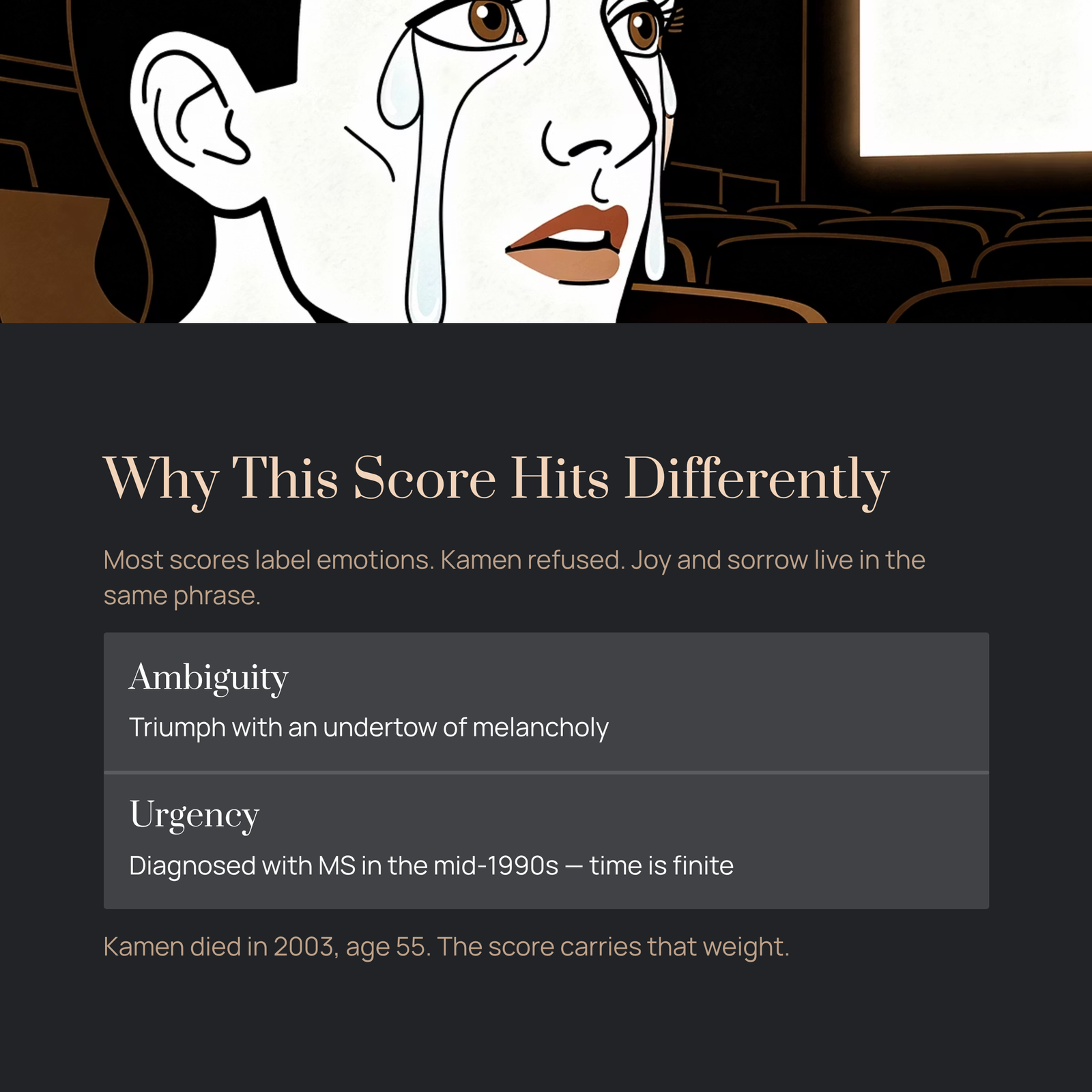
Most animated film scores traffic in clearly labeled emotions. Happy scenes get major keys. Sad scenes get minor keys. The audience is guided, comfortably and predictably, from one feeling to the next.
Kamen refused that approach entirely. What makes The Iron Giant score so devastating is its ambiguity. Joy and sorrow exist in the same phrase. A passage that sounds triumphant will suddenly reveal an undertow of melancholy. The music refuses to tell you how to feel — instead, it opens a space where multiple emotions can coexist, the way they do in real life when something beautiful and something terrible happen at the same time.
There is also something deeply personal in this score that goes beyond craft. In the mid-1990s, Kamen was diagnosed with multiple sclerosis, a progressive neurological disease that would eventually contribute to his death in 2003 at the age of 55. Knowing this, certain passages in The Iron Giant take on an almost unbearable poignancy. The theme is not just about a robot learning what it means to be alive. It is about a composer who understood, with increasing urgency, that time is finite — and that the question of how we choose to spend it is the only question that matters.
How to Listen: A Personal Guide
If you are coming to this score for the first time, here are a few suggestions.
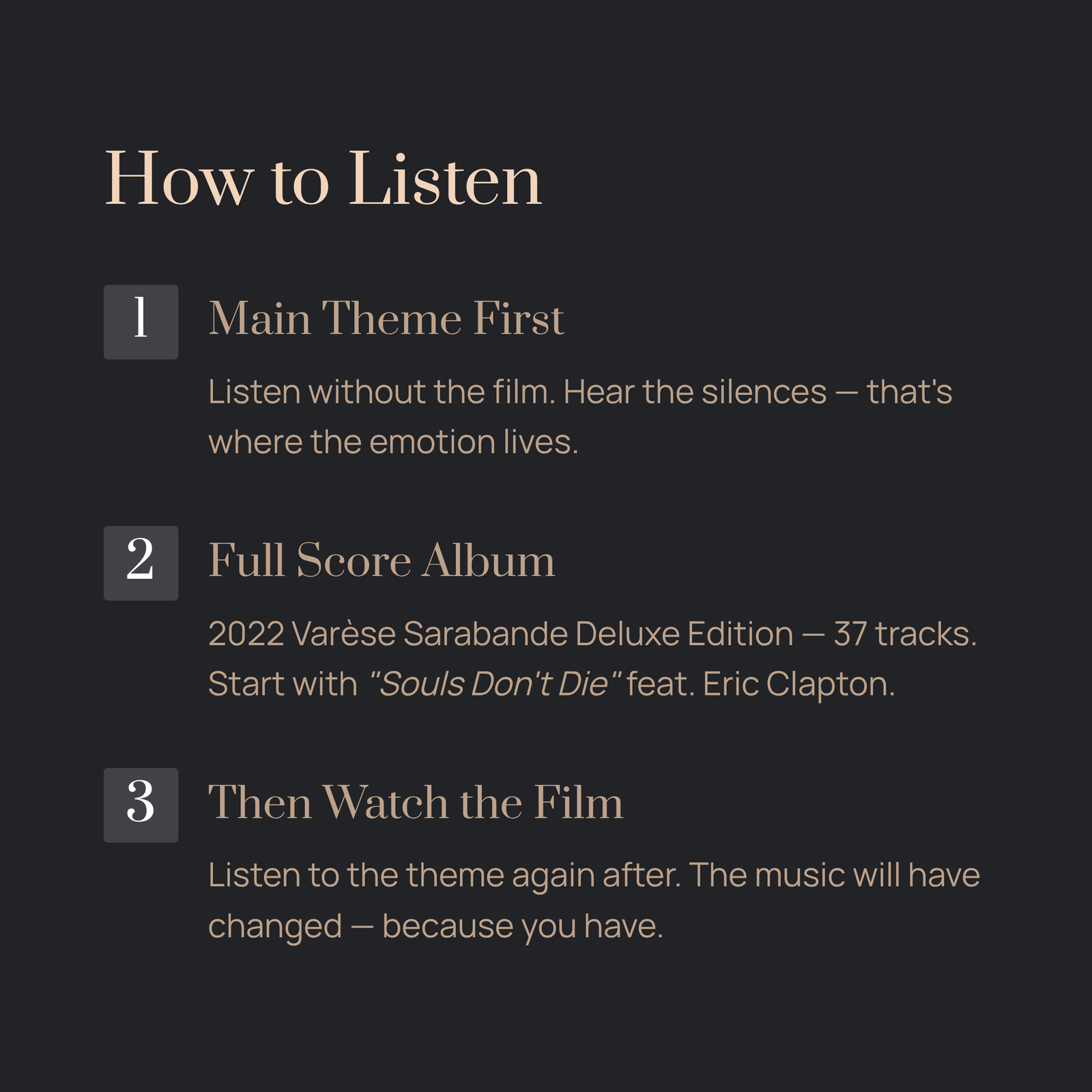
First, listen to the Main Theme on its own, without watching the film. Let the music exist as pure sound. Pay attention to how Kamen uses silence — the pauses between phrases, the moments where the orchestra breathes. Those silences are not empty. They are where the emotion lives.
Second, listen to the full score album, ideally the 2022 Deluxe Edition released by Varèse Sarabande, which includes 37 tracks and previously unreleased material. Pay particular attention to “Souls Don’t Die,” a track that features Kamen himself alongside Eric Clapton. It is the emotional thesis statement of the entire score, distilled into a single piece.
Third, watch the film. Watch the ending. Then listen to the Main Theme one more time. You will hear things you did not hear before. The music will have changed — not because the notes are different, but because you are.
For those who want to go deeper, the Czech Philharmonic’s performance brings a warmth and depth that rewards repeated listening. Their string section, in particular, has a dark, burnished quality that gives the score its distinctive emotional weight. Compare it to a typical Hollywood studio recording and you will immediately understand why Kamen traveled to Prague.
The Giant Stays
Michael Kamen died on November 18, 2003, in London. He was 55 years old. At the time of his death, he was still composing, still conducting, still building bridges between musical worlds that others kept separate.
The Iron Giant, the film that failed at the box office, has since become one of the most beloved animated films ever made. It holds a 96% score on Rotten Tomatoes. Its Blu-ray Signature Edition, released in 2015, introduced it to a new generation. And its score — recorded in a week, in a Prague concert hall, by musicians playing as though their lives depended on it — continues to do what all great music does: it finds you exactly where you are and takes you somewhere you did not know you needed to go.
There is a line in the film that has become something of a secular prayer for the people who love it: “You are who you choose to be.” Kamen’s score is the musical embodiment of that idea. It does not tell you what a giant robot is. It shows you what a giant robot chooses to become.
And in doing so, it asks you — gently, without judgment, in the language of strings and woodwinds and silence — what you might choose to become, too.