📑 Table of Contents
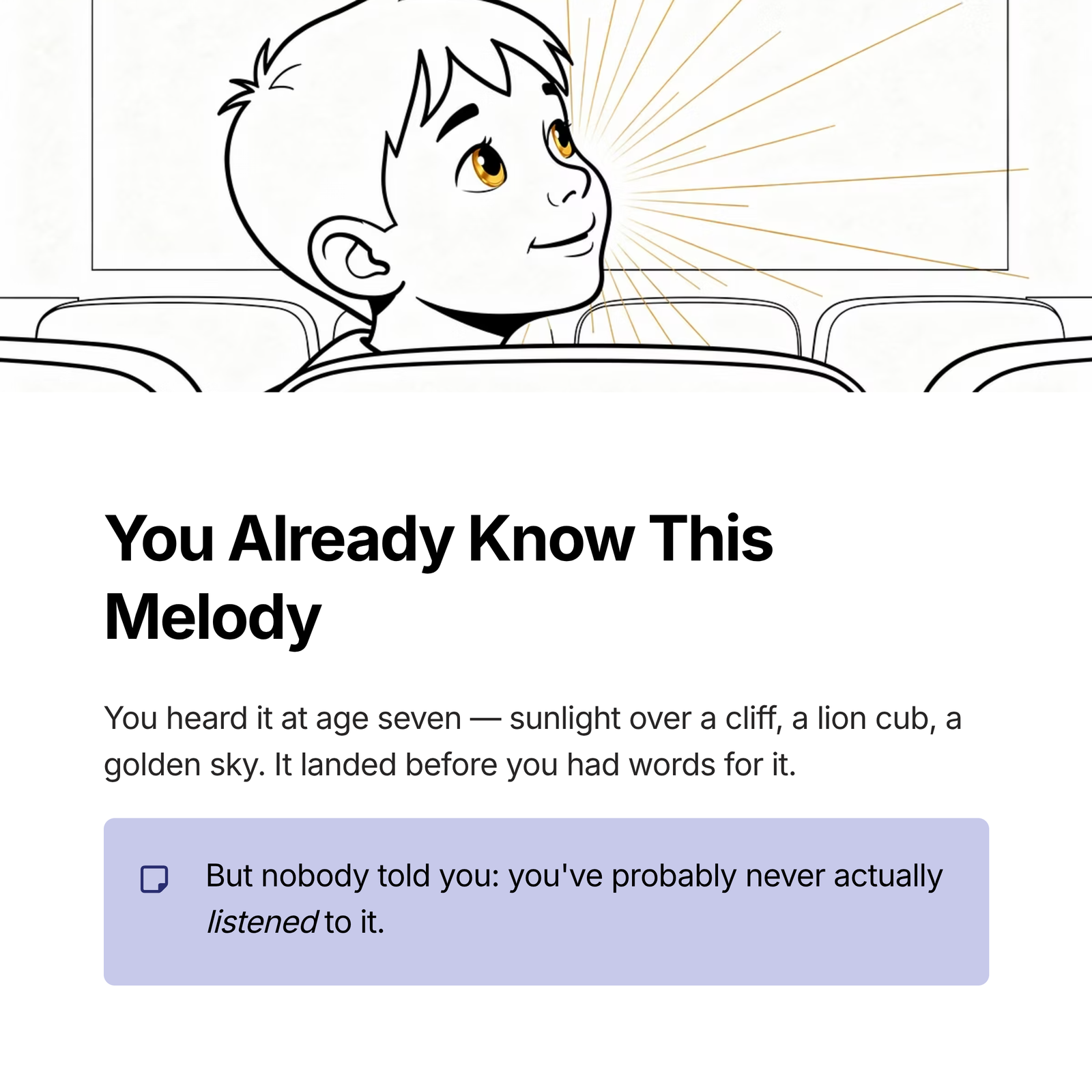
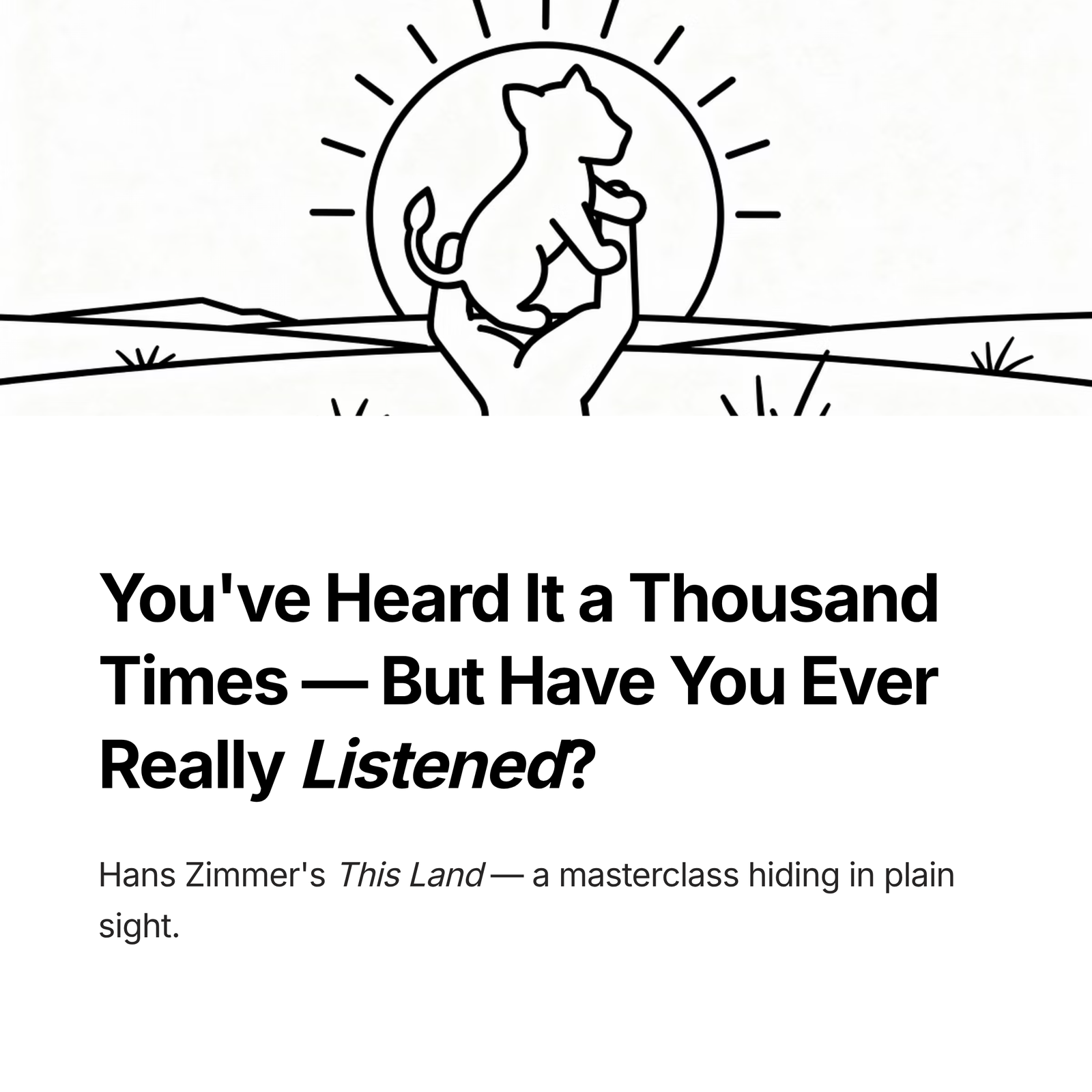
There’s a version of this piece you already know. You heard it at age seven, maybe eight — flickering across a movie screen, sunlight pouring over a cliff edge, a lion cub held up to a golden sky. The melody landed somewhere inside you before you had the vocabulary to describe what it was doing.
But here’s the thing nobody tells you about This Land: you’ve probably never actually listened to it.
The Composer Who Refused to Write “Movie Music”
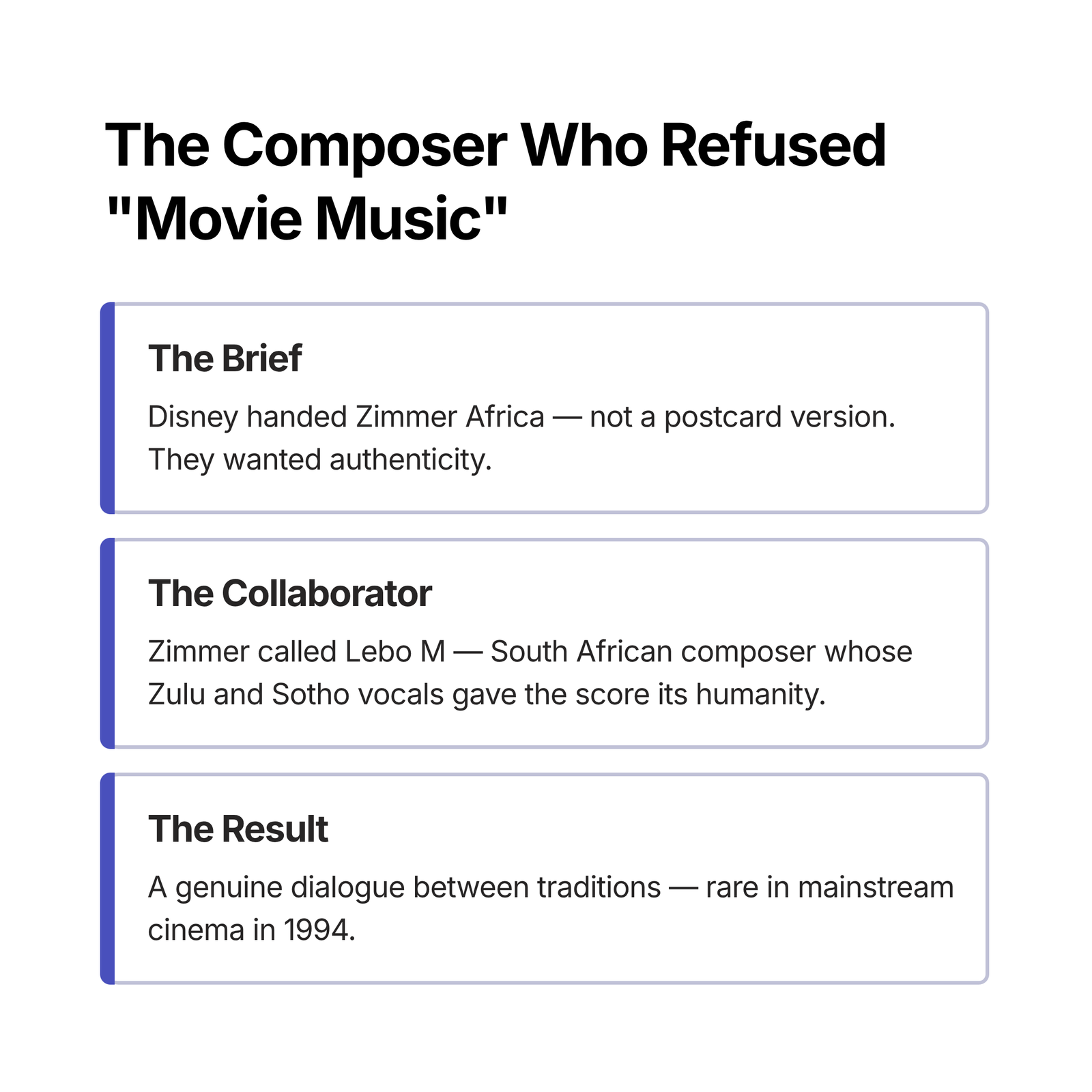
Hans Zimmer is, by any reasonable measure, the most influential film composer alive. His credits span Gladiator, Inception, Interstellar, Dune — a catalog that reads like a syllabus for the modern cinematic imagination. But in 1994, when Disney handed him The Lion King, Zimmer was handed something more complicated than a brief: he was handed Africa.
Not a postcard version of Africa. Not drums and a vague sense of otherness. Disney specifically wanted authenticity, and Zimmer — who had grown up in Germany and built his career in London and Los Angeles — was wise enough to know the limits of his own cultural knowledge.
So he called Lebo M.
The South African composer and vocalist became Zimmer’s essential collaborator on the project, contributing the Zulu and Sotho vocal textures that give the score its unmistakable humanity. What you hear in This Land is not one composer’s imagination of a continent — it’s a genuine dialogue between traditions, recorded at a moment when that kind of collaboration was still genuinely uncommon in mainstream cinema.
What Is This Land, Exactly?
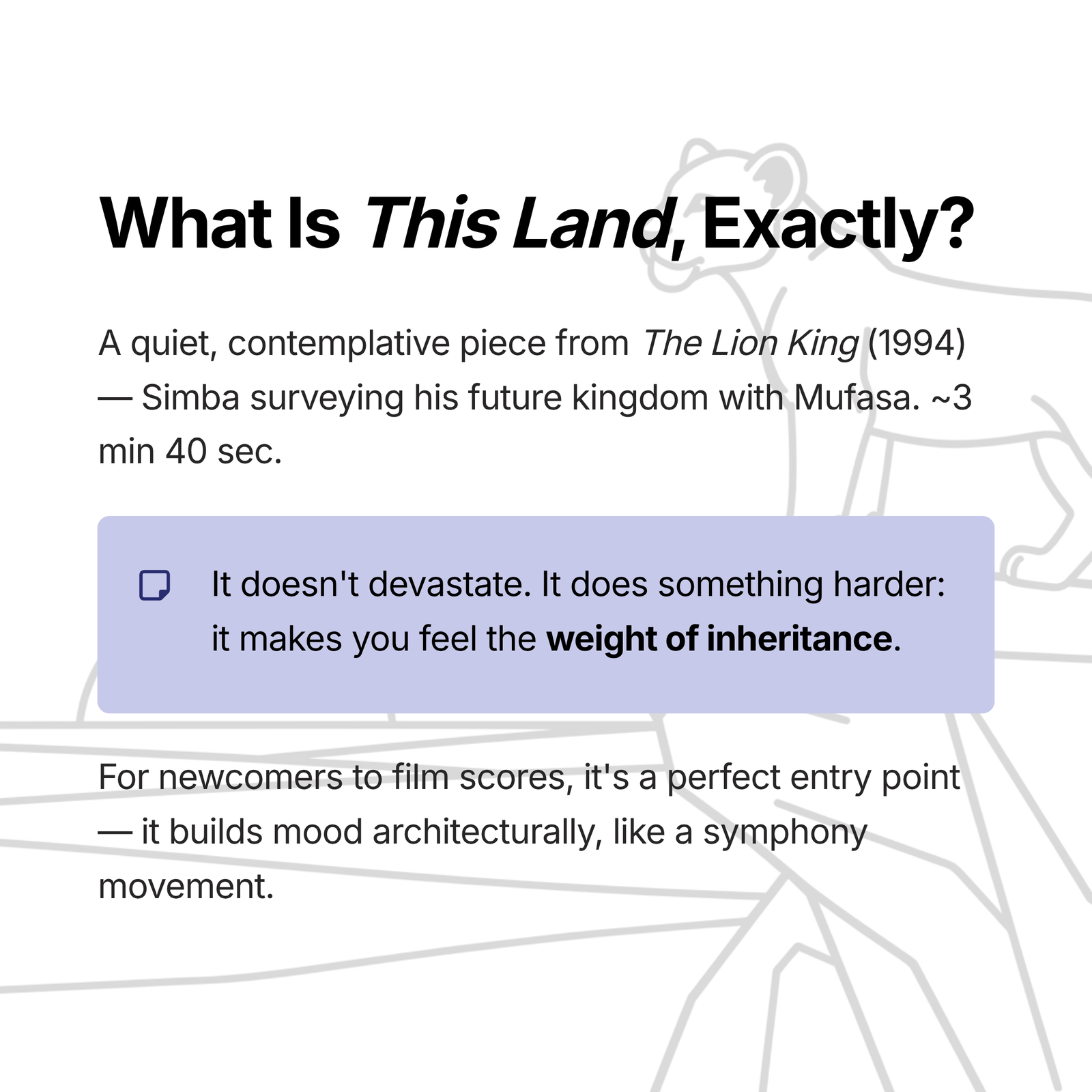
Released as part of the 1994 animated film The Lion King, This Land appears during one of the film’s quieter, more contemplative sequences — Simba’s early morning survey of his future kingdom, accompanied by his father Mufasa. It’s not the film’s action centerpiece. It doesn’t carry the emotional devastation of the scenes that follow. Instead, it does something subtler and arguably more difficult: it makes you feel the weight of inheritance.
The piece runs approximately three minutes and forty seconds in its original film version. On the official soundtrack album — produced by Zimmer and released by Walt Disney Records — it sits among the film’s purely orchestral tracks, distinct from the Elton John/Tim Rice songs that anchored the film’s commercial release.
For classical music newcomers, this is actually an ideal entry point into understanding how film scores work. This Land doesn’t rely on narrative shorthand. It builds a mood architecturally, the way a symphony movement does, through repetition, variation, and the slow accumulation of orchestral color.
A Listening Guide: Three Layers to Discover
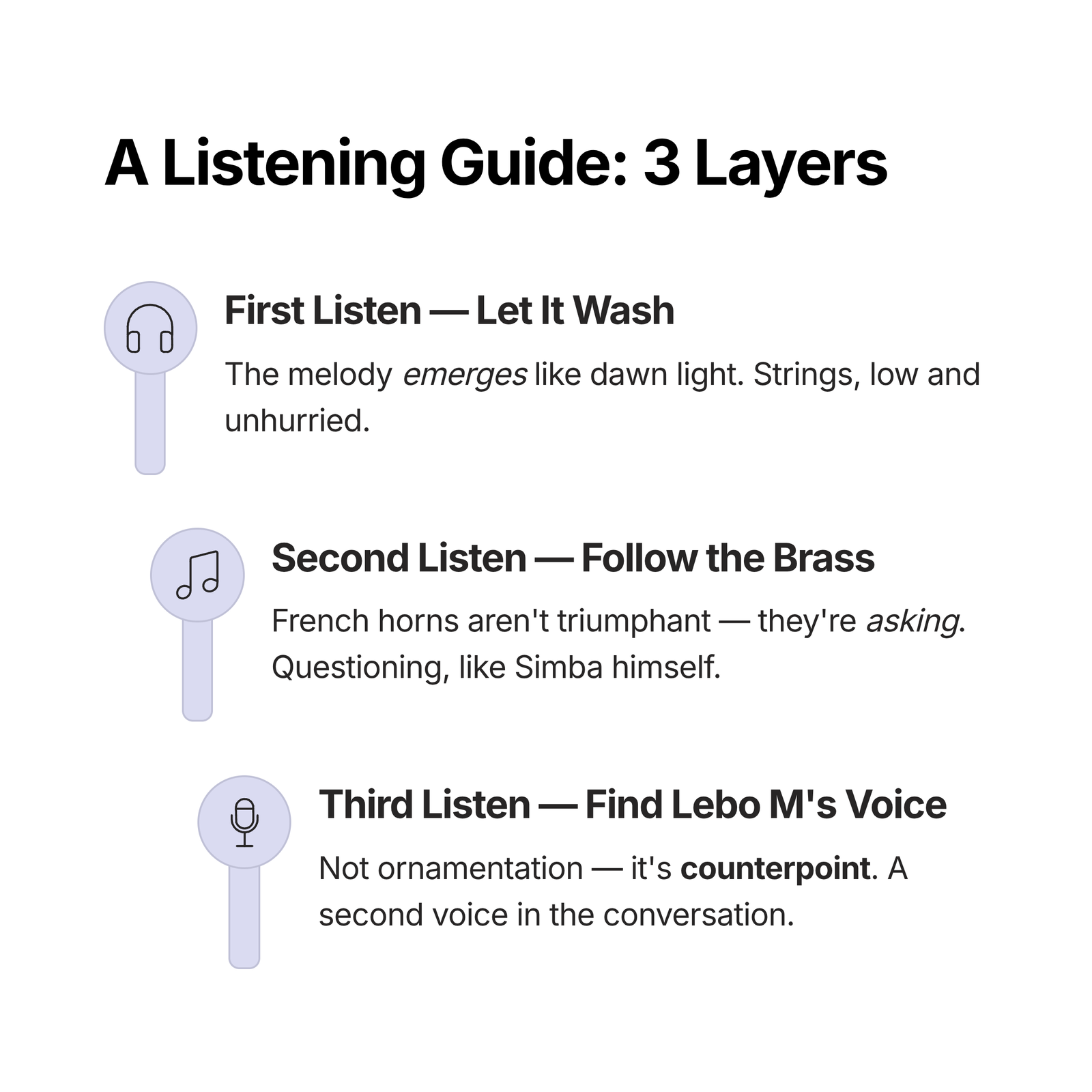
First listen — let it wash over you. Don’t analyze. Just notice that the opening feels like waking up. There’s a deliberate quality to how Zimmer introduces the melody — it doesn’t arrive fully formed, it emerges, the way light does at dawn. The strings carry most of the early weight, low and unhurried.
Second listen — follow the brass. The French horns in particular do something remarkable in the middle section of the piece. They’re not announcing or triumphant, the way brass tends to be in lesser film scores. They’re asking. There’s a questioning quality to the phrasing that mirrors what the visual sequence is doing: a young animal looking out over land he doesn’t yet understand and isn’t sure he deserves.
Third listen — find Lebo M’s voice. The vocal element that surfaces in this track — and more prominently throughout the broader score — carries a melodic logic entirely different from the European orchestral tradition surrounding it. It’s not ornamentation. It’s counterpoint. It’s another voice in the conversation, and once you hear it as structurally integral rather than atmospheric texture, the whole piece reorganizes itself.
The Harmonic Architecture of a Kingdom
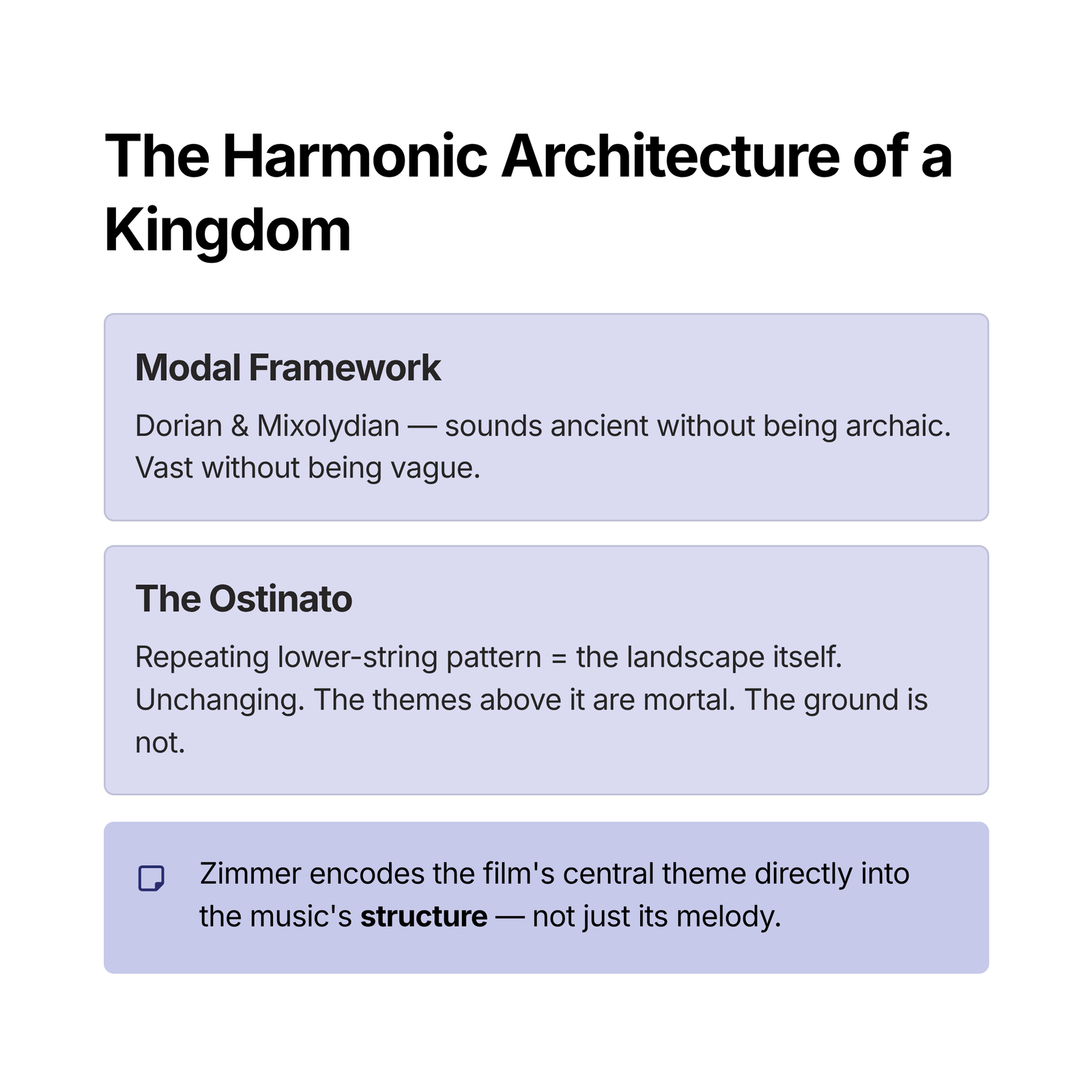
For listeners with some musical background, here’s what Zimmer is doing harmonically that makes This Land so durable. The piece is built around a modal framework — it leans into Dorian and Mixolydian colors rather than straight major/minor, which gives it a kind of ancient, untethered quality. It sounds old without being archaic. It feels vast without being vague.
The ostinato pattern — a repeating rhythmic and melodic figure in the lower strings and percussion — functions as the landscape itself. It doesn’t change. The themes that move above it are transient, mortal, personal. The ground beneath them is not. This is not accidental. This is Zimmer encoding the film’s central theme — the relationship between the individual life and the permanent, impersonal world — directly into the music’s structure.
If you want to understand why This Land has persisted in cultural memory long after most 1990s film scores have faded, this is part of the answer. It’s not memorable because of one great melody. It’s memorable because its architecture holds.
Recommended Listening
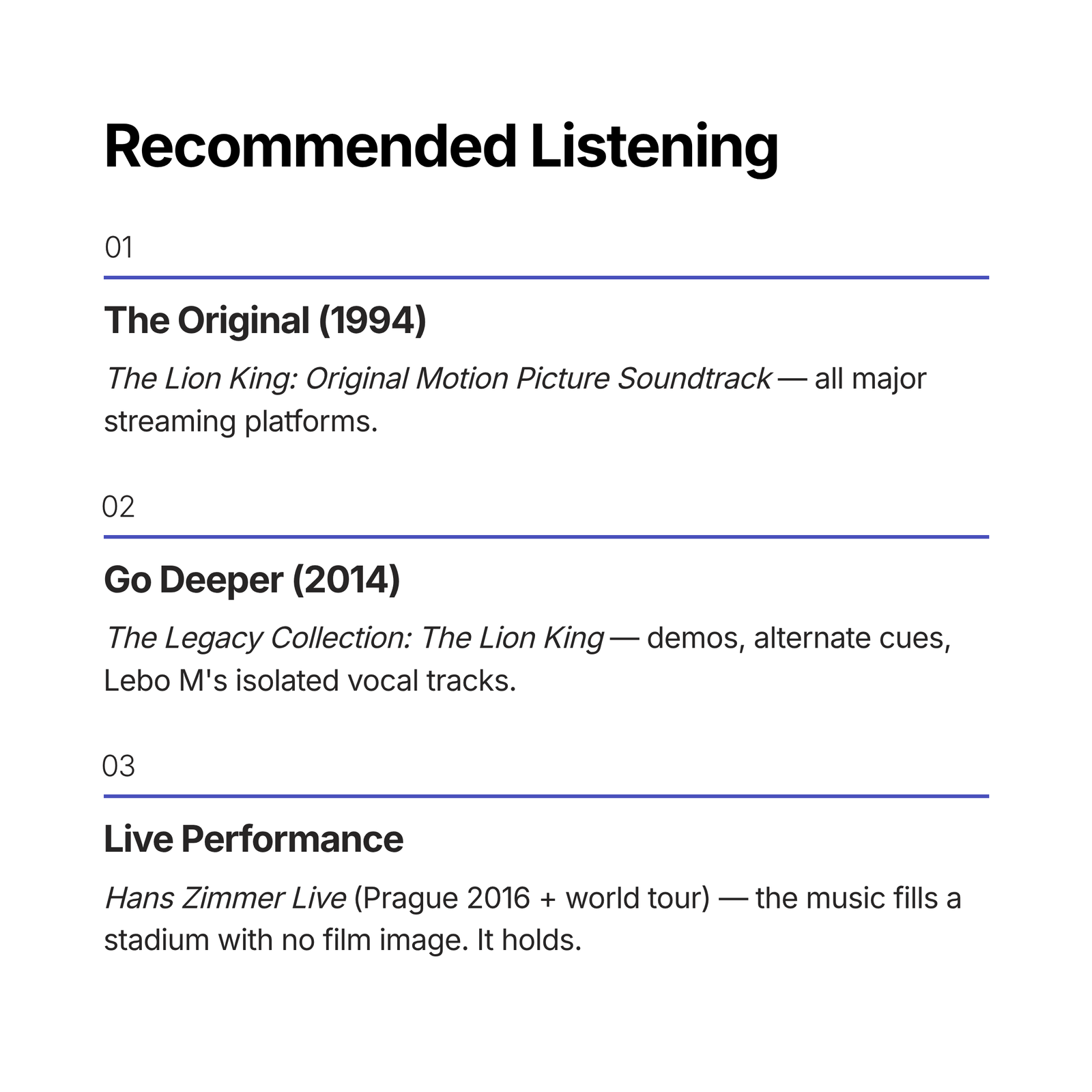
The definitive version is the original 1994 soundtrack recording. The Lion King: Original Motion Picture Soundtrack — available on all major streaming platforms — captures the film mixes as Zimmer intended them, before the 2019 remake introduced Jon Favreau’s more naturalistic reinterpretation (which, for all its technical accomplishment, strips something ineffable from the original’s unashamed grandeur).
If you want to go deeper, seek out The Legacy Collection: The Lion King (2014), Disney’s expanded archival release that includes demo recordings, alternate cues, and Lebo M’s standalone vocal tracks. Hearing those elements separated from the final mix is one of the better music education experiences available for free — or near-free — to anyone with a streaming subscription.
For a live performance version, the Hans Zimmer Live recordings (both the 2016 Prague concert and the subsequent world tour releases) include an extended medley from The Lion King that gives the themes room to breathe outside their film context. Hearing an orchestra fill a stadium with this material, with no film image to anchor it, is revelatory. The music holds. That’s not a given.
What This Piece Is Actually About
Here is something worth sitting with: This Land is not a piece about joy. It’s a piece about responsibility.
The sequence it accompanies in the film — Mufasa explaining to Simba what the kingdom is, who it belongs to, what its boundaries mean — is one of the few moments in popular cinema where inheritance is treated with genuine seriousness. The land doesn’t belong to the king. The king belongs to the land. That inversion, philosophically significant in ways that the film itself doesn’t fully unpack, is what Zimmer’s music is quietly insisting on throughout.
The melody never quite resolves into triumphalism. Every time it builds toward something that feels like arrival, it turns. It cycles back. It asks again.
This is what great instrumental music can do that narrative can’t always manage: it can hold a question open. This Land asks you what you’ve been given, what you owe in return, and whether you’re paying attention to the difference between the two.
You don’t need to be seven years old on a theater seat to feel it. You just need to put on headphones, press play, and this time — actually listen.