📑 Table of Contents
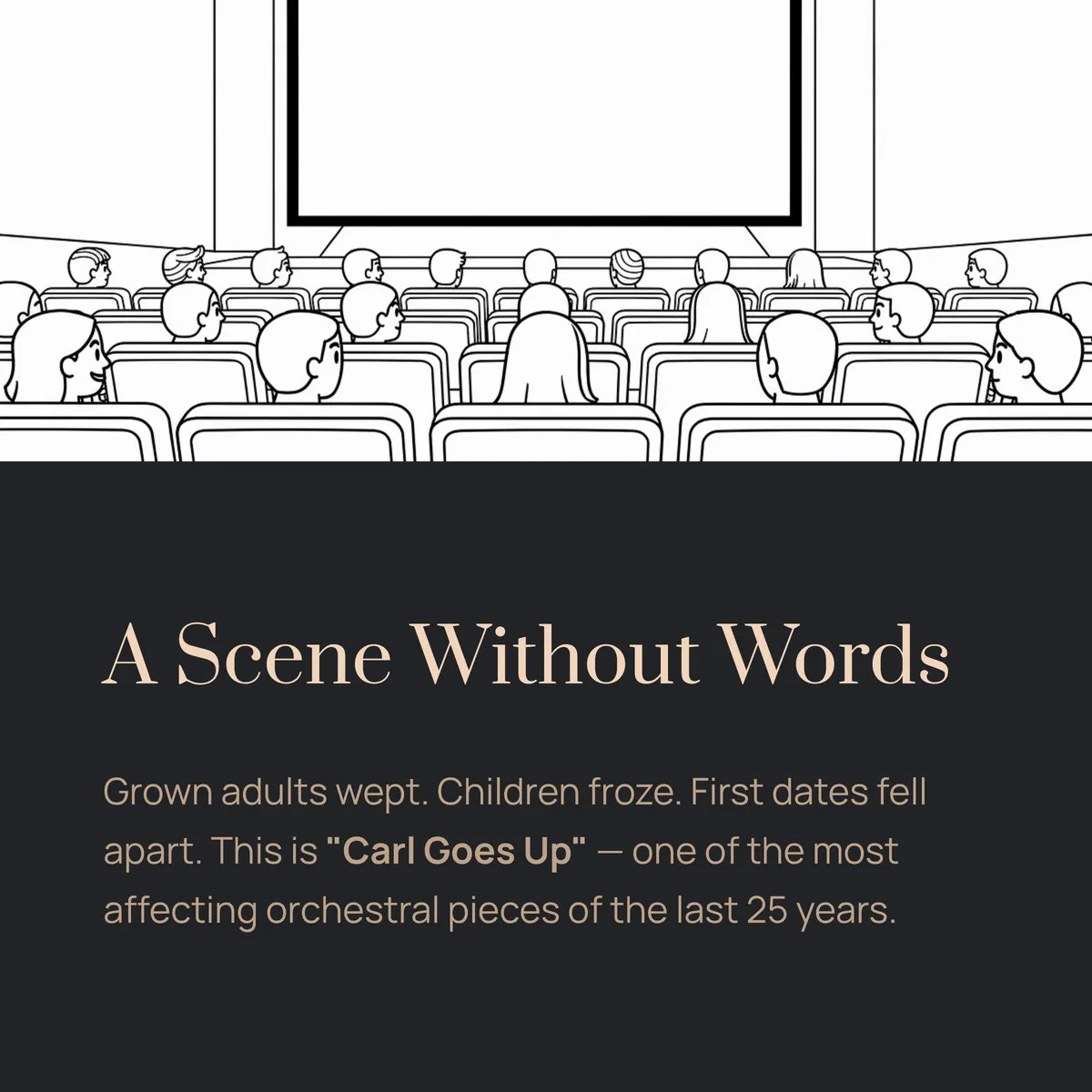
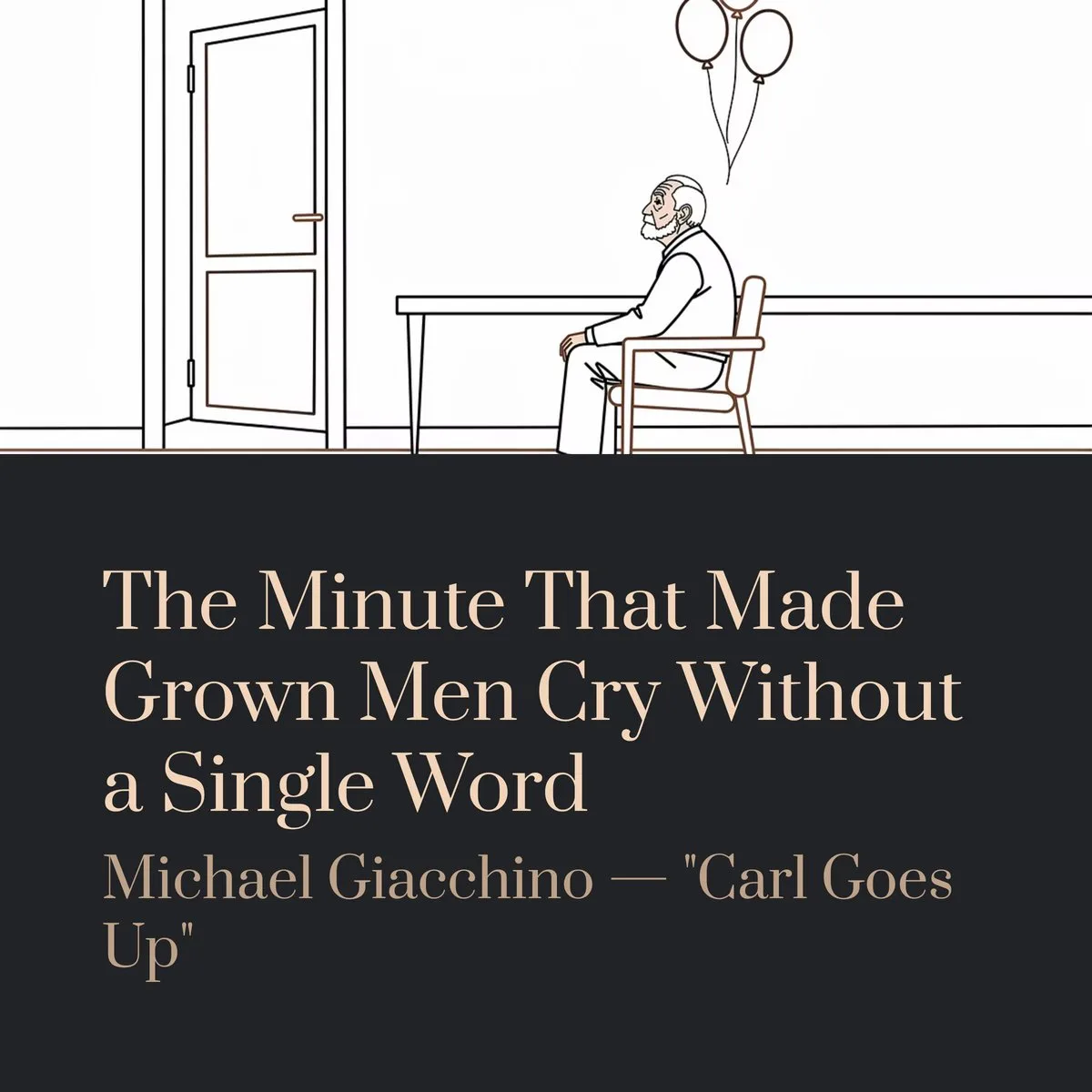
There’s a moment in the opening of Up — no dialogue, no exposition, just Giacchino’s music and a sequence of images — where audiences around the world sat in darkened theaters and wept. Grown adults. Children frozen in confused silence. First dates suddenly, awkwardly, undone.
If you’ve seen it, you know exactly what moment that is. And if you’ve only ever heard the music — divorced from the visuals, playing through headphones on a quiet evening — you may find it hits even harder.
This is “Carl Goes Up.” And it belongs in any conversation about the most affecting pieces of orchestral music written in the last twenty-five years.
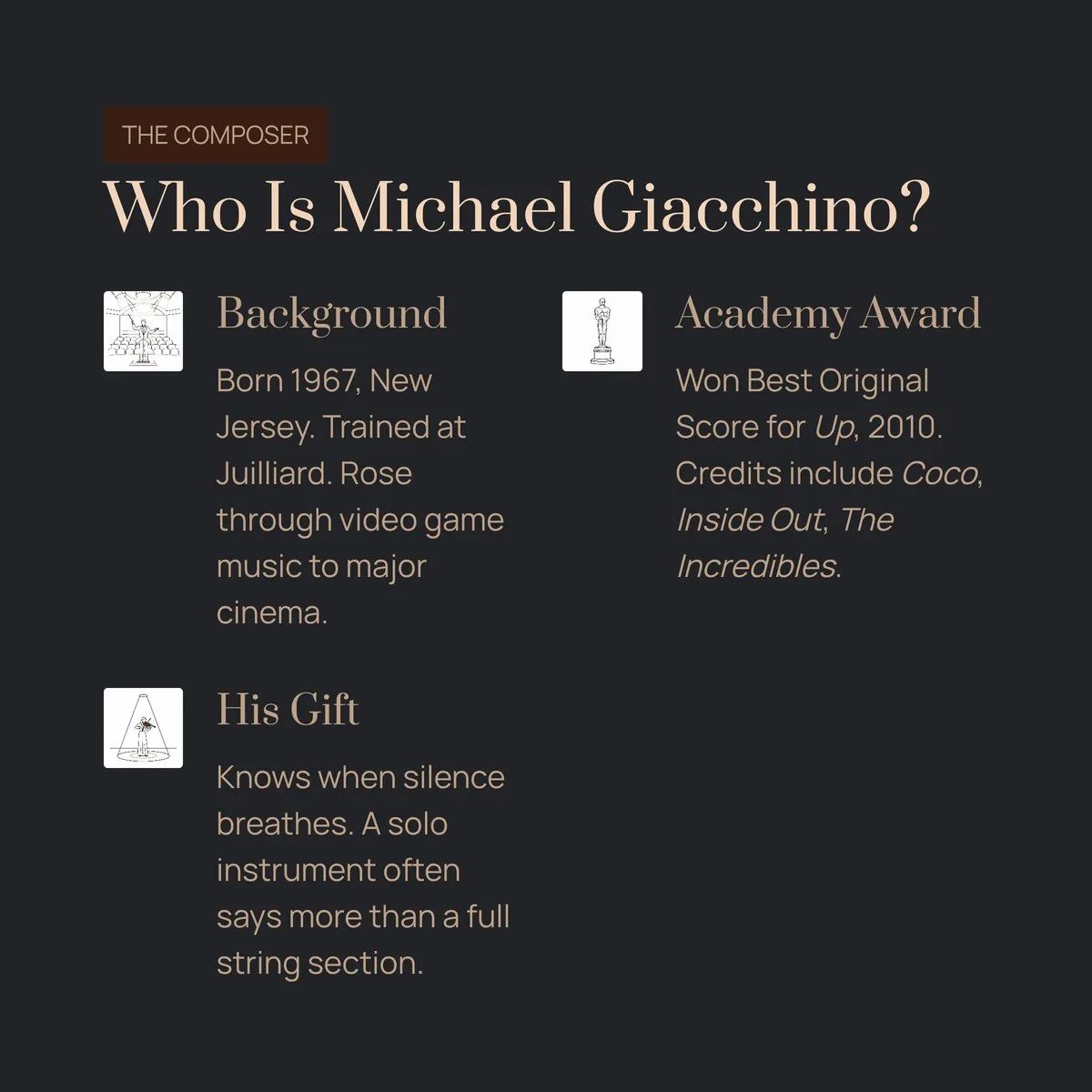
Who Is Michael Giacchino?
Michael Giacchino isn’t the kind of composer who gets discussed in the same breath as Brahms or Debussy — at least not yet. But give it time.
Born in 1967 in New Jersey, Giacchino came up through the world of video game music before landing film work with Brad Bird and J.J. Abrams. His credits read like a greatest-hits of modern cinema: The Incredibles, Ratatouille, Star Trek, Inside Out, Coco, Doctor Strange. He won the Academy Award for Best Original Score for Up in 2010.
What separates Giacchino from many of his contemporaries is a deep fluency in the emotional grammar of the classical orchestra. He studied at The Juilliard School and the School of Visual Arts, and it shows — not in technical showing-off, but in restraint. Giacchino knows when to let silence breathe. He knows when a solo instrument says more than a full string section.
In “Carl Goes Up,” every one of those instincts is on full display.
The Piece and Its Context
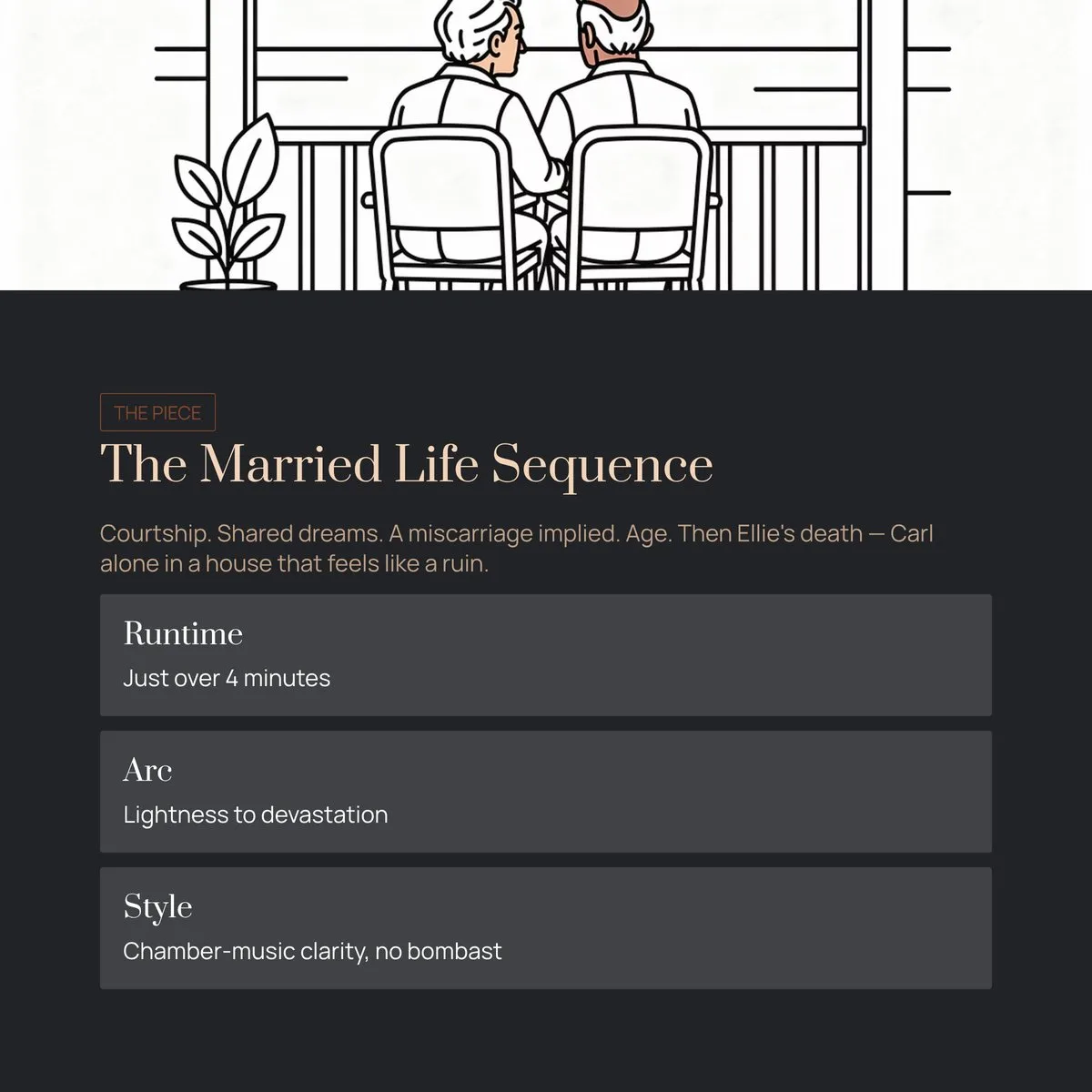
“Carl Goes Up” is the primary theme from the Married Life sequence — that infamous, wordless montage at the beginning of the film that walks us through the entire arc of Carl and Ellie’s life together: their courtship, their shared dreams, their small domestic joys, a miscarriage quietly implied, the slow dimming of adventure as age sets in, and then Ellie’s death, leaving Carl alone in a house that now feels like a ruin.
It is, by any measure, an astonishing piece of narrative filmmaking. But strip away the visuals, and the music still tells the whole story.
The piece runs just over four minutes. In that span, Giacchino achieves something that takes many composers entire symphonies to attempt: a complete emotional arc, from lightness to devastation, rendered with chamber-music clarity and almost no bombast.
What to Listen For
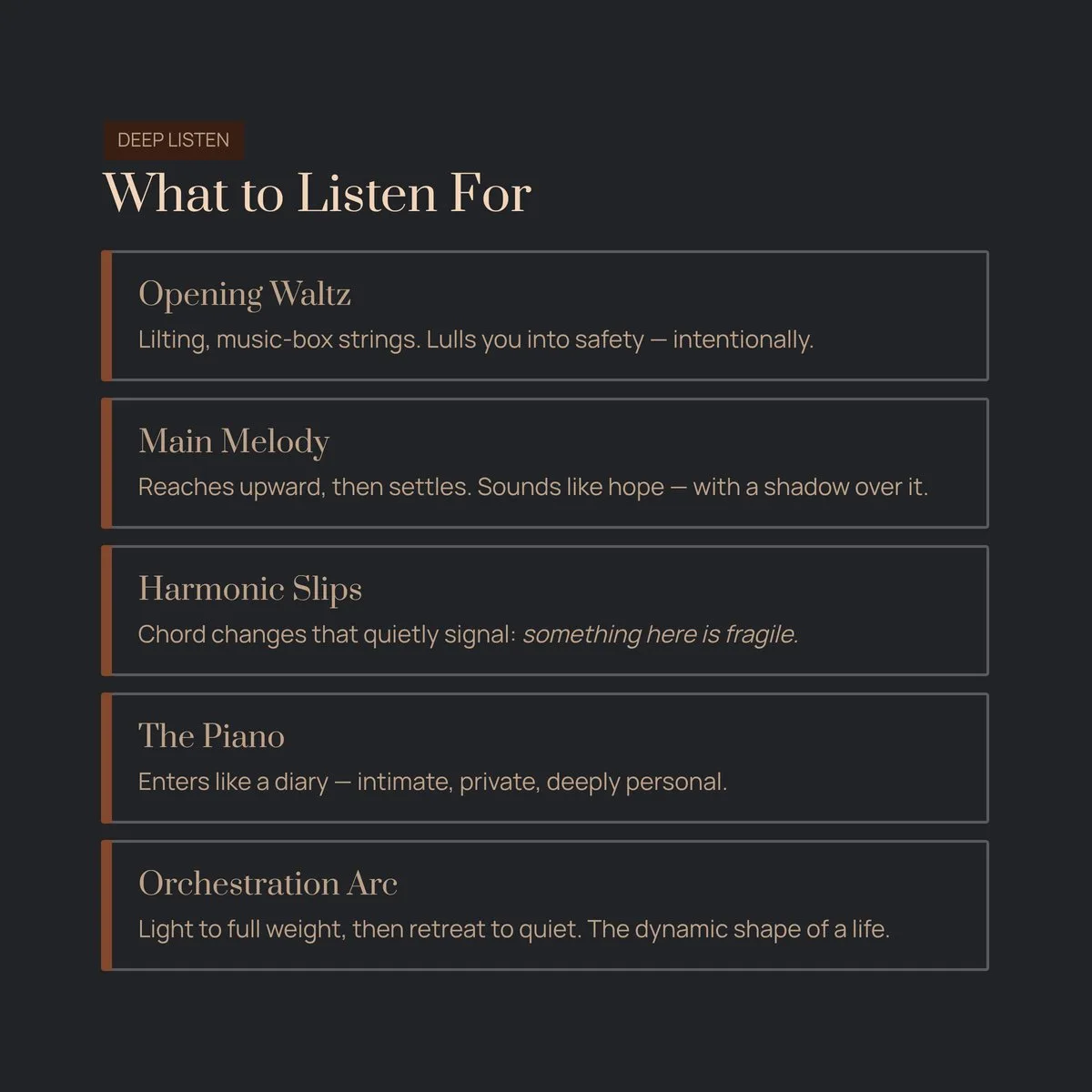
The opening waltz figure is deceptively simple — a lilting, playful theme in the strings that feels almost like a music box. It has the quality of something half-remembered, something from childhood. This is intentional. We are being invited in gently, lulled into a feeling of safety.
The main melody, when it arrives in the strings and then the woodwinds, has a quality that musicologists sometimes call yearning — it reaches upward and then settles, like a sigh. It resolves, but not quite completely. There’s always a slight sense of something just out of reach. That melodic shape is doing enormous emotional work: it sounds like hope, but hope with a slight shadow over it.
The harmonic language is tonal and accessible — this isn’t Schoenberg. But Giacchino is careful to use unexpected chord changes that introduce a sense of melancholy underneath what sounds, on the surface, like a happy tune. Listen for the moments where the harmony slips sideways rather than resolving cleanly. Those are the places where the music is quietly telling you something is fragile.
The orchestration shifts are worth tracking as the piece develops. Early on, the texture is light — solo instruments, chamber-sized forces. As the emotional stakes deepen, Giacchino thickens the texture. The moment of peak grief is carried not by volume alone, but by the full weight of the orchestra pressing down, followed — crucially — by a retreat back to quiet. The dynamic shape of the piece mirrors the shape of a life.
The piano enters at key moments as a kind of intimate voice, as though we’ve moved from a public space into something private. In the context of Carl and Ellie’s story, it functions almost like a diary.
Why This Piece Matters Beyond the Film
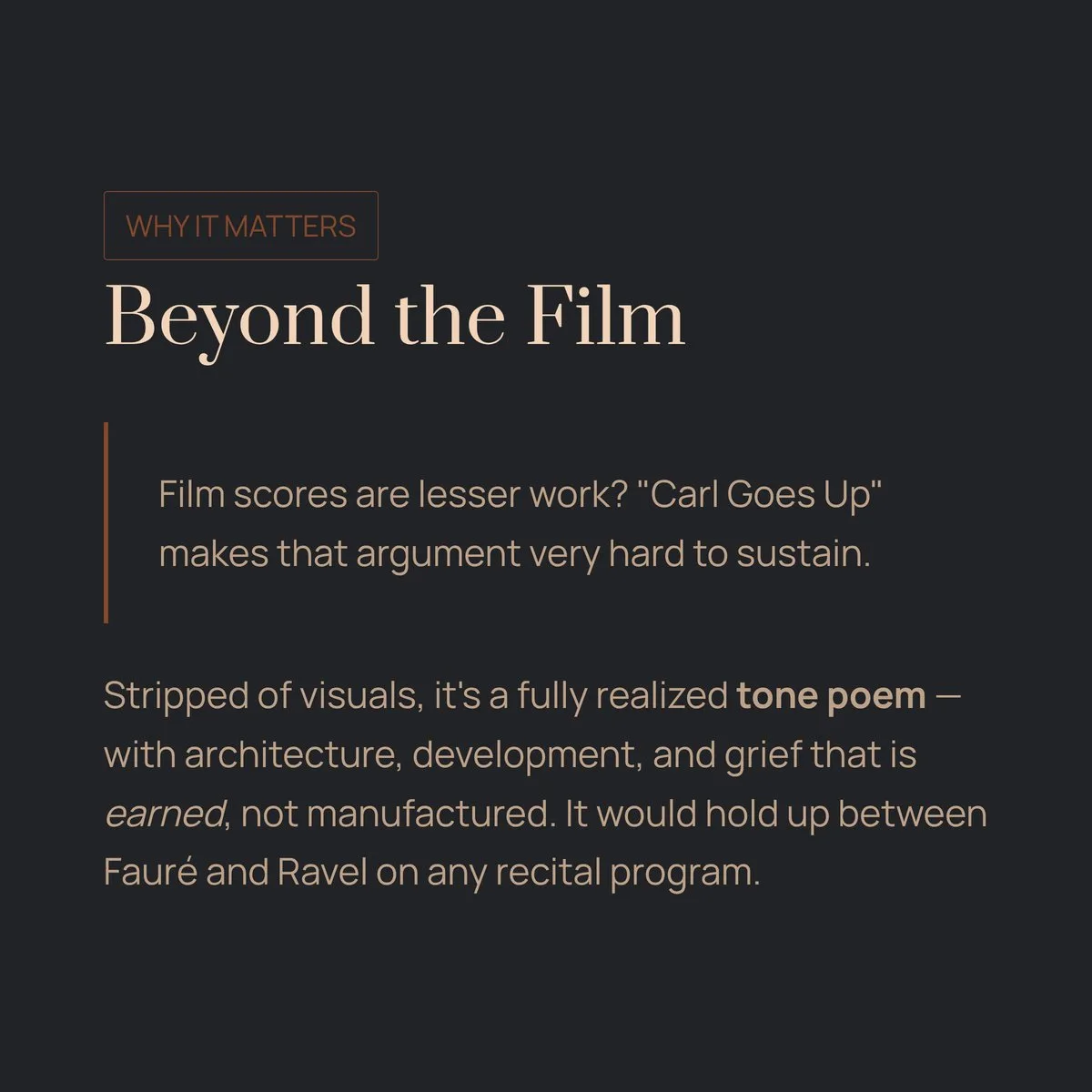
There’s a long-standing bias in classical music circles that film scores are lesser work — functional music, subordinate to image. “Carl Goes Up” is one of the pieces that makes that argument very hard to sustain.
Stripped of its visuals, this music functions as a fully realized miniature tone poem. It has architecture. It has development. It has something to say. The grief it expresses isn’t cheap or manipulative — it’s earned through careful structural logic, through a melodic idea that contains, from its very first phrase, the seed of its own loss.
Giacchino has said in interviews that he approaches scoring as if writing for the concert hall first, and only then adapting to the screen. “Carl Goes Up” bears that out. This is music that would hold up in a recital program between Fauré and Ravel, and not because it sounds like them — but because it demonstrates the same commitment to craft and the same understanding that in music, as in life, what is left unsaid is often what matters most.
Recommended Listening
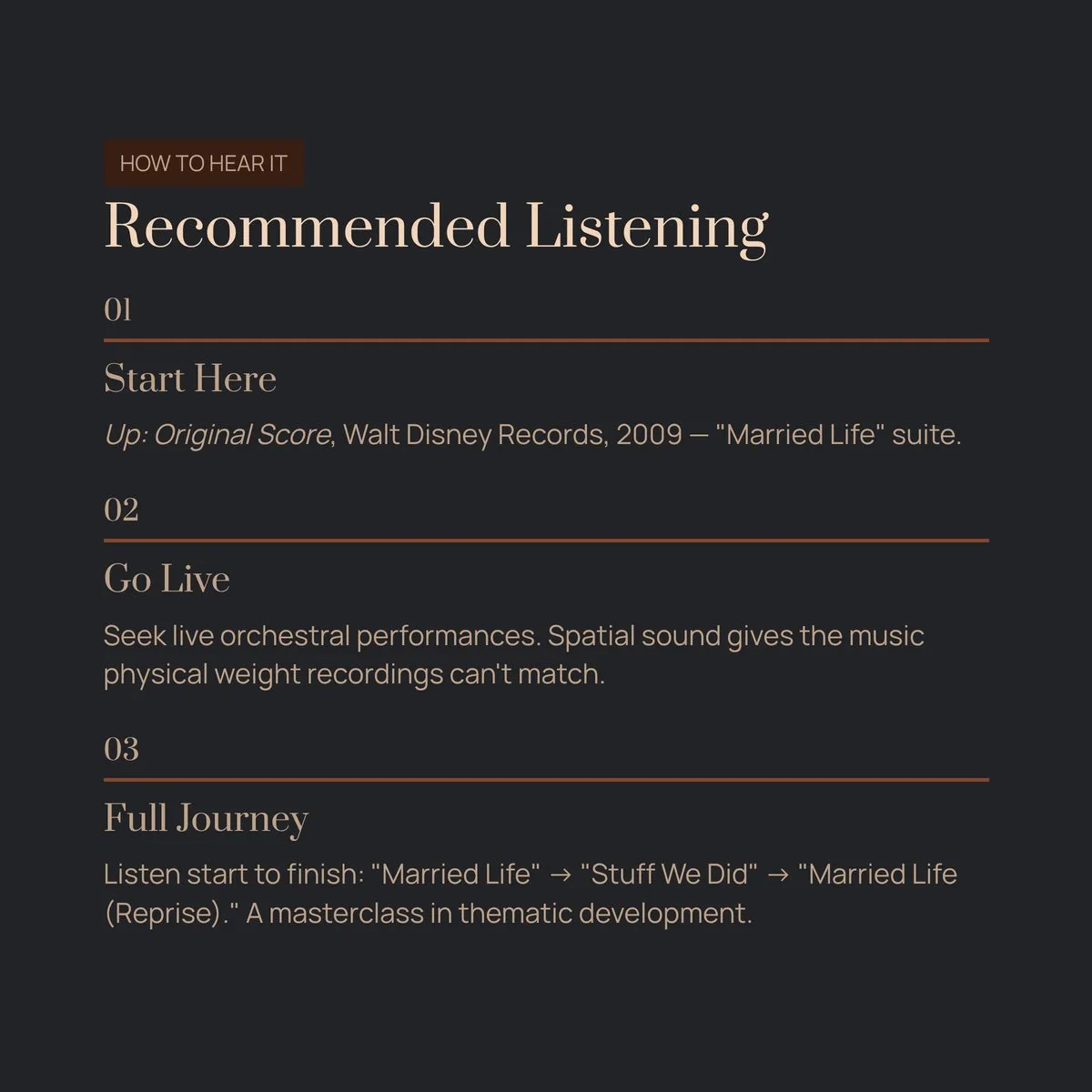
The original soundtrack album, Up: Original Score (Walt Disney Records, 2009), is the most direct way in. The track is labeled as part of the “Married Life” suite, but individual versions of the theme appear in different forms across the score.
For a deeper experience, seek out live orchestral performances — several film music concert series have featured the Up suite in recent years, and hearing this piece played by a full symphony orchestra in a concert hall is a qualitatively different experience from earbuds. The spatial dimension of live orchestral sound, the way the string sections envelop you from different angles, gives the music a physical weight that recordings can only approximate.
If you want to trace Giacchino’s emotional range across a single film, listen to the full Up score from beginning to end: “Married Life” to “Stuff We Did” to “Married Life (Reprise)” — the reprise, near the film’s end, carries everything the opening established and transforms it into something closer to acceptance. It’s a masterclass in thematic development across the span of a feature film.
A Note for Newcomers to Film Music
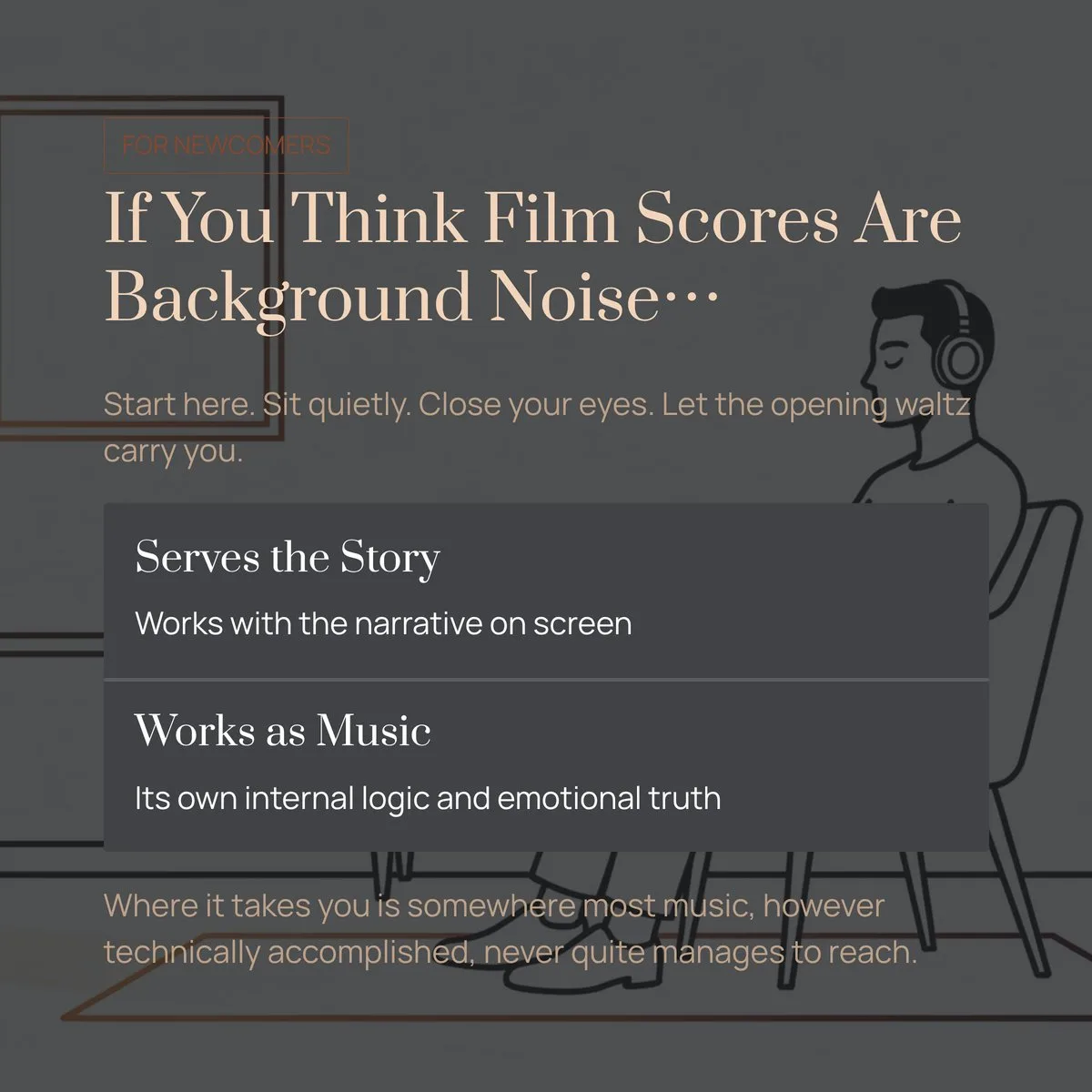
If you’ve always considered film scores background noise — music that exists to tell you how to feel rather than inviting you to feel — “Carl Goes Up” is a reasonable place to begin reconsidering that position.
The best film music does something interesting: it has to work in two directions at once. It has to serve the narrative needs of the story unfolding on screen. And it has to work as music — as organized sound with its own internal logic and emotional truth. When those two functions align perfectly, you get pieces like this one.
You don’t need to know anything about music theory to hear what Giacchino is doing here. You don’t need to know the film. You need only to sit quietly, close your eyes, and let the opening waltz carry you somewhere.
Where it takes you is somewhere most music, however technically accomplished, never quite manages to reach.
Michael Giacchino — “Carl Goes Up” (from Up, 2009). Walt Disney Records / Pixar Animation Studios.