📑 Table of Contents
Imagine a city where the police arrest you for a crime you haven’t committed yet. The screens glow, the trains glide silently, and somewhere a machine has already decided your fate. Now—what does that world sound like?
When John Williams sat down to score Steven Spielberg’s Minority Report in 2002, he reached for something most of us never expect from the man who gave us the soaring fanfares of Star Wars and Superman. He reached for shadow. The main theme that opens the film doesn’t announce a hero. It hovers—cool, watchful, restless—like a surveillance camera that never blinks. And yet, woven through all that chrome and dread, there’s a heartbeat. A father missing his son.
That tension is the whole reason this score lingers with you long after the movie ends.
Who Is John Williams, Really?
You almost certainly know his music even if you’ve never learned his name. John Williams, born in 1932, is the most recognizable film composer who has ever lived—the architect behind Jaws, E.T., Indiana Jones, Jurassic Park, and the entire sonic universe of Star Wars. If a movie made you feel something with an orchestra in the last fifty years, there’s a strong chance he wrote it.
But here’s the part worth knowing for Minority Report: by 2002, Williams had nothing left to prove with big, golden, triumphant melodies. So he did the opposite. Spielberg himself described this score as Williams’ first “in black and white”—and even pointed to it as a kind of homage to Bernard Herrmann, the legendary composer behind Hitchcock’s most nerve-shredding films. In other words, Williams deliberately traded warmth for unease. For a composer that famous, choosing restraint is its own kind of daring.
The Story Behind the Score
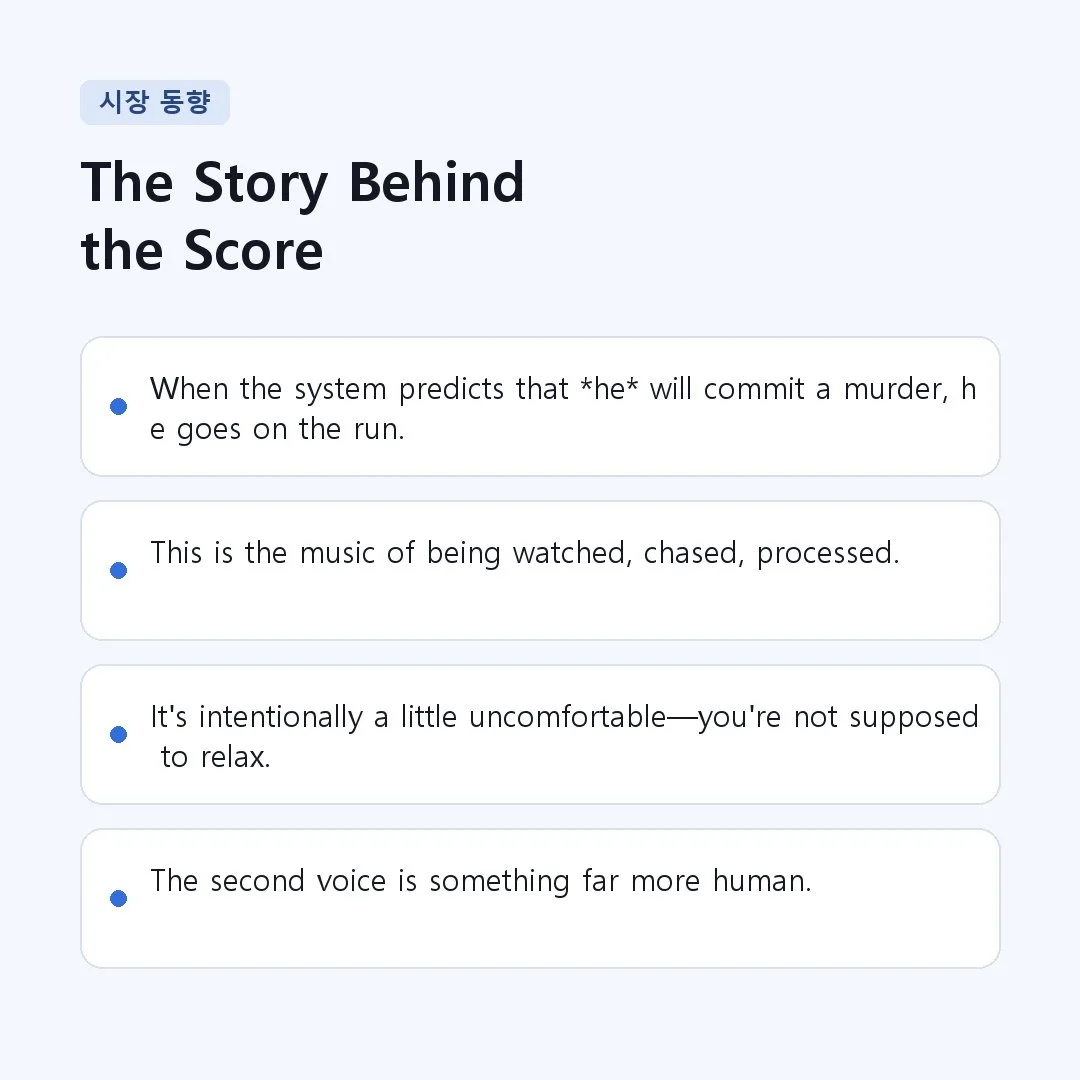
Minority Report is set in a future where a special police unit arrests murderers before they kill, using three psychic “precogs” who see crimes in advance. Tom Cruise plays the chief of this unit—a man haunted by the disappearance of his young son, Sean. When the system predicts that he will commit a murder, he goes on the run.
Williams scored this world in two voices that constantly pull against each other.
The first voice is the cold machinery of the future: jittery strings, ticking percussion, and unsettling textures that never quite resolve. This is the music of being watched, chased, processed. It’s intentionally a little uncomfortable—you’re not supposed to relax.
The second voice is something far more human. The score’s true emotional anchor isn’t the dystopia at all—it’s a tender, aching melody for the protagonist’s lost child, known on the soundtrack as “Sean’s Theme.” Critics have long singled it out as the one melody instantly recognizable as classic Williams—soft strings and woodwinds carrying a quiet, almost unbearable longing. Everything frantic in the score exists, in a sense, to make that fragile little tune hit harder.
What to Listen For (A Beginner’s Guide)
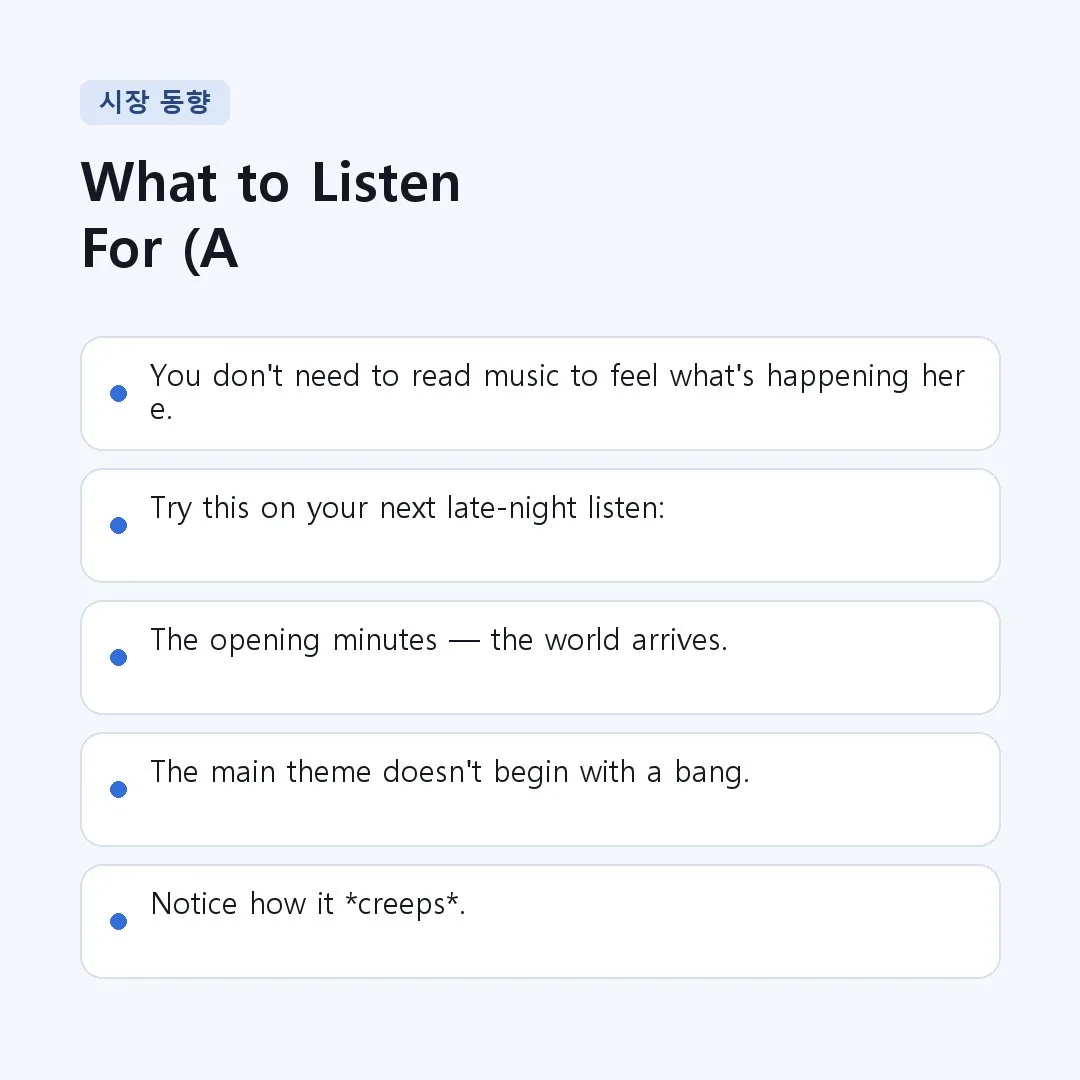
You don’t need to read music to feel what’s happening here. Try this on your next late-night listen:
The opening minutes — the world arrives. The main theme doesn’t begin with a bang. Notice how it creeps. There’s a floating, weightless quality, as if the music itself is suspended in glass. Williams is painting a future that’s beautiful and sterile at the same time.
Listen for the heartbeat underneath. Pay attention to the percussion—those tick-tock rhythms. They feel like a clock, like time running out. In a film obsessed with predicting the future, that’s no accident.
Wait for the melody to soften. When the strings finally relax and a gentle, singable theme emerges, that’s the human core breaking through the machine. This is the moment Williams wants you to feel the father, not the fugitive. If you only catch one thing, catch this contrast: cold, then warm, then cold again.
The strangeness is the point. Some passages drift and shimmer without ever settling into a tune. If that feels unresolved—good. That unease is Williams scoring paranoia itself.

Where to Start Listening
If you’re new to this score, here’s how I’d recommend approaching it:
Start with “Sean’s Theme.” It’s under two minutes and it’s the gateway. Hear the gorgeous, melancholic melody first, and the rest of the score will make emotional sense.
Then play the opening track, “Minority Report.” This is where the main theme lives in full. Around six and a half minutes long, it carries you through both the chill of the future and glimpses of that human warmth.
For the complete picture, the Minority Report: Original Motion Picture Score (2002) is the album to find, later expanded into a remastered two-disc release by La-La Land Records for listeners who want every cue. The original conducting is by Williams himself, which means you’re hearing the music exactly as he intended its phrasing and pacing.
A small tip: this is a score that rewards headphones and dim light. The quiet details—the shimmer, the ticking, the breath between phrases—get lost on laptop speakers in a bright room.
Why This Music Stays With You
Most film scores try to tell you how to feel. Minority Report does something rarer: it makes you feel two things at once and refuses to resolve them. It’s the sound of a future we’re half-afraid is coming true—and the sound of a parent who would trade all of it just to find one missing child.
That’s the quiet genius of what Williams did here. He took the most technologically paranoid story Spielberg ever told and reminded us that underneath every cold system is a person who simply misses someone. Press play late at night, let the chrome and the longing wash over you, and you’ll understand why this “black and white” score remains one of the most quietly human things in his entire catalogue.