📑 Table of Contents
- The Miracle of Messiah: 24 Days That Changed Music Forever
- Anatomy of Triumph: Understanding the Musical Architecture
- A Journey Through Sound: Your Listening Guide
- Why Do We Stand? The Royal Legend
- The Emotional Landscape: What Makes It Move Us
- Recordings That Illuminate: Finding Your Hallelujah
- Beyond the Concert Hall: Cultural Echoes
- A Final Reflection: Music as Miracle
There are moments in music when the boundary between earth and heaven seems to dissolve completely. George Frideric Handel’s “Hallelujah Chorus” is one such moment—a thunderous declaration of joy that has moved audiences to their feet for nearly three centuries. Whether you’ve heard it echoing through a grand cathedral on Christmas Eve or stumbled upon it in a shopping mall flash mob, this four-minute explosion of sacred ecstasy carries an undeniable power that transcends time, culture, and even religious belief.
But what makes this particular chorus so universally overwhelming? The answer lies not just in the music itself, but in the extraordinary circumstances of its creation—a story of miraculous composition, royal tradition, and one man’s journey from despair to divine inspiration.
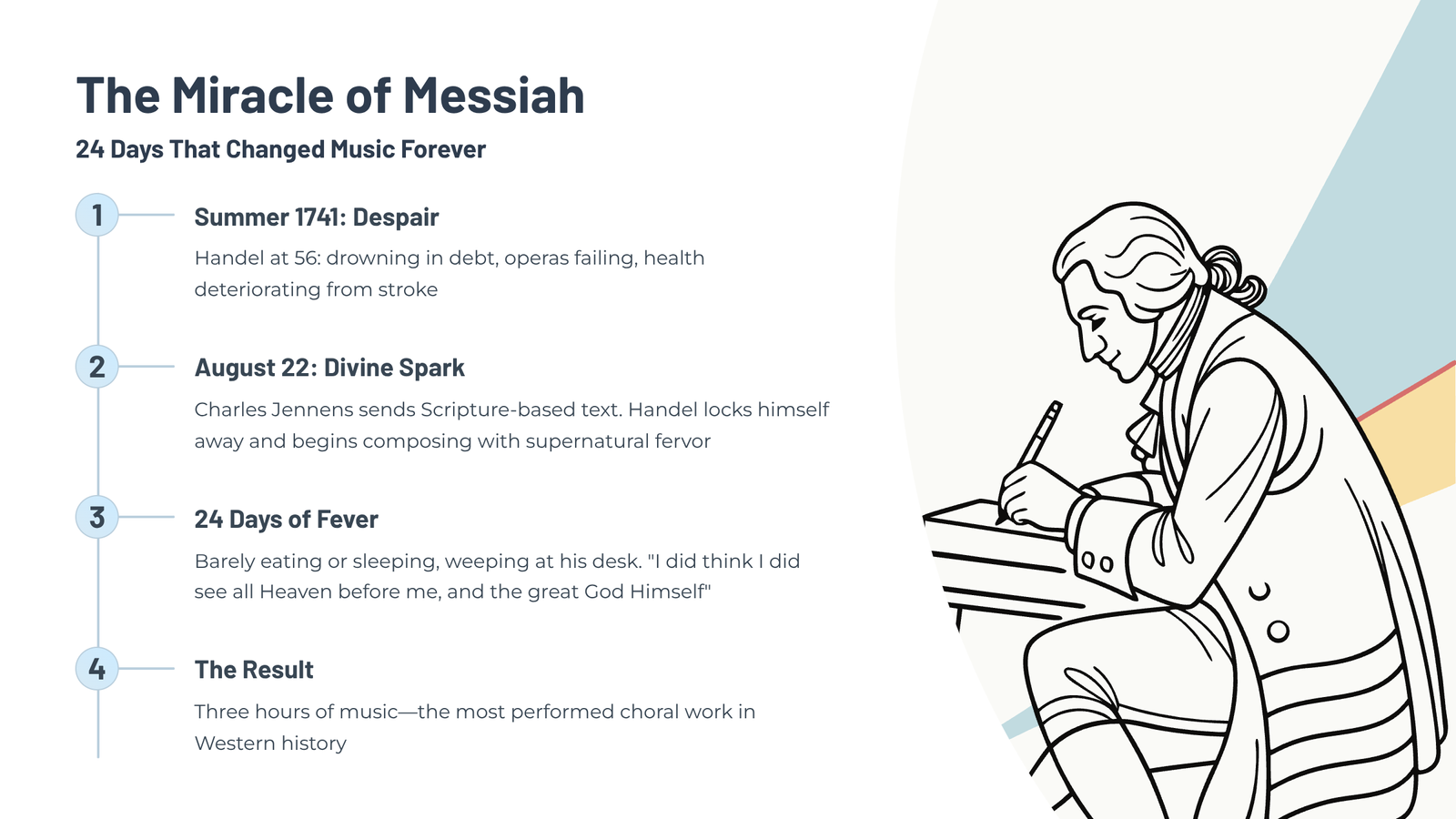
The Miracle of Messiah: 24 Days That Changed Music Forever
In the summer of 1741, George Frideric Handel was a broken man. At 56 years old, the German-born composer who had once been the toast of London found himself drowning in debt, his Italian operas falling out of fashion, and his health deteriorating. A stroke had partially paralyzed his right hand just four years earlier, and creditors circled like vultures. Many believed his career was finished.
Then, on August 22nd, something extraordinary began.
Charles Jennens, a wealthy librettist and friend, sent Handel a Scripture-based text he had compiled—a dramatic narrative tracing prophecy, birth, passion, and resurrection. Handel locked himself in his small house on Brook Street in London and began to compose with a fervor that bordered on the supernatural.
For the next 24 days, Handel barely ate or slept. His servant would find him weeping at his desk, overwhelmed by the music pouring through him. When he finished the “Hallelujah Chorus,” Handel reportedly told his servant with tears streaming down his face: “I did think I did see all Heaven before me, and the great God Himself.”
In just over three weeks, he had composed the entire Messiah—nearly three hours of music that would become the most performed choral work in Western history.
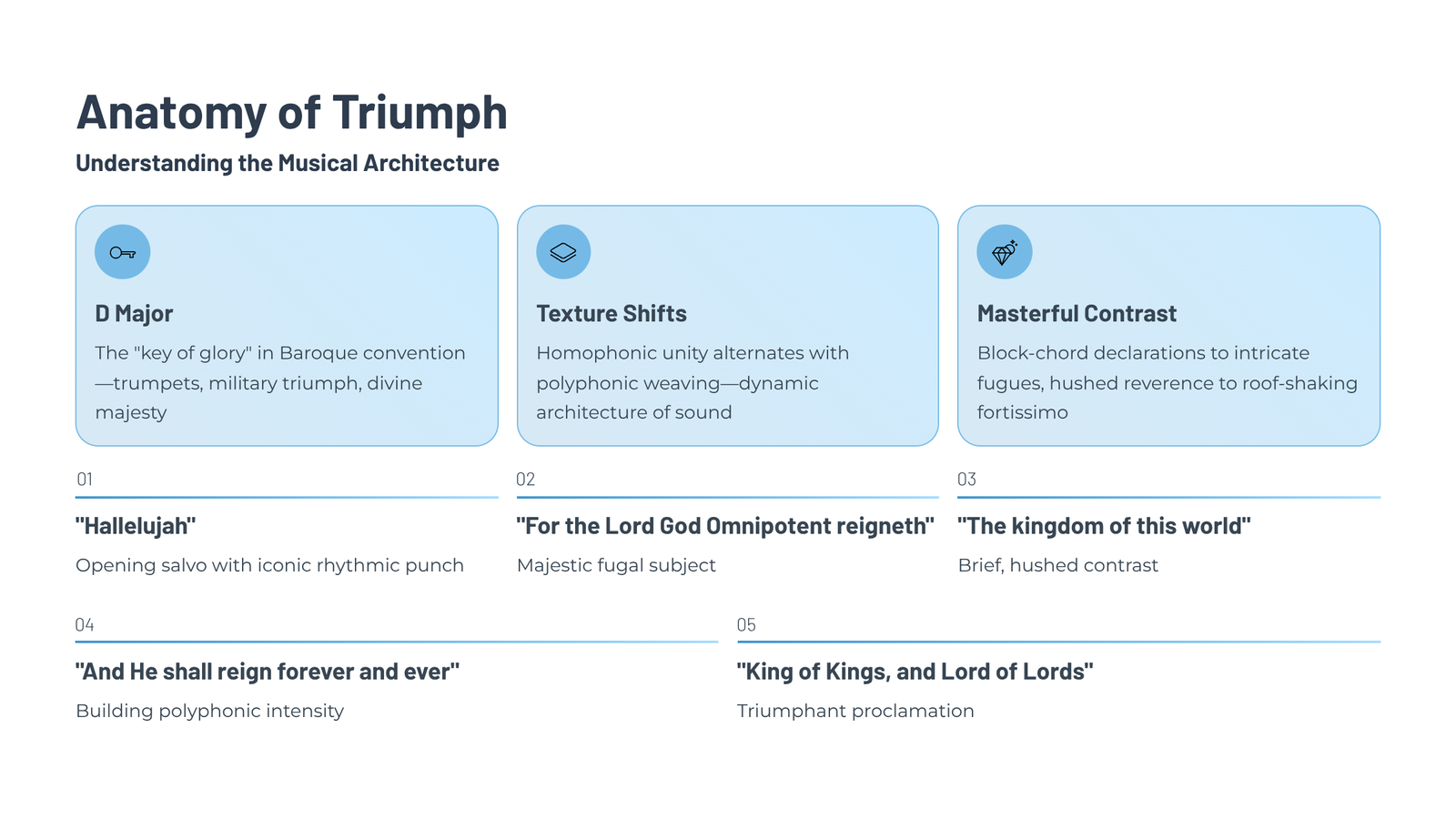
Anatomy of Triumph: Understanding the Musical Architecture
The “Hallelujah Chorus” arrives as the climactic conclusion to Part II of Messiah, which deals with Christ’s passion, death, and resurrection. After the darkness of crucifixion narratives, this chorus bursts forth like sunrise after the longest night.
Key and Structure
The chorus is set in D major—the “key of glory” in Baroque convention, associated with trumpets, military triumph, and divine majesty. Handel employs a sophisticated blend of homophonic passages (where all voices move together in rhythmic unity) and polyphonic sections (where independent melodic lines weave around each other), creating a dynamic architecture of sound.
The piece can be understood through five main textual sections, each receiving distinct musical treatment:
- “Hallelujah” — The opening salvo, with its iconic rhythmic punch
- “For the Lord God Omnipotent reigneth” — A majestic fugal subject
- “The kingdom of this world” — A brief, hushed contrast
- “And He shall reign forever and ever” — Building polyphonic intensity
- “King of Kings, and Lord of Lords” — The triumphant proclamation
The Genius of Contrast
What makes this chorus so emotionally effective is Handel’s masterful use of contrast. The texture constantly shifts between massive, block-chord declarations (“Hallelujah!”) and intricate fugal passages where voices chase each other in celebration. The dynamic range spans from hushed reverence to roof-shaking fortissimo. Each time you think the piece has reached its peak, Handel finds another level of intensity.
The orchestration—strings, oboes, bassoons, trumpets, timpani, and continuo—supports rather than competes with the choir. The trumpets and drums, in particular, add a ceremonial, almost military grandeur that reinforces the text’s imagery of cosmic kingship.
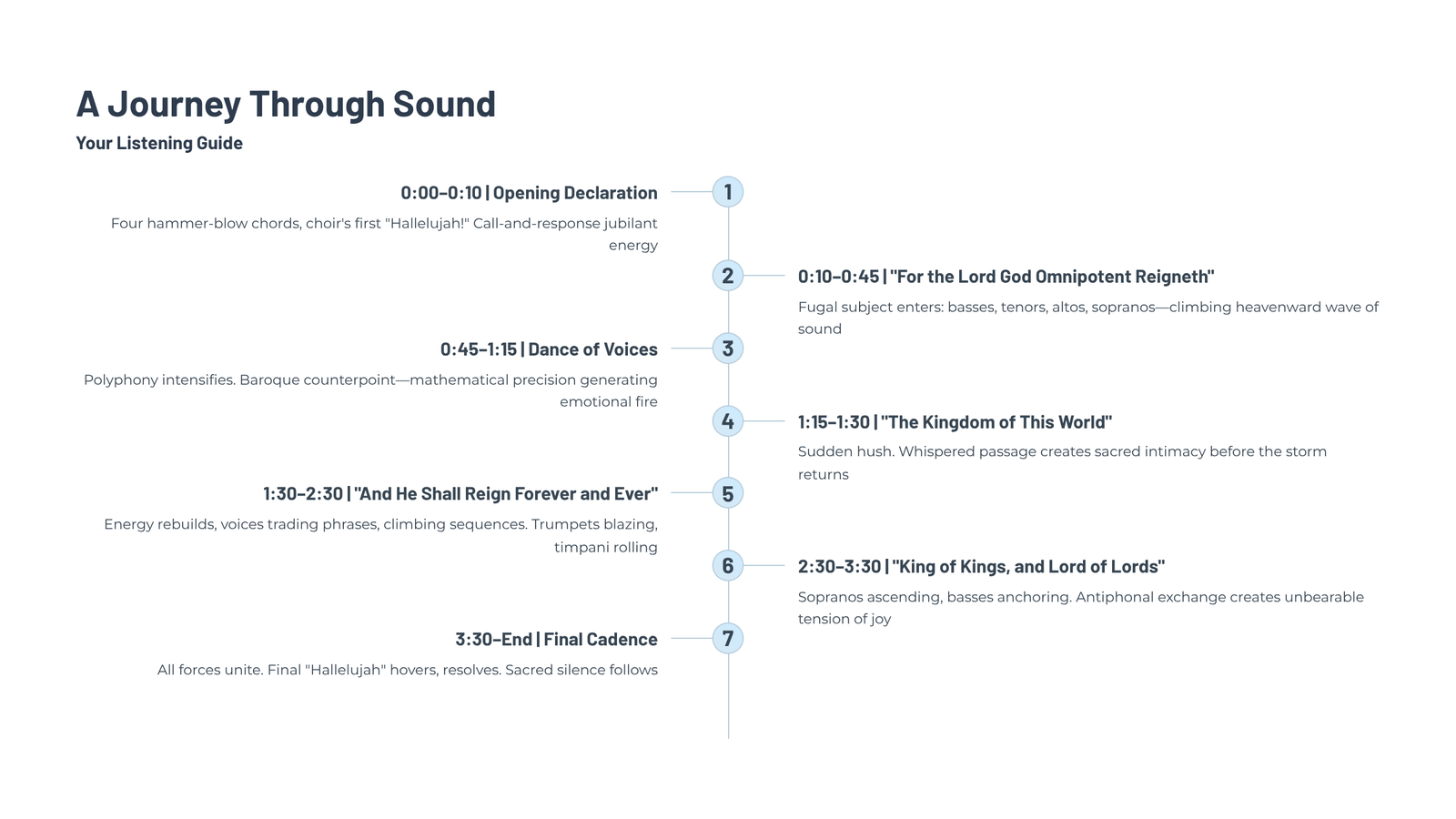
A Journey Through Sound: Your Listening Guide
0:00–0:10 | The Opening Declaration
Four hammer-blow chords from the orchestra, answered immediately by the choir’s first “Hallelujah!” This call-and-response pattern establishes the jubilant energy. Notice how the rhythm itself seems to shout—short, punchy syllables that feel like physical exclamations.
0:10–0:45 | “For the Lord God Omnipotent Reigneth”
Here, Handel introduces his fugal subject—a rising, confident melody that seems to climb heavenward. Listen for how this theme enters first in the basses, then tenors, altos, and finally sopranos, each voice adding to the growing wave of sound. Meanwhile, the other voices continue their “Hallelujah” interjections, creating a glorious sonic tapestry.
0:45–1:15 | The Dance of Voices
The polyphony intensifies as the fugal subject and “Hallelujah” motif interweave. This is Baroque counterpoint at its most exhilarating—mathematical precision generating emotional fire. Pay attention to the bass line, which provides a solid foundation while the upper voices soar and tumble.
1:15–1:30 | “The Kingdom of This World”
A sudden hush. The choir drops to piano, singing in unison: “The kingdom of this world is become the kingdom of our Lord and of His Christ.” This whispered passage creates a moment of sacred intimacy before the storm returns. It’s a masterstroke of dramatic pacing.
1:30–2:30 | “And He Shall Reign Forever and Ever”
The energy rebuilds as voices begin trading phrases, the music climbing through sequences that ratchet up the excitement. The orchestral texture thickens, trumpets blazing, timpani rolling. Handel is building toward his final revelation.
2:30–3:30 | “King of Kings, and Lord of Lords”
The sopranos begin their ascending proclamation—each repetition of “King of Kings” stepping higher while basses anchor with repeated “Forever and ever, Hallelujah!” responses. This antiphonal exchange creates an almost unbearable tension of joy. The harmony grows richer, the dynamics swell, until finally…
3:30–End | The Final Cadence
All forces unite for the closing declarations. The final drawn-out “Hallelujah” hovers, then resolves with one last triumphant chord. The silence that follows feels sacred.

Why Do We Stand? The Royal Legend
One of classical music’s most enduring traditions holds that audiences should stand during the “Hallelujah Chorus.” The origin traces to the London premiere in 1743, when King George II allegedly rose to his feet during this chorus—perhaps moved by the music, perhaps mistaking it for the end of the piece, or perhaps his legs had simply fallen asleep.
Whatever the reason, royal etiquette demanded that when the King stood, everyone stood. The tradition persists nearly 300 years later, though its practice varies by venue and cultural context. Some see it as a beautiful continuation of historical reverence; others find it an awkward interruption. Either way, the very existence of this debate speaks to the chorus’s singular power—no other piece in the classical repertoire commands such physical response from its audience.

The Emotional Landscape: What Makes It Move Us
Music theorists and psychologists have attempted to explain the “Hallelujah Chorus effect.” Several elements converge to create its emotional impact:
Rhythmic Certainty: The strong, regular pulse creates a sense of stability and confidence. Your heartbeat wants to synchronize with it.
Harmonic Resolution: Handel uses consonant, satisfying harmonies that create feelings of completeness and rightness. There’s no ambiguity here—only clarity and affirmation.
Dynamic Narrative: The piece tells a story of triumph through its formal structure. We experience journey, contrast, building tension, and glorious release.
Collective Voice: There’s something primal about hearing many voices united in proclamation. It triggers ancient instincts of tribal belonging and shared purpose.
The “Hallelujah” Word Itself: Regardless of personal belief, this Hebrew word—meaning “Praise the Lord”—carries millennia of cultural and spiritual weight. Its very syllables, with their open vowels and liquid consonants, feel physically satisfying to hear and sing.
Recordings That Illuminate: Finding Your Hallelujah
The performance history of Messiah reveals fascinating interpretive evolution:
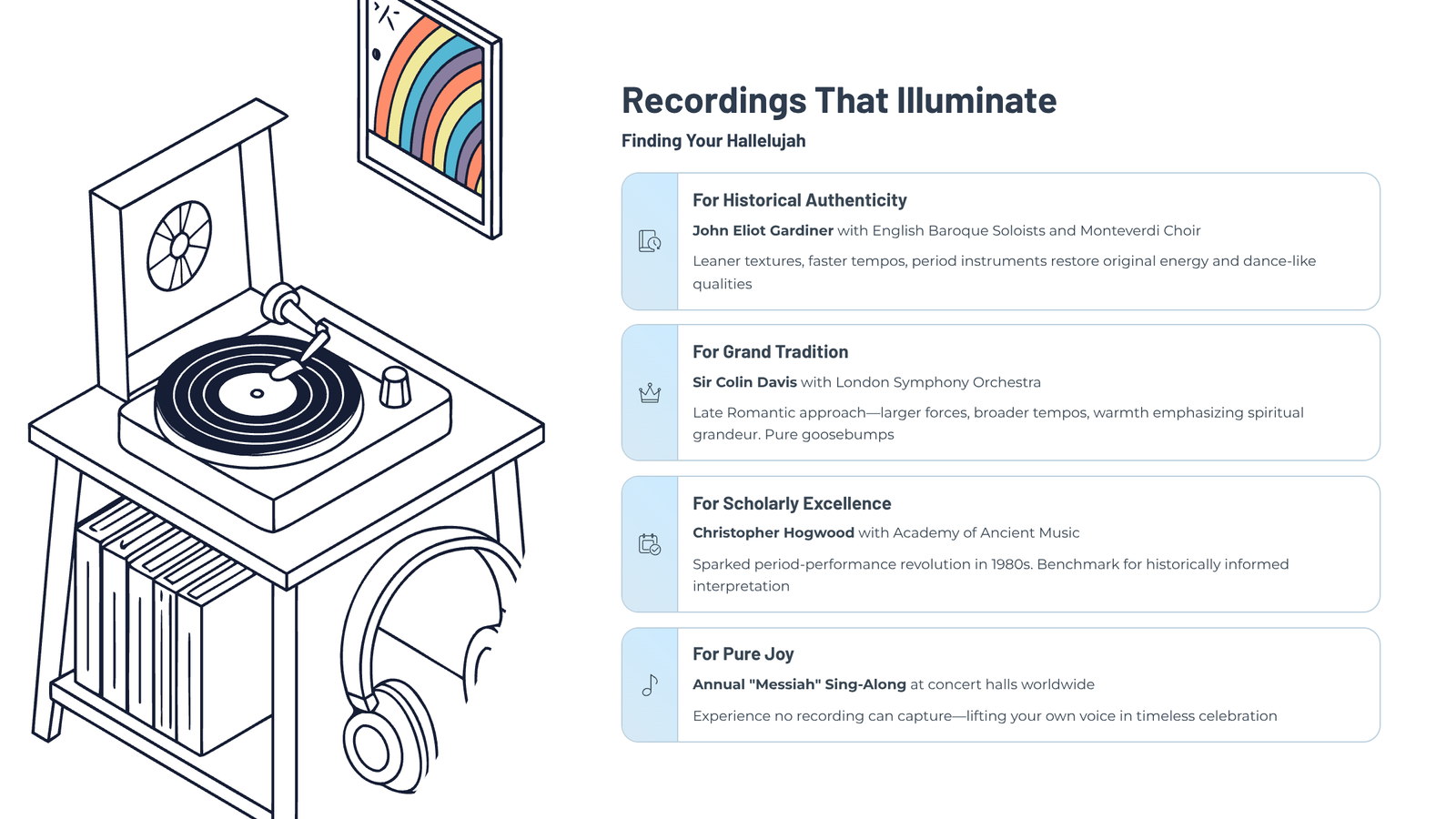
For Historical Authenticity: John Eliot Gardiner with the English Baroque Soloists and Monteverdi Choir offers a revelation—leaner textures, faster tempos, and period instruments that restore the work’s original energy and dance-like qualities. This isn’t your grandmother’s plodding Messiah.
For Grand Tradition: Sir Colin Davis with the London Symphony Orchestra represents the late Romantic approach—larger forces, broader tempos, and a warmth that emphasizes the work’s spiritual grandeur. If you want goosebumps, this delivers.
For Scholarly Excellence: Christopher Hogwood’s recording with the Academy of Ancient Music sparked the period-performance revolution in the 1980s. It remains a benchmark for historically informed interpretation.
For Pure Joy: The annual “Messiah” sing-along at various concert halls worldwide offers something no professional recording can capture—the experience of lifting your own voice in this timeless celebration.

Beyond the Concert Hall: Cultural Echoes
The “Hallelujah Chorus” has escaped the concert hall to become a universal symbol of triumph and celebration. It appears in countless films—from The Shawshank Redemption to animated comedies—whenever a scene needs to communicate transcendent victory. Flash mobs have performed it in food courts and train stations, bringing startled shoppers to tears.
Perhaps most remarkably, the chorus has been claimed by both sacred and secular contexts. It plays at Christmas concerts and Easter services, at graduations and weddings, at moments of personal triumph and communal celebration. Its message—that something greater than ourselves reigns, that darkness gives way to light, that joy is possible—speaks across boundaries of belief.

A Final Reflection: Music as Miracle
When Handel emerged from his compositional fever in September 1741, he had created something that would outlast empires. The Dublin premiere on April 13, 1742, was a sensation—700 people packed the hall, with ladies asked to leave their hoops at home and gentlemen their swords to make more room.
But the true miracle wasn’t the music’s reception. It was its transformation of Handel himself. The man who began composition in despair emerged renewed. He would go on to compose for another two decades, and he conducted Messiah performances until just days before his death in 1759.
In the “Hallelujah Chorus,” we hear not just technical mastery or theological conviction, but something rarer—the sound of a human being lifted beyond his limitations, channeling something greater than himself. Whether you call it divine inspiration, artistic genius, or simply the mysterious alchemy of creativity, the result remains: four minutes of music that, for nearly 300 years, has been making listeners feel that heaven has broken into song.
Stand if you wish. Sit if you prefer. But listen—really listen—and let those triumphant “Hallelujahs” wash over you. In a world that so often feels broken, this music insists on joy.
#Handel #HallelujahChorus #Messiah #BaroqueMusic #ChoralMasterpiece #ClassicalMusicForBeginners #SacredMusic #ChristmasClassical #EasterMusic #TriumphantClassical #Oratorio #MusicHistory #ClassicalMusicGuide #InspiringClassical #ConcertHallTraditions