📑 Table of Contents
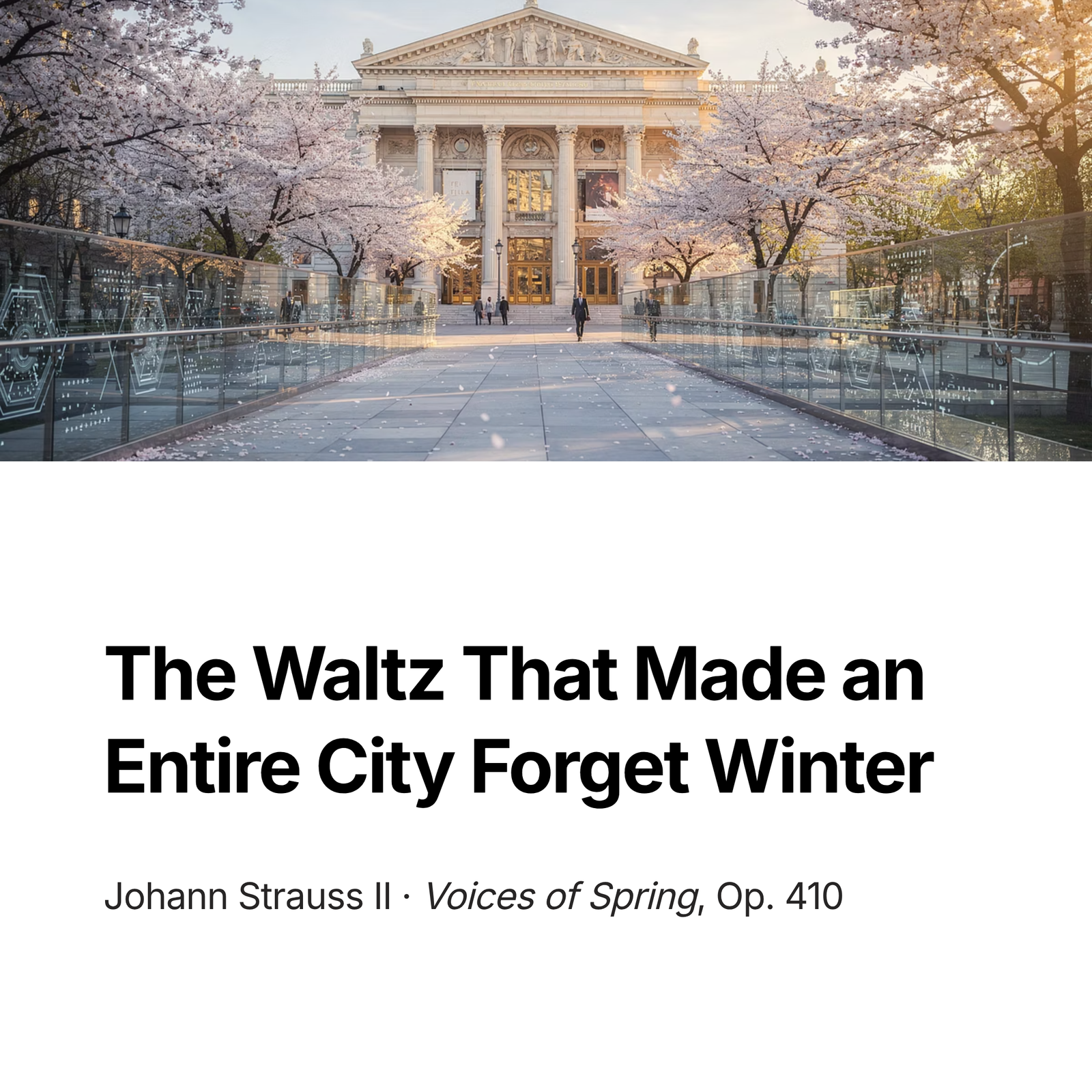
There’s a moment every year — maybe you’ve felt it too — when the air shifts. Yesterday it was still winter, cold and stubborn. But today, something loosens. The breeze carries a faint sweetness, almost floral, and suddenly the whole world feels like it’s stretching awake after a long nap.
Johann Strauss II caught that exact feeling in music. His Voices of Spring (Frühlingsstimmen), Op. 410, doesn’t just describe spring — it is spring, condensed into roughly seven minutes of whirling, soaring, laughing melody. From the very first bars, you can practically feel the frost cracking open.
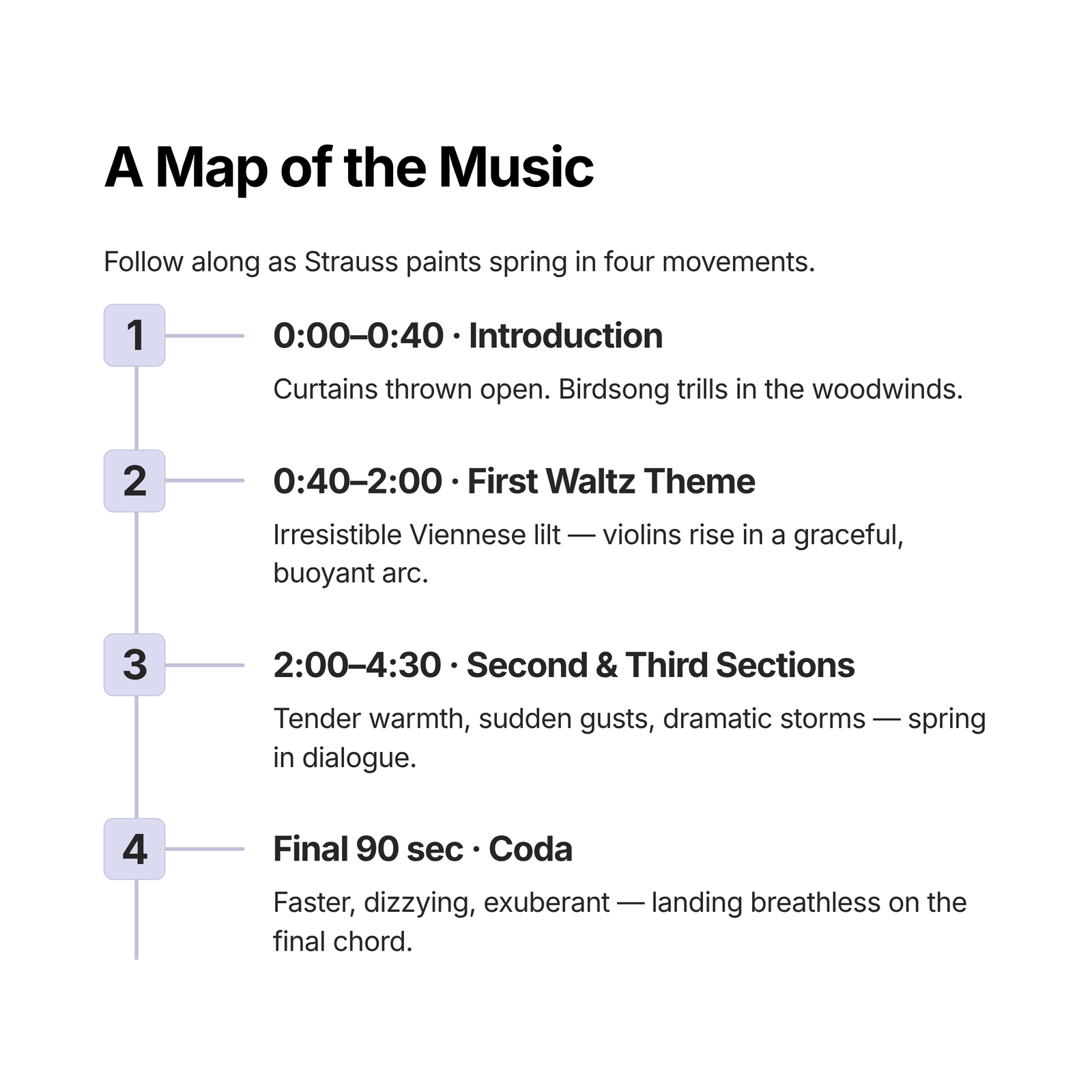
But here’s the part most people don’t know: this waltz wasn’t originally written for the concert hall. It was written for a voice — a soprano, singing wordlessly above the orchestra like a bird returning after months of silence.
The Waltz King’s Gift to a Legendary Soprano
By 1883, Johann Strauss II was already the undisputed “Waltz King” of Vienna. He had written The Blue Danube, Tales from the Vienna Woods, and dozens of other waltzes that had become the soundtrack of an entire empire. But Strauss was restless. He wanted to do something different — something that merged the elegance of the waltz with the dramatic power of opera.
The catalyst was Bianca Bianchi, a celebrated soprano performing at the Theater an der Wien. Strauss composed Voices of Spring specifically for her, crafting a piece where the human voice wouldn’t just carry a melody but would dance alongside the orchestra, leaping and twirling through coloratura passages like a figure skater on a frozen lake.
The premiere took place on March 1, 1883, during a performance of Strauss’s operetta Der Lustige Krieg (The Merry War). It was inserted as an interpolation — a standalone showpiece tucked into the evening’s entertainment. The audience went wild. Within weeks, the waltz had taken on a life of its own, performed in concert halls and salons across Europe.
What’s remarkable is that the purely orchestral version — the one most of us know today — came second. Strauss arranged it for orchestra without voice after the vocal version proved so popular, and it was this instrumental arrangement that conquered the world.
What to Listen For: A Map of the Music
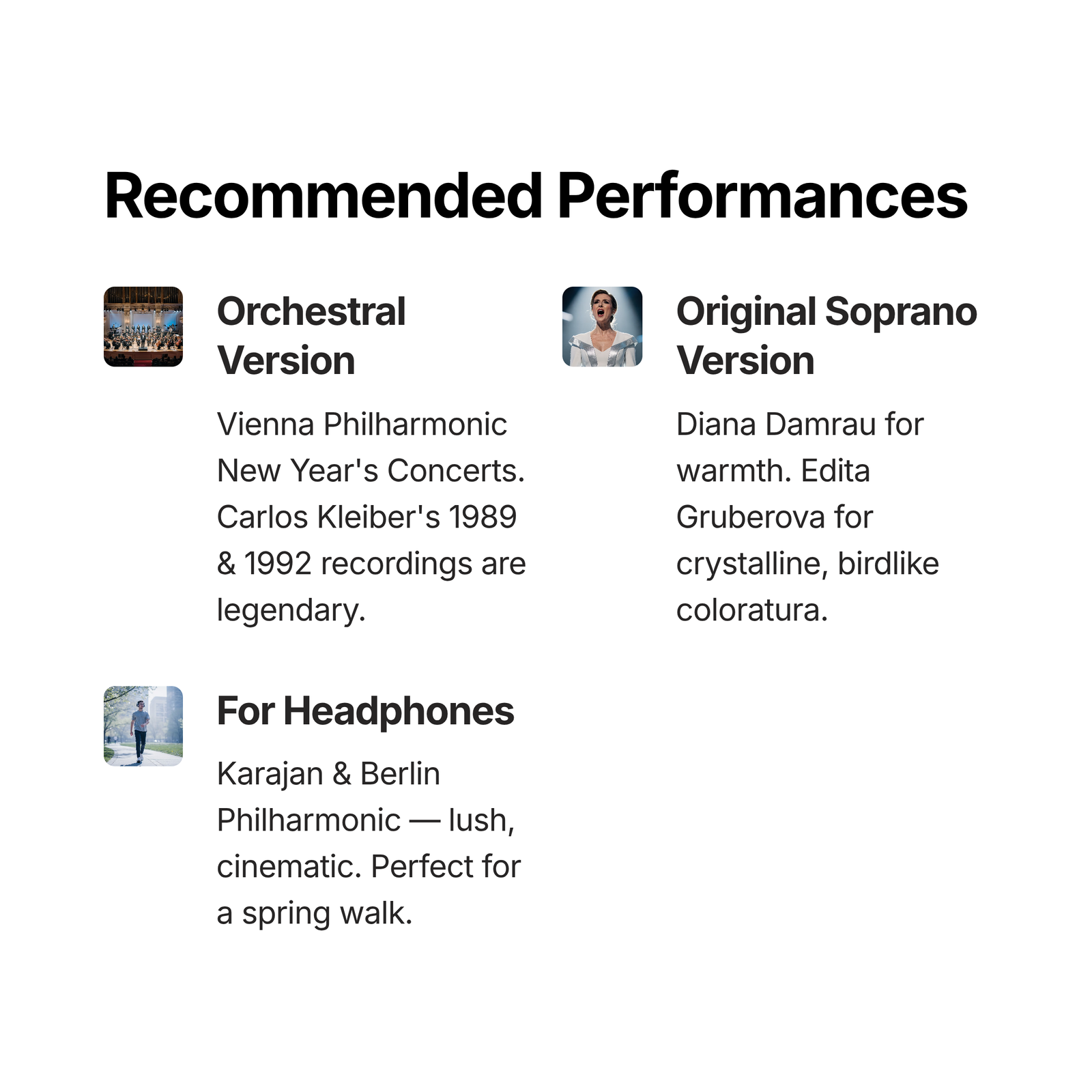
Voices of Spring follows the traditional Viennese waltz structure — an introduction, a chain of waltz themes, and a coda — but Strauss fills every corner with invention.
The Introduction (0:00–0:40)
The piece opens with a burst of orchestral energy, bright and declarative, like curtains being thrown open on a sunny morning. Rapid string passages tumble downward, then upward, as if the music itself can’t decide whether to rush outside or pause to enjoy the view. Listen for the playful trills in the woodwinds — they sound exactly like birdsong, and that’s no accident.
The First Waltz Theme (0:40–2:00)
Here it comes — one of the most immediately lovable melodies Strauss ever wrote. It rises in a graceful arc, light and buoyant, carried primarily by the violins. The rhythm has that characteristic Viennese lilt, where the second beat arrives just a hair early, giving the music its irresistible forward momentum. If you’ve ever watched couples swirl across a ballroom floor, this is the melody you’re hearing in your head.
The Second and Third Waltz Sections (2:00–4:30)
Strauss shifts colors here, moving through contrasting moods — one moment tender and intimate, the next bold and triumphant. Pay attention to how he uses the woodwinds and brass to create dialogue with the strings. It’s like a conversation between different aspects of spring: the gentle warmth of morning sun, the sudden gust of wind that scatters petals, the dramatic thunderstorm that clears the air.
The Coda (final 90 seconds)
This is where Strauss pulls out all the stops. The main theme returns, faster and more exuberant than before, building to a dizzying climax. The orchestra sounds like it’s physically spinning, accelerating through the final turns of a dance before landing — breathless and laughing — on the final chord.
Why This Waltz Still Matters
It would be easy to dismiss Voices of Spring as “light” music — pleasant background material for garden parties and film montages. And yes, it has appeared in countless movies, commercials, and figure skating routines. But that ubiquity speaks to something deeper.
Strauss understood something that more “serious” composers sometimes forgot: music doesn’t have to be dark or complex to be profound. The experience of joy — real, unguarded, full-bodied joy — is one of the hardest emotions to capture honestly. Melancholy is easy to write. Tragedy practically composes itself. But a piece that makes you feel genuinely happy without a trace of irony or sentimentality? That’s a rare and difficult achievement.
Voices of Spring does this by never standing still. Every phrase opens into the next, every melodic idea unfolds into something unexpected. There’s a generosity to the writing — Strauss gives you melody after melody, each one singable, each one distinct, as if he had an inexhaustible supply and couldn’t bear to hold any of them back. This abundance is the spring feeling. It’s nature being recklessly, almost absurdly, productive.
Recommended Performances
For the orchestral version, the Vienna Philharmonic’s New Year’s Concert recordings are the gold standard. The annual tradition of performing Strauss waltzes in the Musikverein gives these performances an unmatched authenticity — the musicians grew up breathing this music. Carlos Kleiber’s 1989 and 1992 New Year’s Concerts are particularly legendary for their spontaneity and rhythmic elasticity.
For the original soprano version, seek out recordings by Diana Damrau or Edita Gruberova. Gruberova’s crystalline coloratura brings out the birdlike quality Strauss intended, while Damrau adds a warmth and playfulness that feels less like a technical display and more like pure delight.
If you’re streaming, Herbert von Karajan’s recording with the Berlin Philharmonic offers a more polished, cinematic take — the sound is lush and enveloping, perfect for headphones on a walk when you want the world to feel a little more magical than it actually is.
Close Your Eyes and Let It Carry You
Here’s a small experiment. The next time you listen to Voices of Spring, don’t just hear it — let it move you. Not metaphorically. Literally. Let your body respond to that waltz rhythm, the gentle one-two-three, one-two-three. You don’t have to dance. A slight sway is enough. A tapping foot. A nodding head.
Because that’s what Strauss was after. Not passive listening but physical participation in joy. He wrote music that enters through the ears and travels to the feet, to the chest, to whatever part of you remembers what it felt like to run outside on the first warm day of the year and feel the sun on your face like a gift you’d forgotten you were owed.
Spring always comes back. And so does this waltz — year after year, century after century, still spinning, still singing, still impossibly alive.