📑 Table of Contents
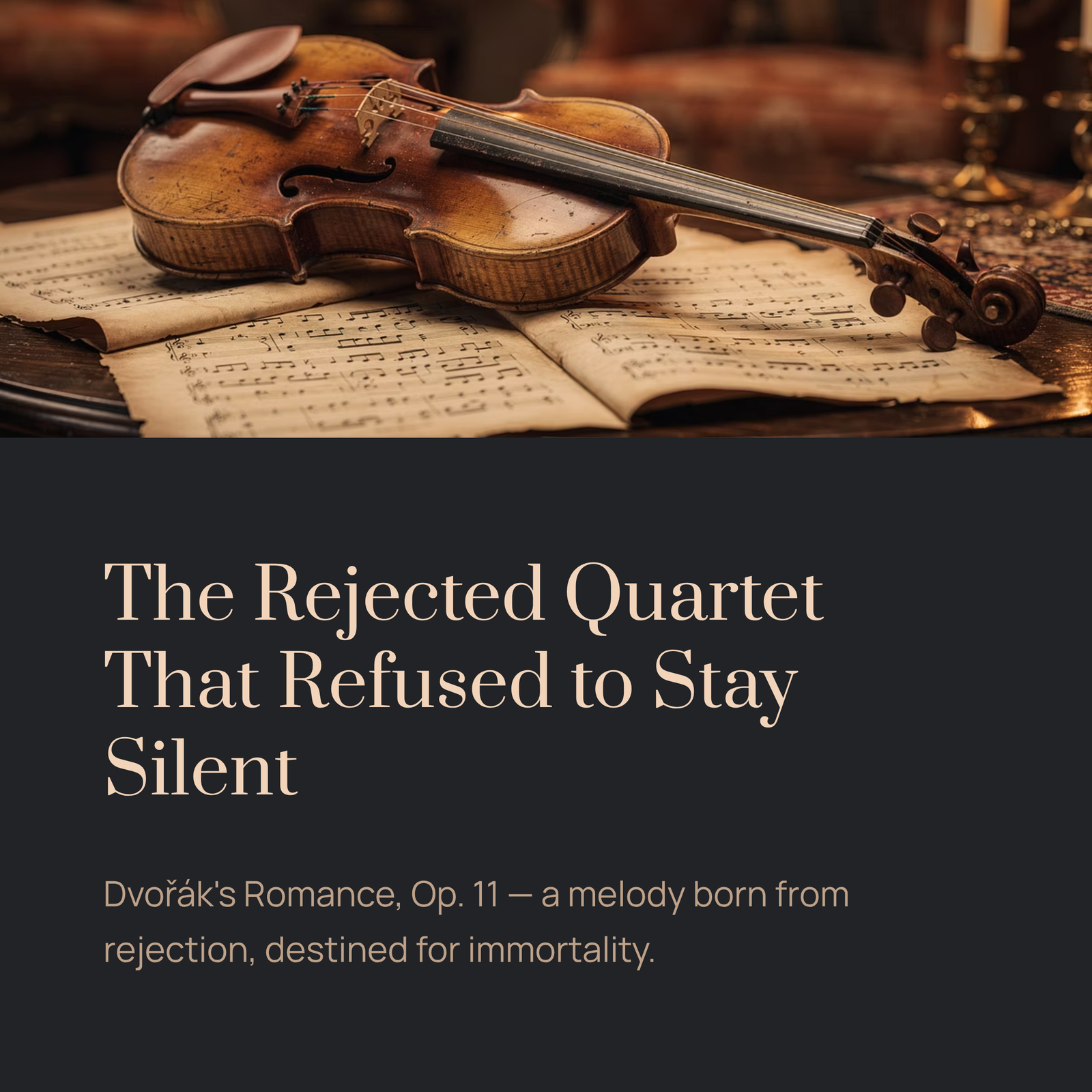
Every piece of music has a birth story. Most begin with inspiration — a sunset, a love affair, a burst of creative fever. But the story behind Dvořák’s Romance in F minor, Op. 11, begins with something far more painful: rejection.
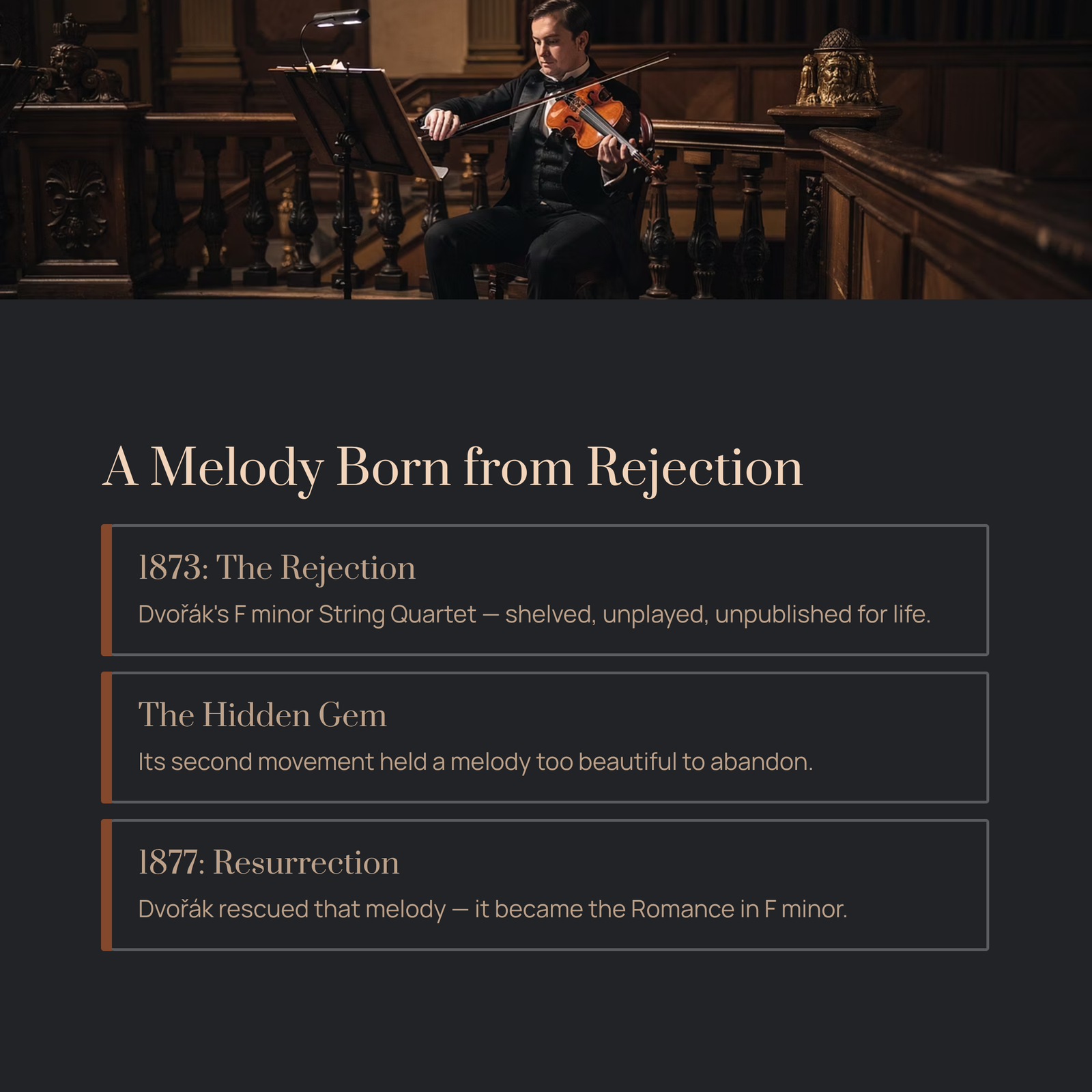
In 1873, Antonín Dvořák was thirty-two years old and virtually unknown. He had spent years as a viola player in Prague’s Provisional Theatre Orchestra, sitting in the pit night after night, playing other composers’ music while his own manuscripts gathered dust at home. That year, he poured his ambitions into a String Quartet in F minor — a work meant to signal a bold new direction in his style, a conscious step away from the Wagnerian influences that had defined his earlier writing.
The musicians who read through it refused to perform it.
The quartet was shelved. Unpublished. Unplayed. It would remain so for the rest of Dvořák’s life. But buried inside its second movement was a melody so achingly beautiful that the composer himself couldn’t let it go. Four years later, he would pull that melody from the wreckage, reshape it, and give it a second life — one that would outlast nearly everything else he wrote in that decade.
That second life became the Romance in F minor.
The Man Behind the Music: A Late Bloomer with Deep Roots
To understand why this piece sounds the way it does, you need to understand the man who wrote it. Dvořák was not a prodigy who dazzled concert halls at age six. He was the son of a butcher and innkeeper from a small Bohemian village called Nelahozeves. Music was part of village life — folk dances, church hymns, the fiddle at the local pub — but it was hardly a path to a career.
Yet Dvořák’s talent was undeniable. He studied organ in Prague, learned viola, and quietly immersed himself in the musical world of the Czech capital. By his early thirties, he was composing prolifically but struggling to break through. The rejection of his opera The King and the Charcoal Burner in 1873 — the same year he wrote the ill-fated quartet — was a turning point. It forced him to reconsider everything: his style, his ambitions, his voice as a composer.
What emerged from that crisis was something remarkable. Dvořák began stripping away grandiosity in favor of directness. He leaned into the folk melodies of his homeland, the warm singing quality of Czech music, the emotional honesty that would eventually make him one of the most beloved composers in the world.
The Romance, Op. 11, is one of the earliest fruits of that transformation.
How a Quartet Became a Love Song for Violin
The story of how this piece actually came to be performed is wonderfully human. In 1877, Josef Markus — the concertmaster of the Provisional Theatre Orchestra, the very ensemble where Dvořák had once sat as a humble viola player — asked the composer to write something for the orchestra’s annual benefit concert at Žofín Palace in Prague.
Dvořák didn’t start from scratch. He returned to that abandoned F minor quartet, to its slow movement marked Andante con moto quasi allegretto, and began to reimagine it. He kept the main melody — that graceful, cantabile theme that sings like a human voice — but added two entirely new themes, weaving everything together in a compact sonata form. The string quartet texture was expanded into a full orchestral palette: woodwinds adding warmth, horns providing depth, and the solo violin soaring above it all.
The premiere took place on December 9, 1877, with Markus as soloist and Adolf Čech conducting. The audience at Žofín Palace heard something they wouldn’t soon forget.
Listening Guide: What to Listen For
If you’re new to this piece, here’s the wonderful thing — you don’t need any technical knowledge to be moved by it. The Romance is only about eleven minutes long, and its emotional arc is as clear as a short story.
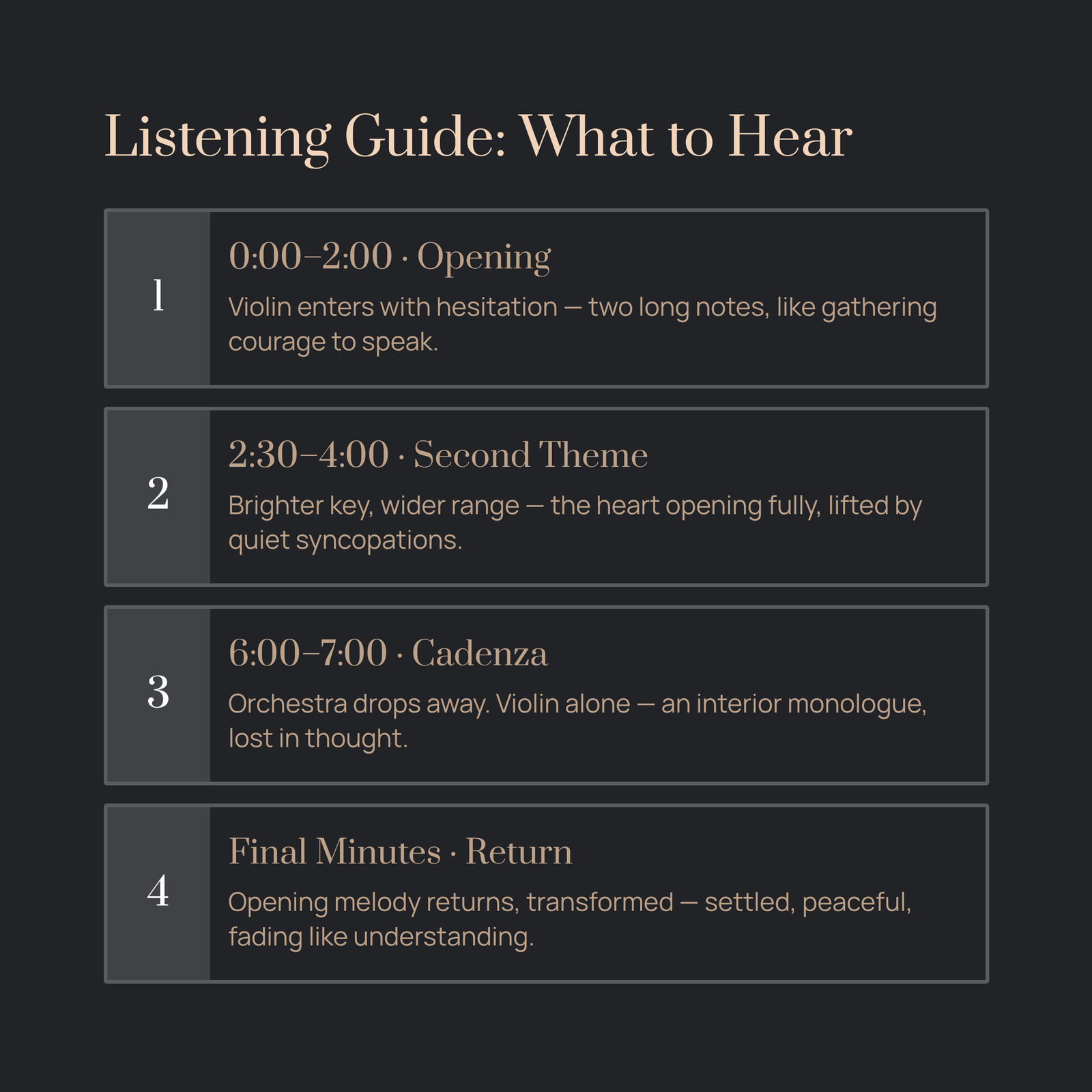
The opening melody (0:00–2:00). The solo violin enters with a theme that feels like someone trying to say something they’ve been holding back for years. It’s in F minor, and there’s a gentle ache to it — not despair, but the kind of tenderness that comes from vulnerability. Notice how the melody starts with two long, sustained notes. There’s hesitation there, as if the violin is gathering courage before it speaks.
The second theme (around 2:30–4:00). After a brief pause, the mood shifts. A new melody appears in a brighter key, wider in range, more expansive. If the first theme was a whispered confession, this one is the heart opening up fully. Listen for the way the solo violin climbs higher and higher, supported by gentle syncopations in the orchestra — a subtle rhythmic pulse that pushes the music forward with quiet urgency.
The cadenza-like passage (around 6:00–7:00). There’s a moment where the orchestra drops away and the violin is almost entirely alone, spinning elaborate figurations that hover between virtuosity and vulnerability. This isn’t a flashy showpiece moment — it’s more like an interior monologue, the soloist lost in thought.
The return and closing (final minutes). The opening melody comes back, but transformed by everything that’s happened. It feels more settled now, more at peace. The piece ends softly, fading like a conversation that trails off not because there’s nothing left to say, but because both people already understand.
Why This Piece Feels Like a Secret
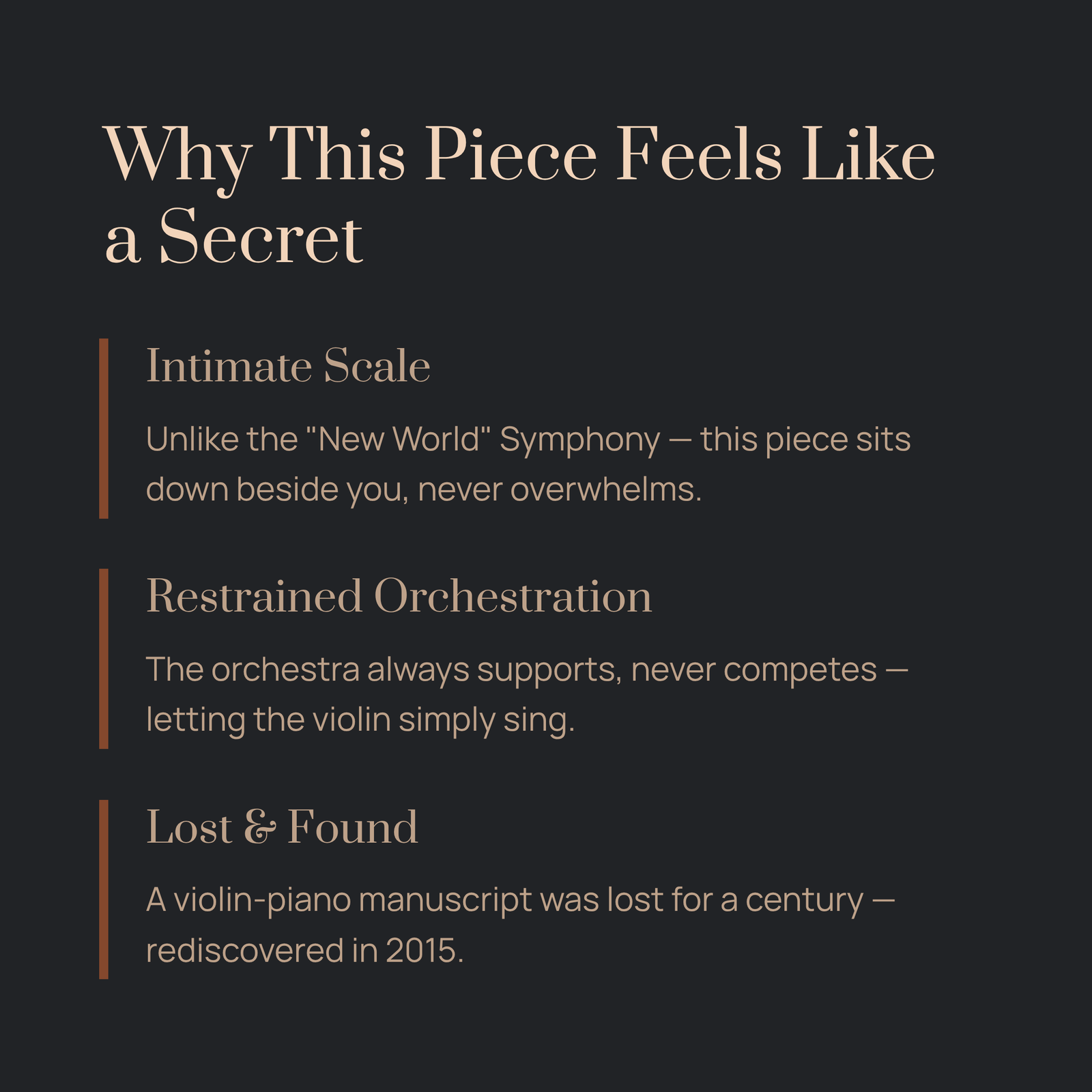
There’s a quality to the Romance in F minor that sets it apart from Dvořák’s more famous works. His “New World” Symphony fills concert halls. The Cello Concerto in B minor is a monument of the repertoire. But the Romance, Op. 11, operates on a more intimate scale. It doesn’t try to overwhelm you. It sits down beside you.
Part of that intimacy comes from its origins. This was music that had already been rejected once — a melody that the world wasn’t ready to hear in 1873. When Dvořák brought it back in 1877, he didn’t inflate it into something grand. He let the violin do what the violin does best: sing. And the orchestration around it is remarkably restrained for a Romantic-era piece, never competing with the soloist, always supporting, always listening.
There’s also the fascinating postscript of the violin-and-piano version. Dvořák created his own arrangement, likely for his friend the virtuoso František Ondříček, who would go on to premiere the famous Violin Concerto in 1883. That manuscript was lost for over a century before being rediscovered in 2015 — yet another chapter in this piece’s strange habit of disappearing and reappearing across time.
Recommended Recordings
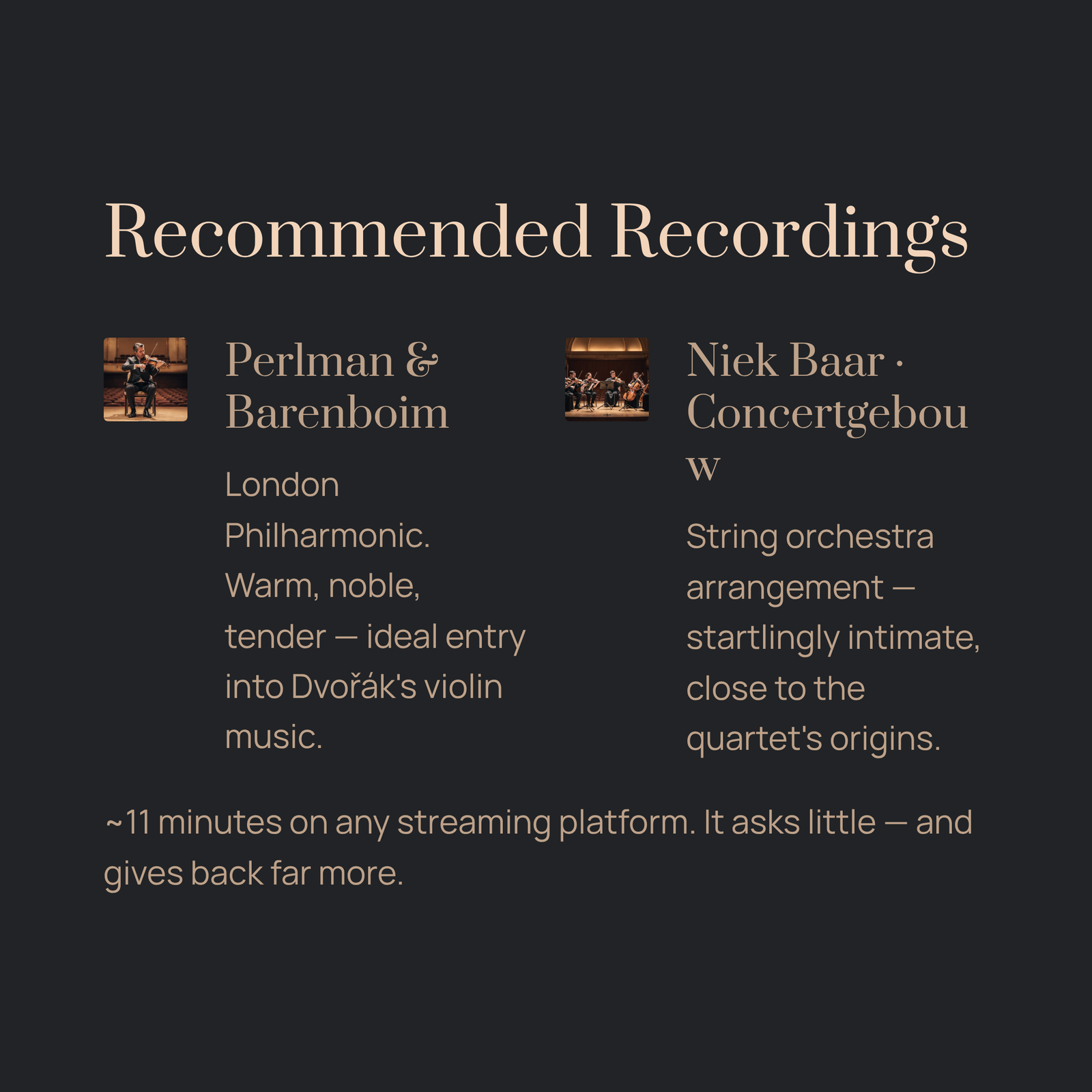
Itzhak Perlman with Daniel Barenboim and the London Philharmonic Orchestra — Perlman’s tone is warm and generous, perfectly suited to Dvořák’s singing melodies. This recording captures the piece’s nobility without sacrificing its tenderness. It’s part of a collection that also includes the Violin Concerto and the Romantic Pieces, making it an ideal entry point into Dvořák’s violin music.
Niek Baar with the Concertgebouw Chamber Orchestra (arr. for string orchestra) — A more recent and unconventional choice. Michael Waterman’s arrangement for violin and string orchestra strips away the winds and brings the piece even closer to its chamber music origins. The result is startlingly intimate, almost like eavesdropping on the original quartet.
For a quick first listen, search for the piece on any streaming platform — at roughly eleven minutes, it asks very little of your time and gives back far more than you’d expect.
The Persistence of a Melody
What strikes me most about the Romance, Op. 11, is its quiet stubbornness. Dvořák wrote a melody in 1873 that no one wanted to hear. He could have let it die with the quartet. Instead, he carried it with him for four years and found a way to let it speak.
There’s something deeply comforting about that. Not every beautiful thing finds its moment right away. Sometimes the truest music needs a second chance, a different form, a new context before it can finally reach the ears it was meant for. Dvořák’s Romance is proof that some melodies simply refuse to be silenced — and that sometimes, the thing the world rejected is exactly the thing it needed most.
The next time you’re sitting quietly on a gray afternoon, feeling that nameless ache that isn’t quite sadness but isn’t quite anything else either, put this piece on. Let the violin speak. You might find it’s been waiting to say exactly what you couldn’t.