📑 Table of Contents

There are pieces you study. There are pieces you admire from a respectful distance. And then there are pieces that seize you by the wrist and drag you onto the dance floor before you can say no.
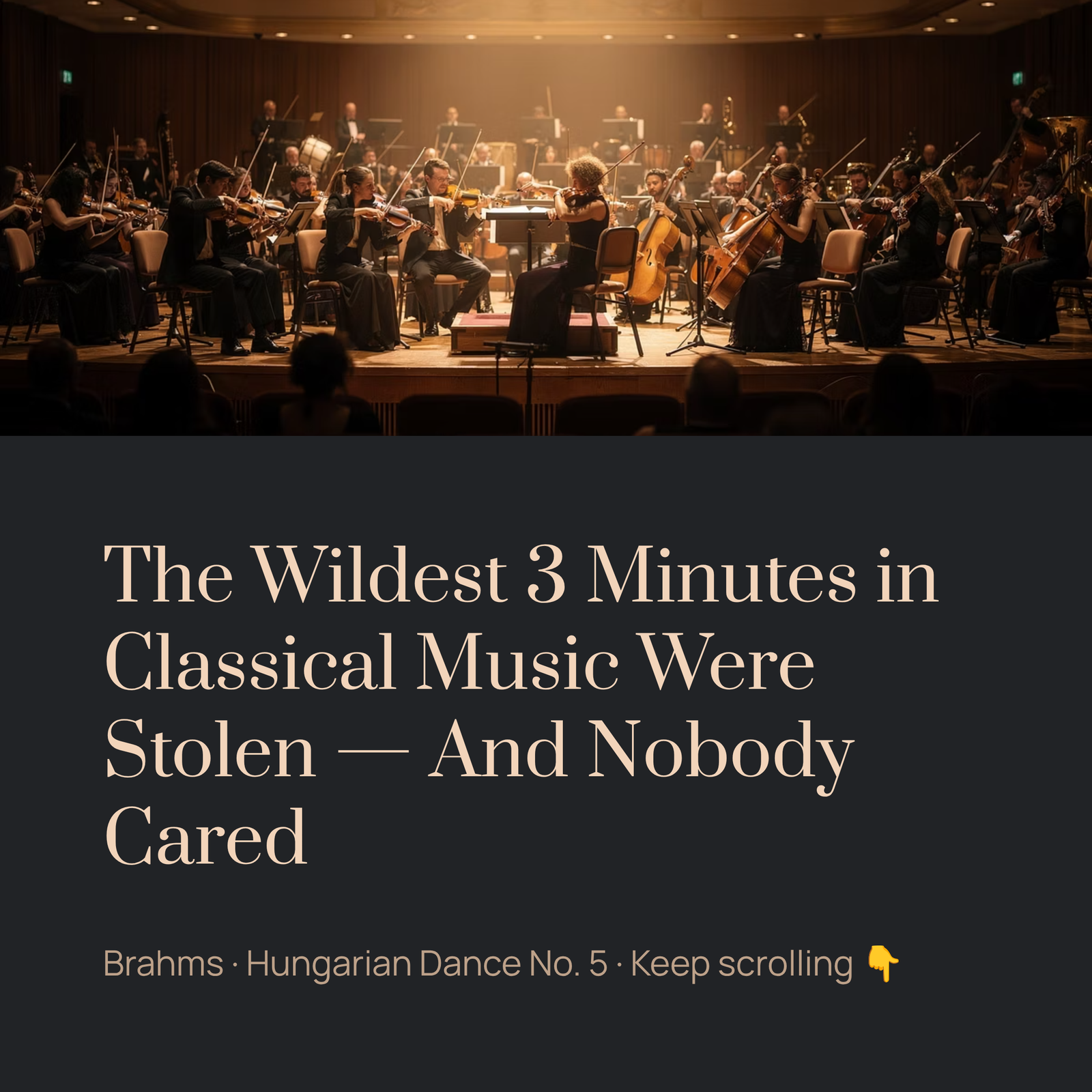
Brahms’ Hungarian Dance No. 5 in G minor is that kind of music. From its very first measure, the piece lunges forward with an urgency that feels almost reckless — a whirlwind of swooping strings, sharp accents, and rhythms that seem to dare you to sit still. It lasts barely three minutes. And yet, in that sliver of time, it manages to deliver more drama, more surprise, and more sheer kinetic joy than many symphonies twice its length.
If you’ve never consciously listened to classical music, there’s a very good chance you’ve already heard this piece. It has appeared in countless films, commercials, and cartoons. It’s been whistled in schoolyards and hummed in kitchens across the world. But knowing about it and actually listening to it are two very different experiences. Let me walk you through why this little dance has captivated audiences for over 150 years.
The Man Behind the Fire: Brahms and His Hungarian Obsession
Johannes Brahms, born in Hamburg, Germany in 1833, was one of the towering figures of the Romantic era. He is often grouped alongside Bach and Beethoven as one of the “Three Bs” of classical music — a designation that speaks volumes about his stature. But while his symphonies and concertos carry a weight that can feel almost geological, Brahms had a playful, passionate side that he rarely let the public see.
That side came alive when he encountered Hungarian and Romani music.
As a young man, Brahms befriended the Hungarian violinist Eduard Reményi, and the two toured together in the early 1850s. During those travels, Brahms became intoxicated by the csárdás — a traditional Hungarian dance that swings between slow, brooding passages and explosive, foot-stomping bursts of speed. The rhythms were infectious. The melodies were drenched in longing and defiance. Brahms absorbed it all like a sponge.
Years later, between 1858 and 1869, he poured that fascination into a set of 21 Hungarian Dances for piano four hands. He was careful to label them as “arrangements” rather than original compositions — a distinction that would later prove both wise and controversial. Among the 21, No. 5 in G minor emerged as the undisputed star, a piece so irresistibly vivid that it practically marketed itself.
A Plagiarism Scandal That Made the Piece More Famous
Here’s where the story gets deliciously complicated.
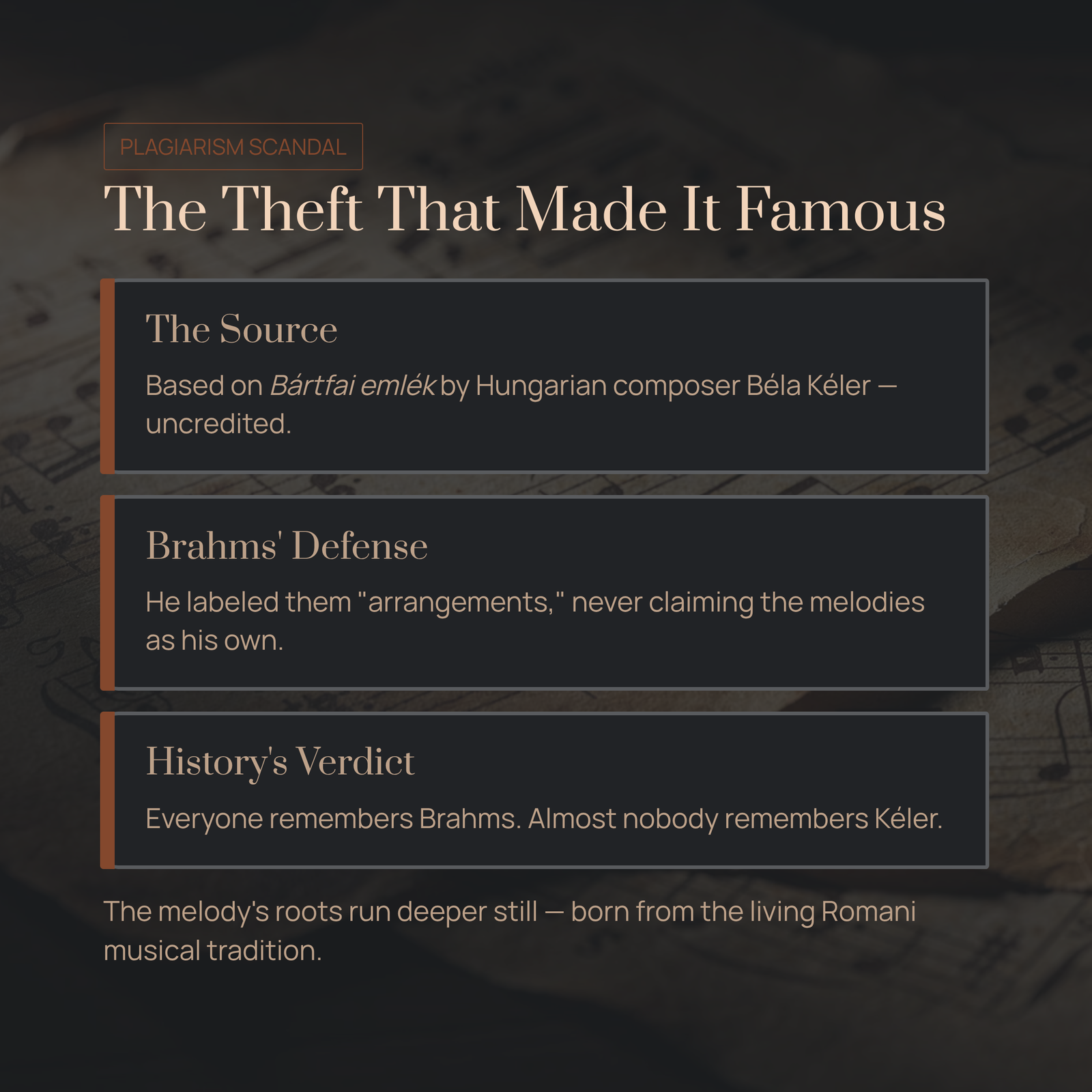
Brahms based Hungarian Dance No. 5 on a csárdás called Bártfai emlék (“Memories of Bártfa”) by the Hungarian composer Béla Kéler. When the dances were published and became wildly popular, Kéler was understandably annoyed. He hadn’t been credited. The resulting controversy was one of the first major plagiarism disputes in classical music history.
Brahms defended himself by pointing out that he had never claimed the melodies were his own — hence the careful “arrangement” label. He had presented himself as a curator, not a creator. The legal and public debate rumbled on for a while, but ultimately, history rendered its verdict in the most ironic way possible: almost everyone remembers Brahms’ Hungarian Dance No. 5, and almost nobody remembers Béla Kéler. Whether that’s justice or tragedy depends on your perspective.
What makes this story matter for listeners today is that the melody itself has roots that run far deeper than any single composer. It grew out of the Romani musical tradition — a living, breathing art form passed down through generations of performers. The raw emotional power you hear in Hungarian Dance No. 5 is not something Brahms manufactured in a study. It’s something he caught, like fire on paper.
What to Listen For: A Three-Minute Emotional Roller Coaster
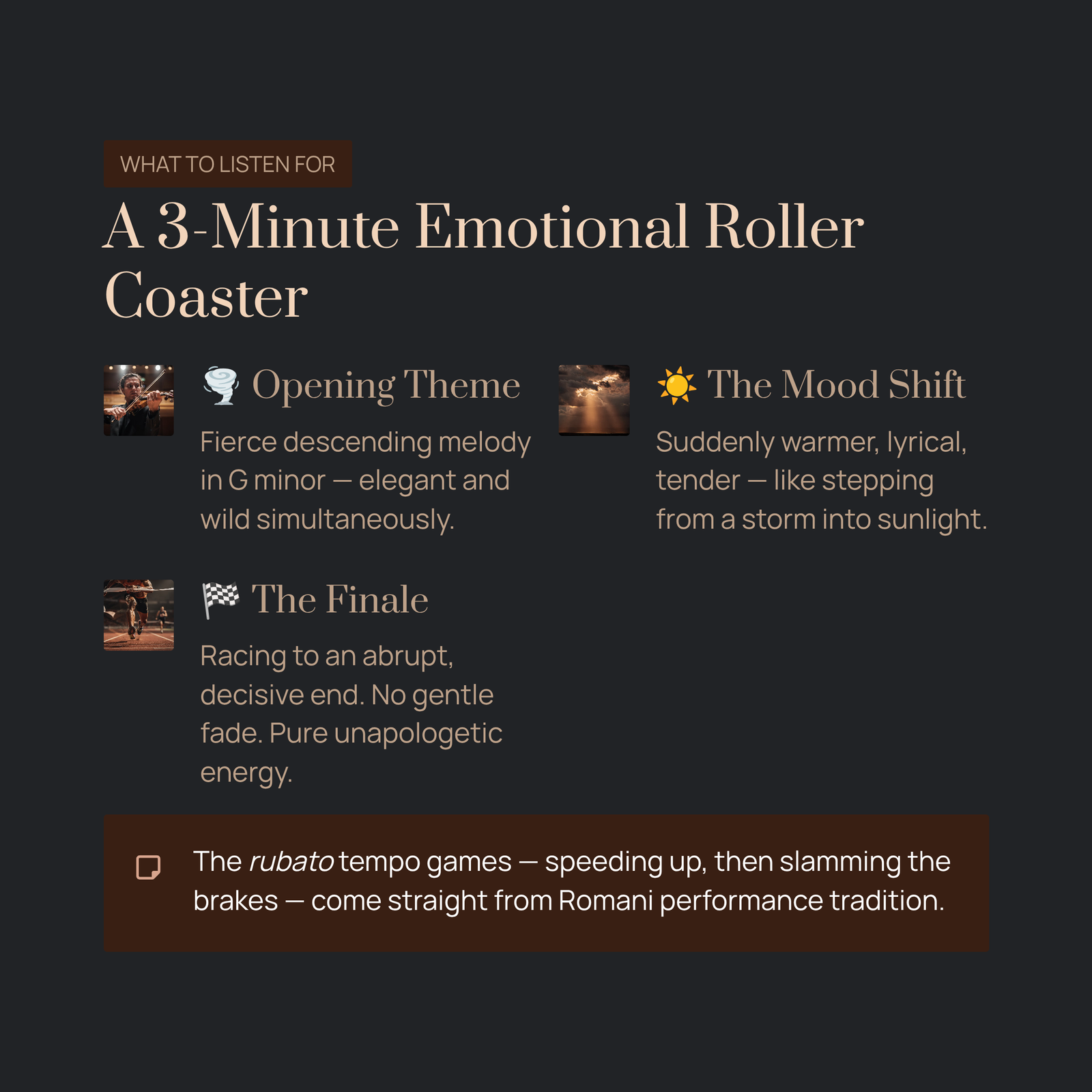
The magic of Hungarian Dance No. 5 lies in its contrasts. The piece is built on a structure that keeps pulling the rug out from under you, and that’s exactly what makes it so thrilling. Here’s what to pay attention to:
The opening theme arrives like a gust of wind — a fierce, descending melody in G minor that moves with restless energy. The rhythm has a characteristic snap to it, an almost aggressive lilt that comes from the Hungarian csárdás tradition. Picture a dancer who plants their heel on the floor with absolute conviction. That’s the energy here. Let yourself feel the tension in those first bars; the melody is simultaneously elegant and wild.
Then, without warning, the mood shifts. A new theme enters in a major key — suddenly warmer, more lyrical, almost tender. It’s like stepping out of a storm into unexpected sunlight. This contrast is the heartbeat of the piece. Brahms doesn’t just change the notes; he changes the entire emotional atmosphere. If the opening is a challenge, this middle section is an embrace.
And then the tempo games begin. This is where Hungarian Dance No. 5 becomes truly unforgettable. The music accelerates, pulling you forward with increasing excitement, then suddenly — slam — it brakes, stretching a phrase out with almost teasing deliberation. These rubato passages, these dramatic pushes and pulls of tempo, are directly inherited from Romani performance practice. Great conductors and pianists treat these moments like a conversation with the audience: speeding up to build anticipation, then holding back just long enough to make the next explosion even more satisfying.
Listen for the final return of the opening theme. It comes back with even more ferocity than before, racing toward a conclusion that feels like a sprint to the finish line. The ending is abrupt, decisive, almost like a slammed door. No gentle fade. No lingering farewell. Just pure, unapologetic energy.
My Encounter with This Dance
I remember the first time Hungarian Dance No. 5 truly registered for me — not as background music, not as a vaguely familiar tune, but as something alive and breathing.
I was in the middle of an ordinary afternoon, half-focused on something forgettable, when a recording came on. Within seconds, my attention was hijacked. The music didn’t politely request my focus; it commandeered it. I found myself leaning forward, caught between wanting to laugh at the sheer audacity of its tempo changes and wanting to hold my breath through the slower passages.
What struck me most was how physical the music felt. This wasn’t something to be contemplated from a velvet seat. It was music for stomping feet, for clenched fists, for spinning until the room blurred. And yet, threaded through all that exuberance, there was a vein of melancholy — a bittersweet ache in the minor key that reminded me that the most joyful dances often carry the heaviest hearts.
I think that’s why this piece endures. It doesn’t ask you to understand music theory or know anything about Brahms’ biography. It asks you to feel — and then it makes that feeling unavoidable.
How to Listen: Recordings That Bring This Dance Alive
One of the great pleasures of Hungarian Dance No. 5 is hearing how different performers interpret its dramatic tempo shifts. Here are some recordings that offer distinctly different windows into the same piece:
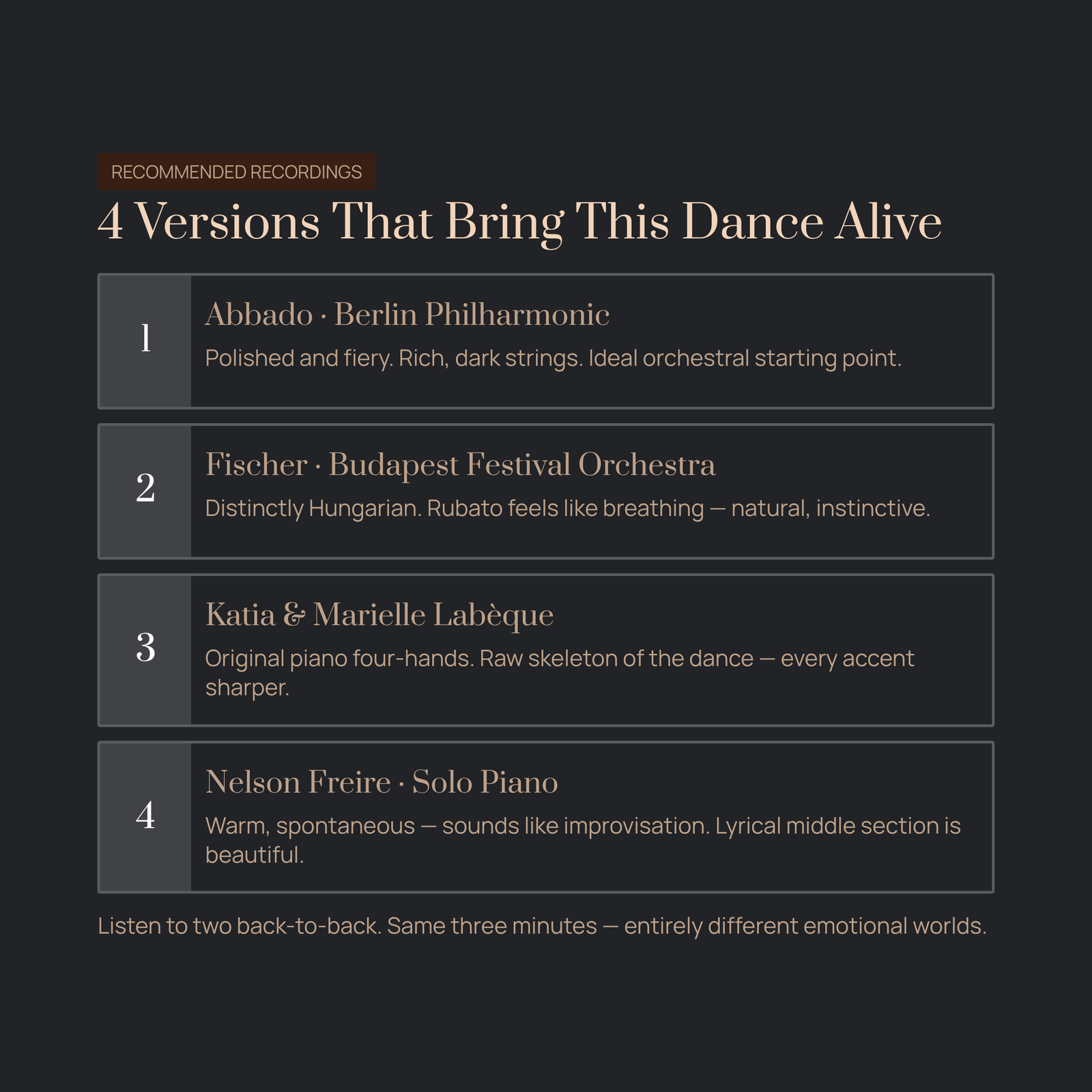
Claudio Abbado with the Berlin Philharmonic delivers an orchestral version that is both polished and fiery. Abbado understood that the piece needs discipline and abandon — his reading has impeccable balance, with the Berlin strings producing a rich, dark tone in the opening that gradually gives way to breathtaking momentum. This is an ideal starting point if you want the full orchestral experience.
Ivan Fischer with the Budapest Festival Orchestra brings a distinctly Hungarian sensibility to the performance. There’s a looseness and authenticity to the rubato here that you won’t find in more meticulous readings. The tempo fluctuations feel less like interpretive choices and more like breathing — natural, instinctive, rooted in the tradition from which the music sprang. If you want to hear this piece the way it might have sounded in a Budapest café, Fischer is your guide.
For the original piano four-hands version, seek out the recording by Katia and Marielle Labèque. Their performance crackles with sibling chemistry and rhythmic precision. Hearing the piece on piano strips away the orchestral grandeur and reveals the raw skeleton of the dance — every accent sharper, every silence more charged. It’s a reminder that Brahms conceived this music for the most intimate of settings: two people at one keyboard.
Nelson Freire’s solo piano arrangement is another revelation. Freire plays with a warmth and spontaneity that makes the piece sound like an improvisation, as if he’s discovering the melodies for the first time. His touch in the lyrical middle section is particularly beautiful — gentle without ever becoming sentimental.
Try listening to at least two of these versions back to back. You’ll be amazed at how the same three minutes of music can feel like entirely different emotional experiences depending on who is performing.
Why Three Minutes Can Change Everything
There’s a quiet lesson tucked inside Hungarian Dance No. 5, one that has nothing to do with music history or compositional technique.
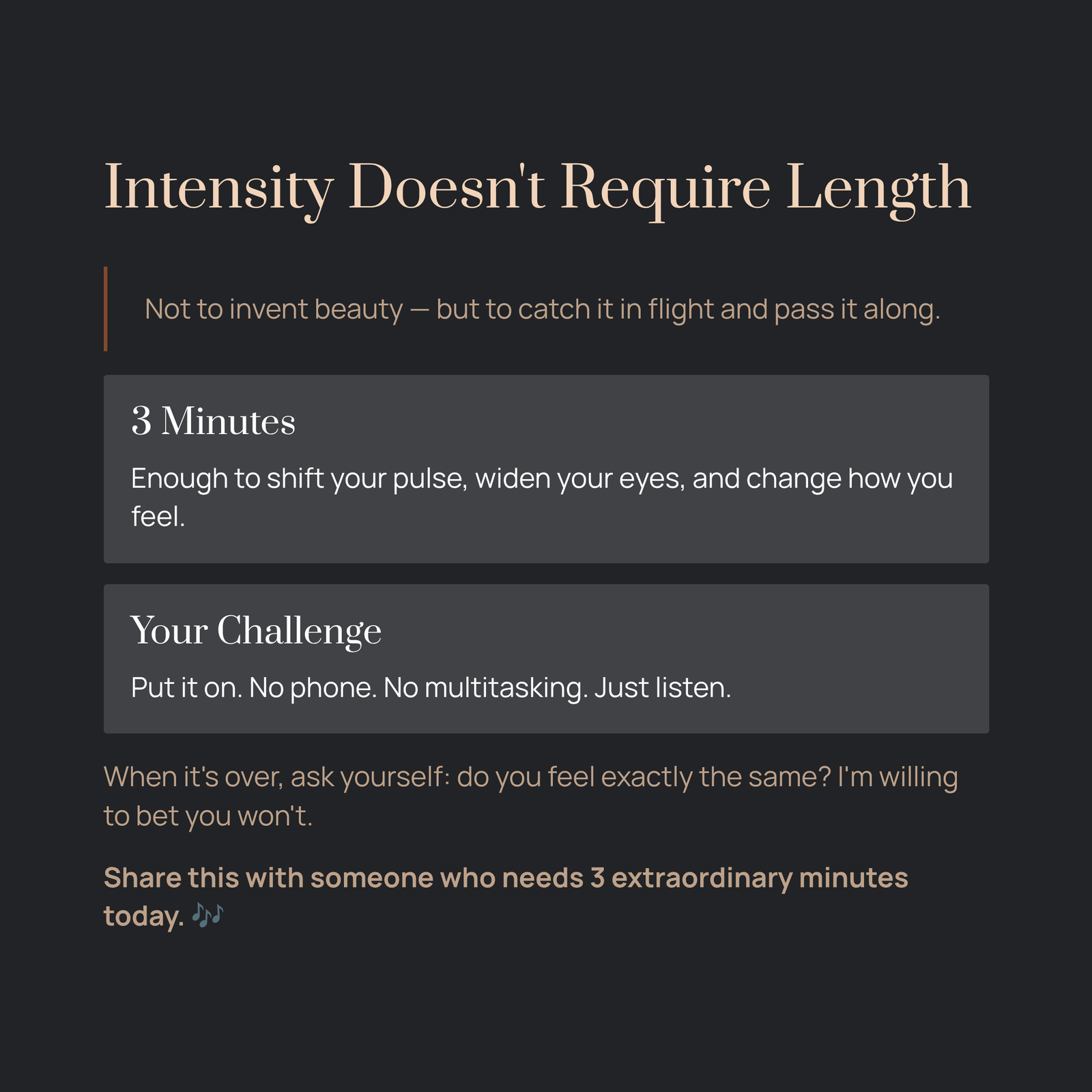
It’s this: intensity doesn’t require length.
We live in an era that often equates depth with duration — longer novels, longer films, longer playlists. But Brahms’ little dance reminds us that a single, concentrated burst of expression can leave a mark that hours of ambient noise cannot. Three minutes. That’s all it takes for this piece to shift your pulse, widen your eyes, and leave you sitting in the silence afterward wondering what just happened.
The melody wasn’t even originally his. The tradition wasn’t his either. What Brahms did was recognize something extraordinary when he heard it, and give it a form that could travel across centuries and continents. In a way, that’s the most human thing a musician can do — not to invent beauty, but to catch it in flight and pass it along.
So the next time you have three minutes — just three — put on Hungarian Dance No. 5. Don’t read while it plays. Don’t check your phone. Just listen. Let the first theme grab you. Let the mood shift surprise you. Let the tempo toy with your expectations.
And when it’s over, ask yourself if you feel exactly the same as you did before it started. I’m willing to bet you won’t.