📑 Table of Contents
There’s a particular kind of melody that feels less like a discovery and more like a memory. You hear the opening bars and something in your chest tightens, as though the music had been waiting for you somewhere just out of reach. The third movement of Brahms’s Third Symphony is exactly that kind of music.
If the melody sounds strangely familiar, you’re not imagining it. Over the decades it has been borrowed by film composers, reshaped into a famous French pop song, and woven into countless soundtracks meant to signal tender heartbreak. But Brahms got there first, in 1883, with nothing more than an orchestra and a feeling he couldn’t quite name.
It begins with the cellos, singing a long, curving line that seems to sigh as much as it sings. There’s no grand fanfare, no dramatic announcement. The music simply opens, the way a window opens onto a courtyard in late afternoon light.
Who Was Brahms, and Why Did He Wait So Long?
Johannes Brahms (1833–1897) was a German composer who carried an almost unbearable weight on his shoulders: the expectation that he would be the rightful heir to Beethoven. That pressure was so intense that he didn’t finish his First Symphony until he was in his forties, having spent more than twenty years agonizing over it.
By the time he wrote the Third Symphony in the summer of 1883, Brahms was at the height of his powers. He composed it quickly, during a peaceful stay in the German spa town of Wiesbaden, and the piece carries that summer’s warmth and contentment, even in its more shadowed corners.
Brahms was a man of deep reserve. He never married, destroyed many of his manuscripts before they could be studied, and guarded his private feelings fiercely. Yet his music tells the truth he kept hidden in conversation. This movement, in particular, feels like a letter he could only write in notes, never in words.
The Story Hidden in the Music
The third movement is marked Poco Allegretto, which simply means “a little lively,” though that description undersells its emotional pull. In the world of symphonies, the third movement is traditionally the lighter, dancing one, a moment of relief before the finale. Brahms turns that convention gently on its head.
Instead of a cheerful dance, he gives us a kind of slow waltz steeped in nostalgia, the musical equivalent of remembering something beautiful that you know you can’t return to. There’s tenderness here, but also a quiet ache. It is music that smiles with tears in its eyes.
The melody is famously passed around the orchestra like a story being retold by different voices. First the cellos carry it. Then the violins take it up. Later a solo horn, and then an oboe, each instrument coloring the same theme with its own character, the way the same memory feels different depending on who’s recalling it.
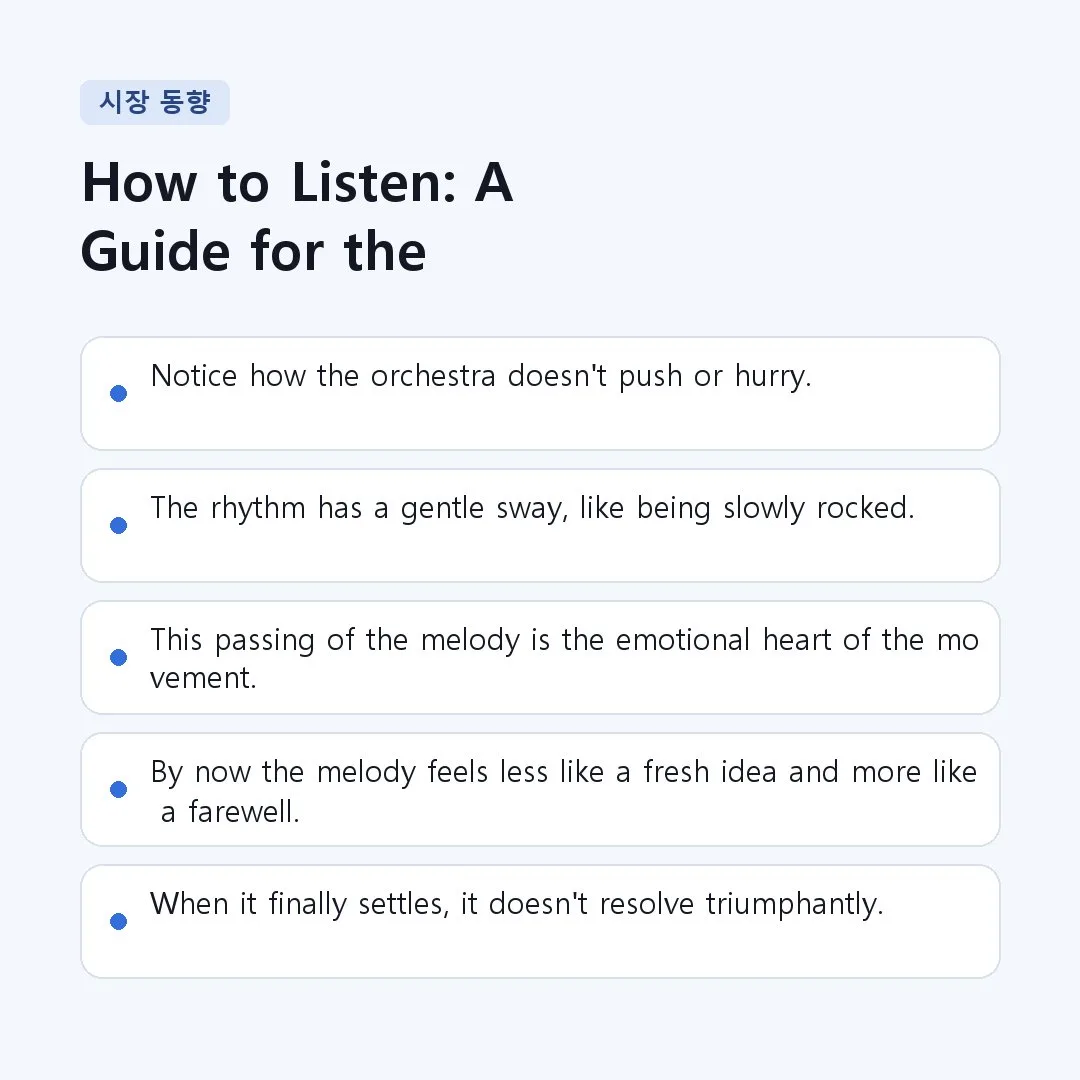
How to Listen: A Guide for the Three Minutes Ahead
You don’t need any technical knowledge to be moved by this music, but a few signposts can deepen the experience.
The opening (0:00–0:30): Listen for the cellos entering with that descending, sighing melody. Notice how the orchestra doesn’t push or hurry. The rhythm has a gentle sway, like being slowly rocked.
The handoff (around 0:40–1:30): Pay attention to how the main theme moves from the cellos up to the violins, gaining brightness as it rises. This passing of the melody is the emotional heart of the movement.
The middle section (around 1:40–3:00): The mood shifts slightly, becoming more searching and uncertain, before the music finds its way back home.
The return (the final minute): Listen for the solo horn taking up the theme one last time, with the oboe answering. By now the melody feels less like a fresh idea and more like a farewell. When it finally settles, it doesn’t resolve triumphantly. It simply fades, the way evening light fades, without ceremony.
The whole movement lasts only about six minutes. Give it your full attention once, in a quiet room, and it tends to stay with you.

Recordings Worth Your Time
Wilhelm Furtwängler with the Berlin Philharmonic — For listeners who want the music at its most emotionally expansive. Furtwängler stretches and breathes with the melody in a way that feels almost unbearably human. Older sound quality, but the interpretation is legendary.
Claudio Abbado with the Berlin Philharmonic — A beautifully balanced, warm recording that’s ideal for a first listen. Abbado lets the melody speak naturally without imposing too much on it. Modern, clear sound.
Bernard Haitink with the Royal Concertgebouw Orchestra — For those who appreciate refinement and transparency. Haitink finds the autumn light in this music, gentle, unhurried, and deeply felt.
If you only have time for one, start with Abbado. It’s the kind of recording that welcomes you in.
Why This Music Still Matters
There’s a reason this melody keeps resurfacing across generations and genres. It captures something we all recognize but rarely manage to say out loud: the bittersweet feeling of loving something we know is passing. Brahms, the most private of men, found a way to make that universal.
The next time you feel the weight of a quiet evening, or the ache of a memory you can’t quite let go of, let these few minutes play. You may find that Brahms understood you long before you were born.