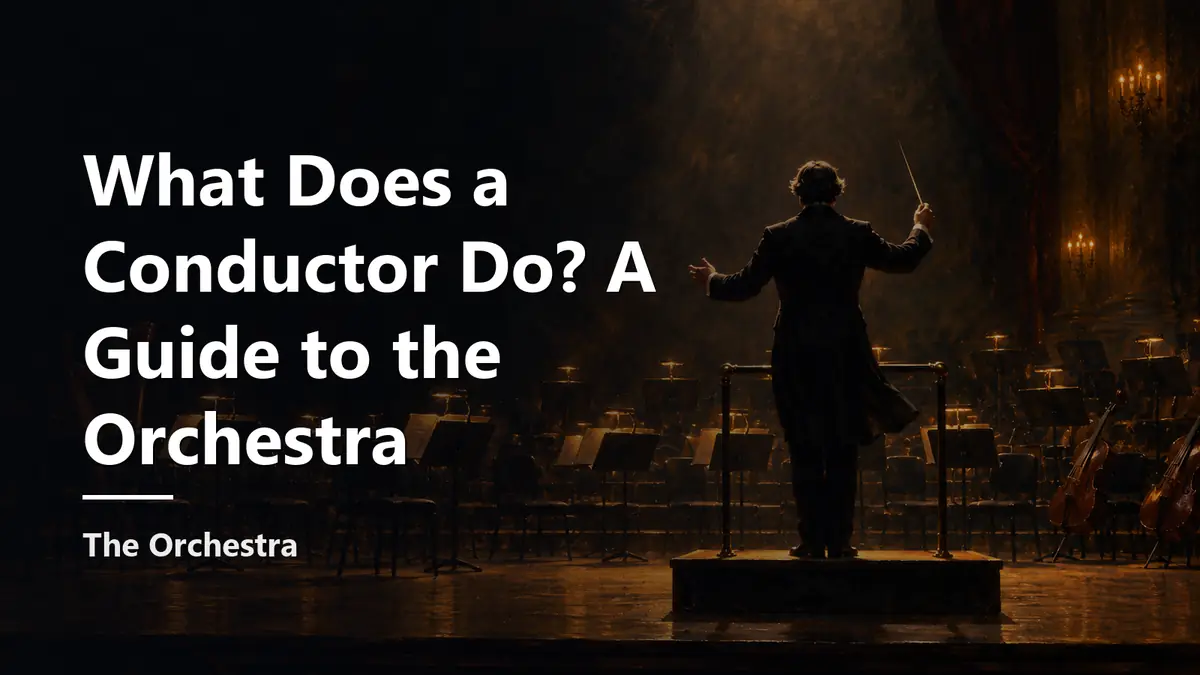
A conductor helps an orchestra agree on how a piece should sound, then guides its musicians through the performance. Keeping a shared beat is part of the job, but so are shaping phrases, balancing instruments, and signaling entrances when the music becomes complicated.
You can hear those choices even if you never watch the podium. A passage might move forward urgently or unfold with more room to breathe; a quiet melody might emerge clearly from a large orchestra or nearly disappear into it.
📑 Table of Contents
How Orchestra Sections Work Together
An orchestra brings several families of instruments into one conversation. Strings usually form the largest group: violins, violas, cellos, and double basses. Woodwinds such as flutes, oboes, clarinets, and bassoons add distinct colors; brass instruments provide both soft harmonies and powerful peaks. Percussion supplies accents, rhythms, and, with instruments such as timpani, pitches.
On a typical stage, the strings sit toward the front, woodwinds near the middle, brass farther back, and percussion toward the rear. The exact arrangement changes with the hall, the piece, and the orchestra. From the podium, the conductor can see the players across these groups and help them respond to one another.
That coordination matters because sound does not reach every player at precisely the same moment. Musicians rely chiefly on listening to each other, while also using the conductor’s movements as a shared visual reference. A clear gesture can help a distant brass player and a violinist at the front enter together.
Balance is another challenge. A flute can be easy to hear over a few quiet strings and difficult to hear over a full brass section. The conductor helps the orchestra decide which musical line should come forward, asking one group to play more lightly or another to bring out a phrase.
What Happens in a Conductor Rehearsal?
Much of a conductor’s work happens before an audience arrives. The conductor studies the score, which shows the parts for all the instruments, and forms a view of the piece’s pace, character, and shape. At rehearsal, that view becomes a set of practical choices the musicians can test together.
A conductor might ask the strings to begin a note more sharply, give the woodwinds more space in a transition, or adjust the speed so a long phrase holds together. Players also offer their own judgment. Rehearsal is where an orchestra works out how its many individual decisions will fit into a single performance.
The conductor must decide where to spend limited rehearsal time. A difficult entrance may need several attempts, while a familiar passage may need only a reminder about balance. That preparation is one reason an orchestra can appear to respond so easily onstage: many of its decisions have already been made and practiced.
What the Conductor Does During a Performance
The conductor’s hands communicate different kinds of information. One hand may show a repeating beat pattern while the other shapes a phrase or invites a section to enter. A small movement can suggest restraint; a broad gesture can ask for a fuller sound. Musicians also watch posture, breathing, and eye contact.
The beat itself is useful, especially when many players must change speed together. But following every motion literally would make for stiff music. Experienced players listen across the orchestra and use the conductor’s gestures to confirm a shared direction.
Watch what happens just before a quiet entrance. A conductor may look toward the players who are about to begin and give them a preparatory motion, often called a cue. It helps them know both when to play and how the phrase should start. When a passage grows louder or softer, the conductor can guide the change so it feels gradual and unified.
The job also involves reacting. A solo line may take a little more time than it did in rehearsal, or sound may carry differently in a particular hall. The conductor listens, adjusts, and helps the rest of the orchestra stay with that moment.
Three Symphonies That Make the Job Easier to Hear
In Mozart’s Symphony No. 41, often called the Jupiter, try the beginning of the first movement. Notice how a bold opening gives way to lighter responses. The conductor helps those changes of weight and character feel connected, while keeping the players together through the quick exchanges. Our guide to Mozart’s Jupiter Symphony offers a closer look at that opening.
For Beethoven’s Symphony No. 9, start at the beginning of the finale and follow its changing orchestral textures toward the entrance of the voices. The conductor’s task expands when solo singers and chorus join the orchestra: everyone needs room to be heard and a clear sense of where the music is going. Our guide to Beethoven’s Ninth gives you another way into the work.
Mahler’s Symphony No. 2 offers an especially large scale. Start with the opening of the first movement and listen for the contrast between forceful passages and moments that pull back. Later, when voices join the symphony, the conductor must help a much wider range of sounds fit into its long arc. You need not track every gesture to hear the result: pay attention to whether each change feels prepared and each new sound has a place.
Famous Orchestras and Conductors
Orchestras develop recognizable sounds through their players and traditions, while conductors help shape what happens in particular rehearsals and performances. The New York Philharmonic and Leonard Bernstein, the Chicago Symphony Orchestra and Georg Solti, and the Berlin Philharmonic and Simon Rattle are well-known orchestra–conductor partnerships.
A recording by one of these ensembles can be a useful point of comparison, but names alone will not tell you what you will hear. Try the same passage in two performances and ask simple questions: Does one feel faster? Can you hear a melody more clearly in one? Does a quiet moment seem intimate or tense? Those differences reveal the choices a conductor and orchestra make together.
No conductor creates an orchestra’s sound single-handedly. The musicians bring skill, attention, and ideas to every performance. The conductor’s contribution is to help those players make a convincing whole from music that gives them many possible ways forward.
Frequently Asked Questions
Do orchestras need a conductor?
Large orchestras often benefit from one, especially in music with many instruments, changing tempos, or entrances spread across the stage. Smaller ensembles can perform without a conductor by listening closely, watching one another, and agreeing on their approach in rehearsal.
Why does a conductor use a baton?
A baton makes the beat and other gestures easier for players to see from a distance. Some conductors use one, and some use only their hands; clarity matters more than the object.
Are musicians watching the conductor the whole time?
No. They read their music, listen to nearby and distant players, and glance toward the conductor when they need a cue or a sense of the larger shape. Much of their coordination comes from doing all three at once.
Sources
Cover art: Cover illustration generated with AI image tools; contains no real person.