Table of Contents
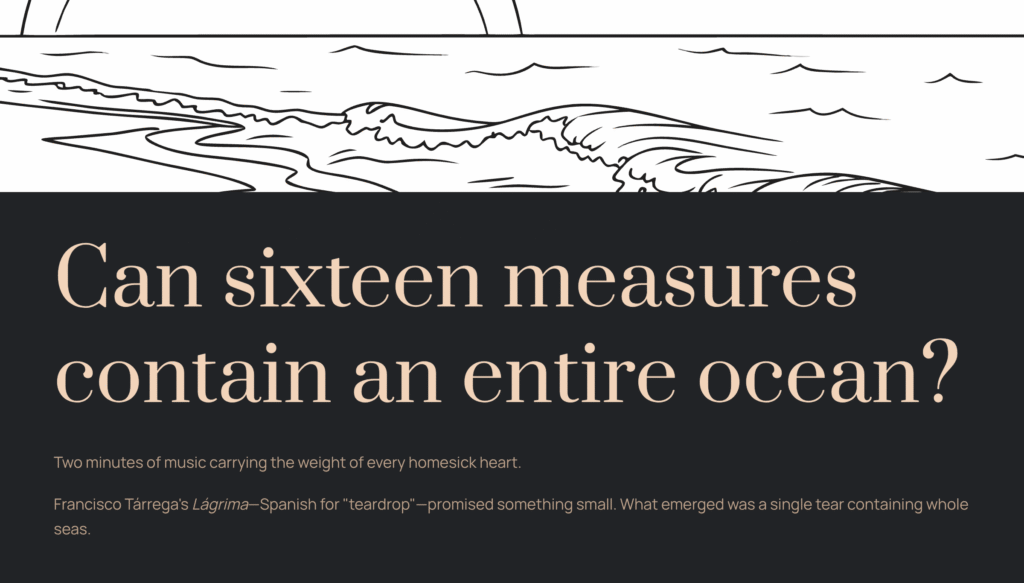
Can sixteen measures contain an entire ocean? Can two minutes of music carry the weight of every homesick heart that’s ever beaten?
I asked myself this the first time I heard Francisco Tárrega’s Lágrima. The title itself—Spanish for “teardrop”—promised something small, something you could hold in your palm. What I didn’t expect was how that single tear could contain whole seas.

The Composer Abroad: Tárrega’s London Longing
Picture London in the 1880s. Fog rolling through gas-lit streets, the constant rumble of carriages over cobblestone. And somewhere in that sprawling city, a Spanish guitarist sits alone with his instrument, thinking of home.
Francisco Tárrega had traveled far from the sunlit plazas of Spain. He was building his reputation, yes—establishing himself as one of the finest classical guitarists of his generation. But success has a price, and that price is often paid in miles between you and everything you love.
So he wrote Lágrima. Not a grand statement, not a showy virtuoso piece. Just sixteen measures. Just two minutes. Just one teardrop falling onto the strings of his guitar.
And somehow, that was enough to change classical guitar music forever.

The Architecture of Longing: Understanding Lágrima’s Structure
Lágrima follows what musicians call an A-B-A form—think of it as a journey that returns home. But here’s where Tárrega’s genius emerges: he uses this simple structure to mirror the very emotion he’s capturing.
The First Voice (A Section – E Major)
The piece opens in E Major. Now, you might remember from music class that major keys are supposed to sound happy, bright, optimistic. But listen to these opening measures. Do they sound joyful to you?
This is Tárrega’s first magic trick. He takes a major key—typically reserved for celebration—and wrings sadness from it. It’s like watching sunlight fall on an empty room. The light itself is beautiful, but the emptiness makes your heart ache.
The melody sings out in the upper voice, simple and direct, like someone speaking to you across a great distance. Below it, harmonies move in what guitarists call parallel thirds—imagine two people walking side by side, their footsteps perfectly synchronized. It creates a fullness, a sense that the guitar is somehow larger than itself, holding multiple conversations at once.
The Middle Distance (B Section – E Minor)
Then something shifts. We move to E Minor, and the guitar climbs higher up its neck, reaching for something just out of grasp. Minor keys are supposed to sound sad, right? But in Tárrega’s hands, this section feels almost hopeful—restless, perhaps, but alive with possibility.
This is his second trick: inverting our expectations entirely. The “happy” key sounds mournful. The “sad” key sounds searching, almost optimistic. It’s as if he’s telling us that homesickness isn’t simple—it’s not just sadness. It’s a complicated swirl of memory and hope, of what was and what might be again.
The Return (A Section Revisited)
And then we come home. The opening melody returns, but it feels different now. We’ve taken a journey, we’ve reached for something higher, and now we’re back where we started—but we’re not the same. That’s the power of this circular structure. It tells us that longing doesn’t resolve—it just continues, wave after wave, tear after tear.

The Guitar Speaks: Tárrega’s Instrumental Poetry
One of the reasons Lágrima endures is how perfectly it captures the essential character of the classical guitar. This isn’t music that could be easily transferred to piano or violin—it lives in the very nature of the instrument.
Notice how each note seems to linger in the air, sustaining just long enough to overlap with the next. The guitar creates its own echo chamber, each sound bleeding into the next like watercolors on wet paper. This is what guitarists call sustain, and in Lágrima, it becomes a form of emotional amplification. The notes don’t just sound—they resonate, they breathe, they refuse to let go.
And then there’s the texture. Tárrega uses parallel thirds and tenths throughout—technical terms for a simple effect: fullness. The guitar sounds like it’s playing multiple voices simultaneously, like a small choir contained in wood and string. You hear the melody, yes, but you also hear the warm cushion of harmony beneath it, supporting it, cradling it like hands cupped around a flame.
This is why Lágrima works so beautifully as both a technical study and an emotional statement. Students practice it to master position shifts, to learn how to voice multiple lines clearly, to develop their sense of dynamics. But in doing so, they’re also learning something more essential: how to make an instrument sing, how to find voice in wood and steel.

Your Listening Journey: A Practical Guide to Lágrima
Let me offer you a way into this music. Not an academic analysis, but a path you can walk yourself.
First Listen: The Complete Arc
Don’t overthink it. Just listen to the whole piece—all two minutes. Let it wash over you. Notice when the mood shifts. Feel when the guitar climbs higher, when it returns to its opening territory. This piece is short enough that you can hear its entire shape in one sitting, like looking at a small sculpture from every angle.
Second Listen: Follow the Melody
Now, focus on the top voice—the melody line. This is the “singer” in the texture. Everything else is accompaniment. Let that melody guide you like following a single thread through a tapestry. Notice how it rises and falls, how it seems to ask questions and receive no answers.
Around the one-minute mark, you’ll hear the guitar shift position—the melody moves higher up the neck. That’s your B section beginning. The character changes here, becomes more urgent, more restless. Then, around 1:30, we descend again. That’s the return home.
Third Listen: Discover the Shadows
This time, shift your attention to what’s beneath the melody. Those moving harmonies, those parallel voices that follow the main line like shadows in evening light. This is where Tárrega’s sophistication lives—in how he makes one instrument sound like many, how he fills the space between the notes.
Try this: close your eyes and imagine each voice as a separate person. The melody is one friend speaking. The bass line is another, steady and grounding. The middle voices are others, adding commentary, filling silence, creating community in solitude.
Fourth Listen: Find the Heartbeat
Notice the tempo—Andante, which means “walking pace.” This isn’t rushed. It moves at the speed of thought, of remembrance, of a slow walk through a city where you don’t belong, thinking of the place where you do.
Count the measures if you like—you’ll find only sixteen. Sixteen measures to say everything Tárrega needed to say about longing and distance and the peculiar pain of being far from home.
A Specific Moment to Treasure
At approximately 1:20 (though this varies by performance), listen for the transition back to the A section. There’s often a slight ritardando—a slowing down—as the music prepares to return home. In this moment, you can hear time itself stretching, as if the piece is reluctant to complete its circle, reluctant to admit that longing has no resolution.
The Sound of Distance: Why Lágrima Endures
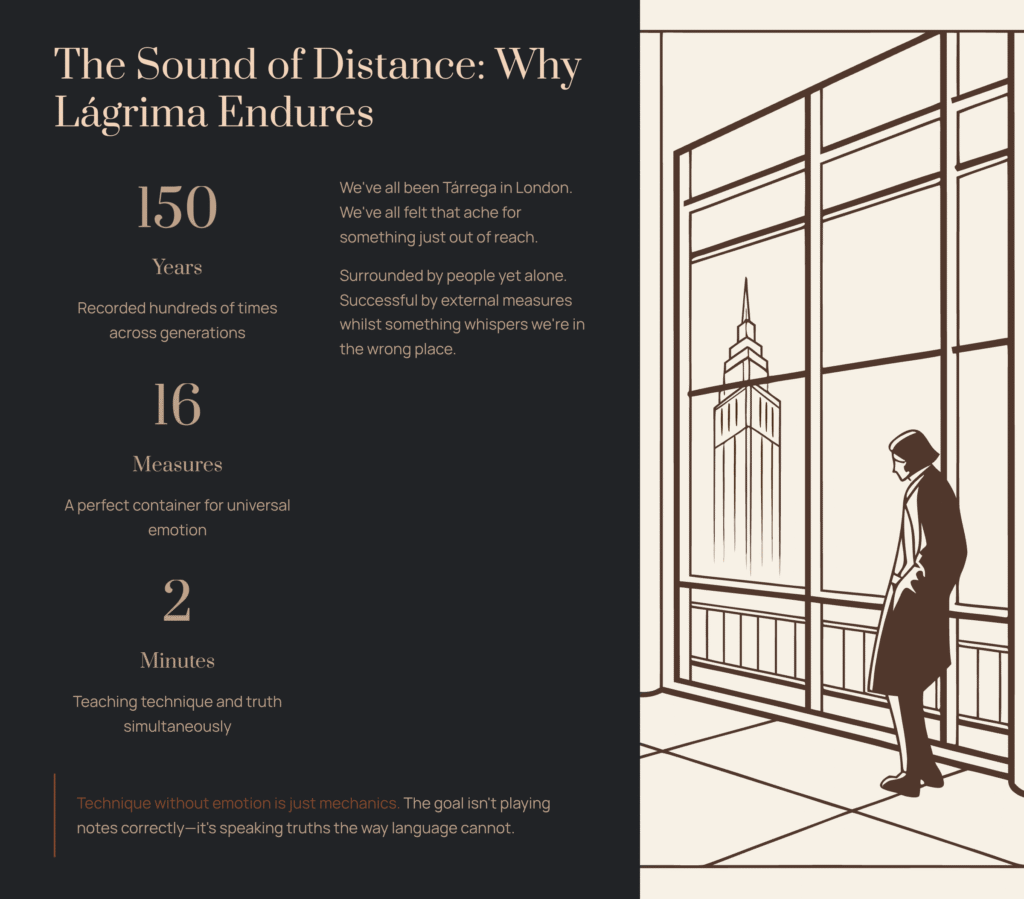
Lágrima has been recorded hundreds of times by classical guitarists across 150 years. It’s a standard in the repertoire, a piece that every serious guitar student encounters. But it’s not just an educational tool—it’s a small, perfect container for an emotion everyone understands.
Because here’s the truth: we’ve all been Tárrega in London. Maybe not literally—maybe we’ve never left our hometown—but we’ve all felt that ache for something or someone just out of reach. We’ve all known what it means to be surrounded by people and still feel alone, to be successful by external measures while something inside us whispers that we’re in the wrong place.
That’s what Lágrima captures. Not just homesickness for a geographical location, but that deeper displacement—the sense that somewhere, somehow, there’s a version of our lives that feels more like home than where we currently stand.
Tárrega wrote this piece as an étude, a study piece for his students. He was teaching them technique: position shifts, voicing, dynamic control. But he was also teaching them something else—that technique without emotion is just mechanics, that the goal of mastering an instrument isn’t to play notes correctly but to speak truths the way language cannot.
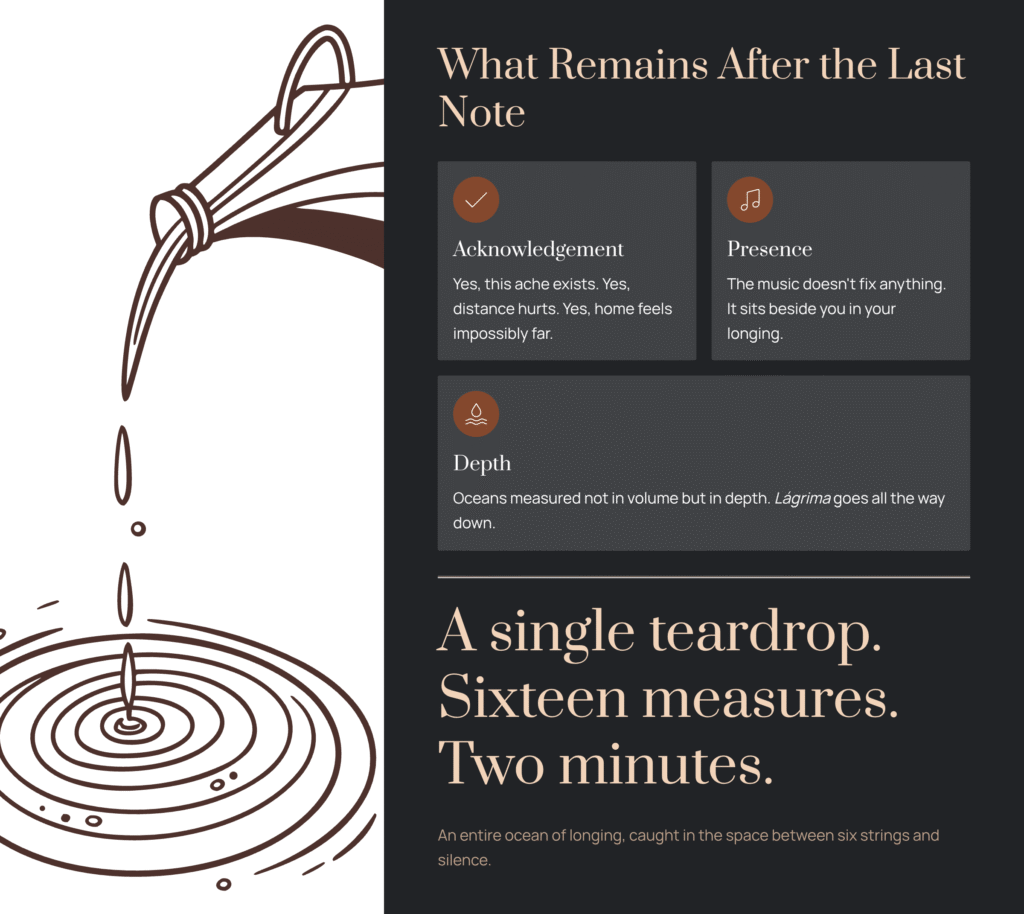
What Remains After the Last Note
The genius of Lágrima lies in what it doesn’t do. It doesn’t resolve the longing it expresses. It doesn’t offer comfort or solution. It simply acknowledges—yes, this ache exists. Yes, distance hurts. Yes, home can feel impossibly far away.
And somehow, that acknowledgment is enough.
When the final note fades—that last E Major chord settling into silence—you’re left not with answers but with presence. The music doesn’t fix anything. It just sits beside you in your longing, like a friend who knows when words would be too much.
This is why a piece of music only sixteen measures long can contain an ocean. Because oceans aren’t measured in volume but in depth. And Lágrima, tiny as it is, goes all the way down to where we keep our most universal truths—about distance and desire, about what we lose when we leave and what we carry with us always, about how sometimes the smallest vessels hold the most profound contents.
A single teardrop. Sixteen measures. Two minutes of your life.
An entire ocean of longing, caught in the space between six strings and silence.