📑 Table of Contents
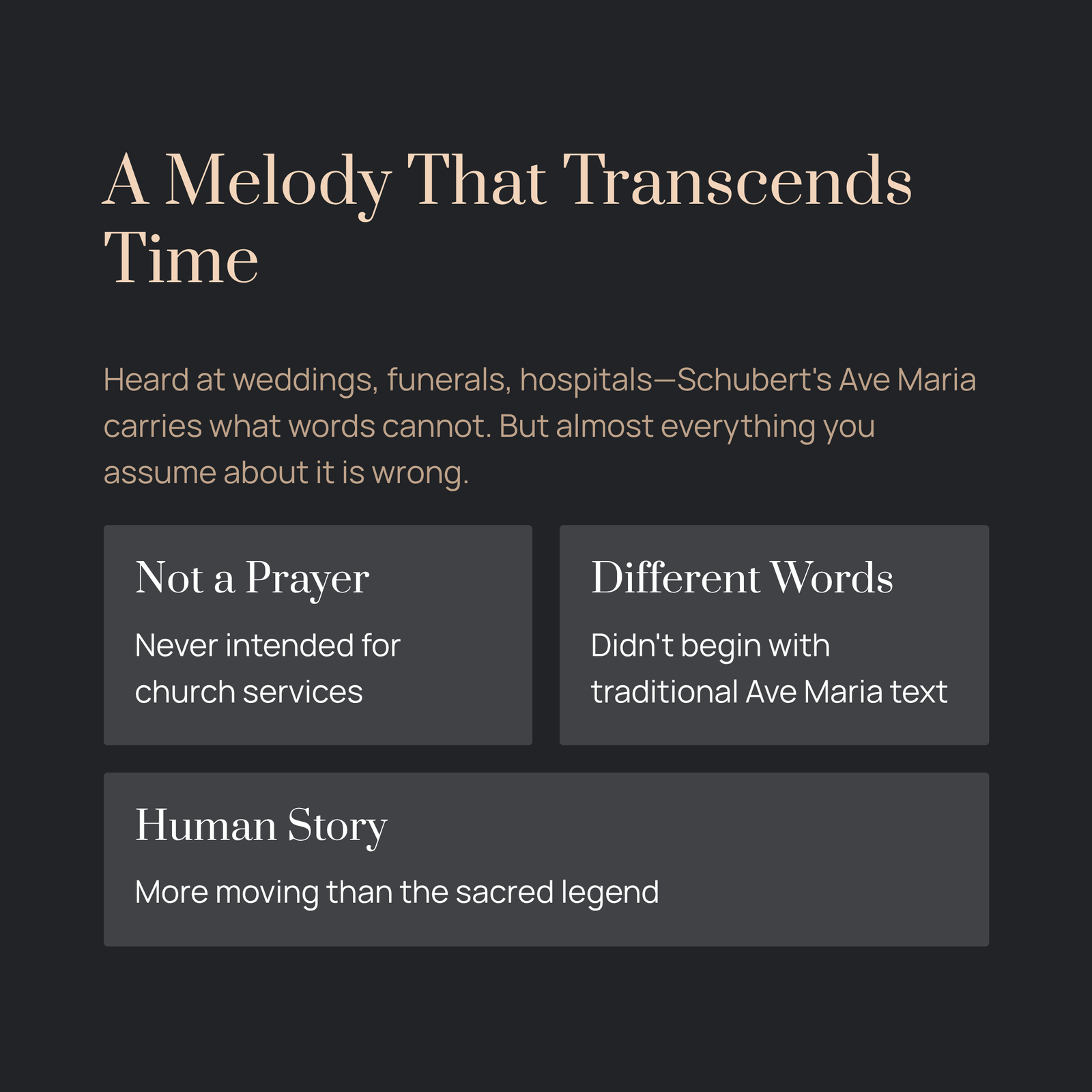
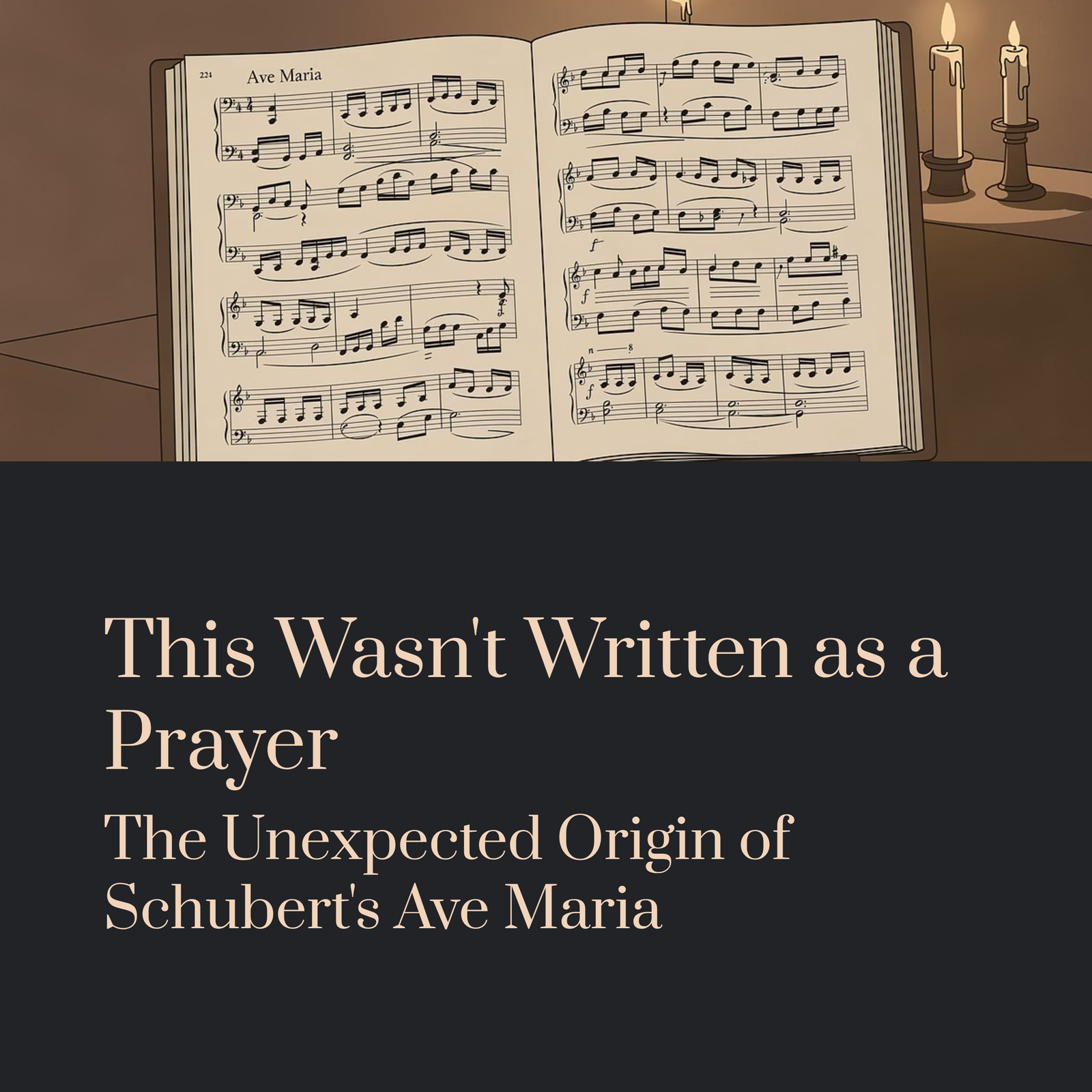
There is a melody that seems to have existed before it was ever written down. You have heard it at weddings, at funerals, in cathedrals where candlelight traces the edges of stone arches. You have heard it in hospitals, in quiet rooms, in those fragile hours when words feel too heavy and only music can carry what needs to be said. It is Schubert’s Ave Maria — and almost everything you assume about it is wrong.
This piece was never intended as a prayer. It was not composed for a church service. It did not even begin with the words “Ave Maria” as we know them today. The true story behind this melody is stranger, more human, and ultimately more moving than the sacred legend it has become.
A Young Composer and a Scottish Poem
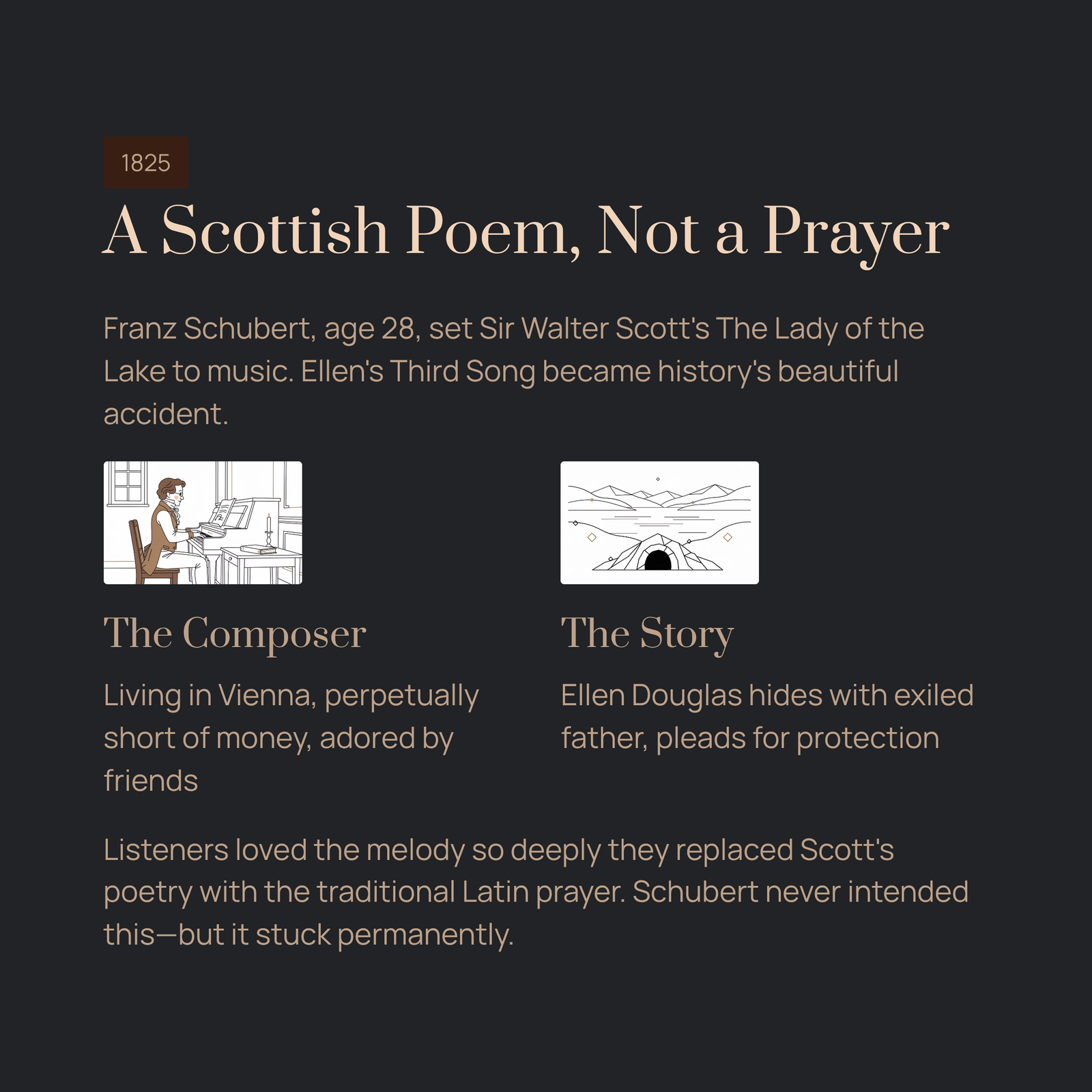
Franz Schubert wrote this piece in 1825, when he was twenty-eight years old. He was living in Vienna, perpetually short of money, surrounded by a close circle of friends who adored his music even as the wider world largely ignored it. That summer, he was captivated by a German translation of Sir Walter Scott’s narrative poem The Lady of the Lake, a sweeping tale of love, exile, and conflict set in the Scottish Highlands.
Schubert decided to set seven songs from this poem to music, and the third of these — titled Ellens dritter Gesang (Ellen’s Third Song), catalogued as D.839 — is what the world now calls “Ave Maria.” In the poem, a young woman named Ellen Douglas hides with her exiled father in a cave by a lake. Frightened and desperate, she kneels before a statue of the Virgin Mary and sings a plea for protection. The opening words happen to be “Ave Maria,” but the rest of the original text follows Scott’s narrative, not the traditional Latin prayer.
What happened next is one of music history’s most fascinating accidents. Listeners were so moved by the melody that they began singing the traditional Catholic Ave Maria prayer over Schubert’s music instead of Scott’s poetry. Schubert himself never intended this pairing, yet the melody fit the Latin words so naturally that the substitution stuck — permanently.
The Architecture of Gentleness
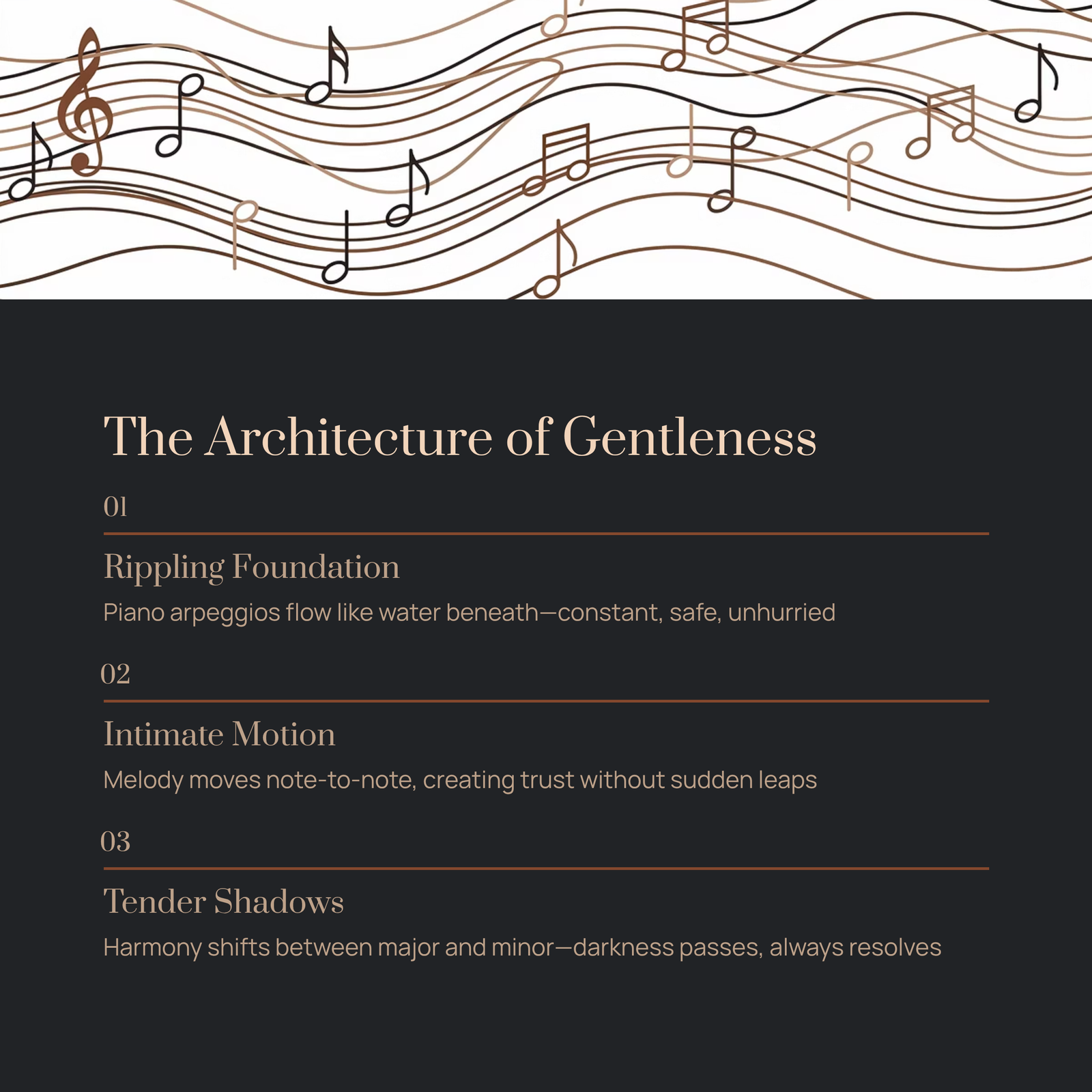
Understanding why this melody affects us so deeply requires listening to how it is built, even if you have never read a note of music in your life. The piece opens with a piano figure that ripples like water — arpeggiated chords that rise and fall in a steady, unhurried pattern. This accompaniment never stops. It flows beneath the vocal line like a current beneath a calm surface, and it is this constancy that creates the feeling of safety the piece radiates.
The vocal melody enters softly, almost tentatively, as if afraid to disturb the stillness. It moves in stepwise motion — note to neighboring note — rarely making large leaps. This is important. Large intervals in music create drama and tension. Stepwise motion creates intimacy and trust. Schubert’s melody speaks the way a mother speaks to a frightened child: close, steady, without sudden movements.
The harmony shifts between major and minor with a tenderness that feels almost unbearable. There are moments — particularly in the middle section — where a shadow passes through the music, a flicker of darkness or doubt. But it never stays. The melody always returns home, always resolves, always forgives. This is not the forgiveness of theology. It is the forgiveness of breath itself, of a heart that simply refuses to stop beating.
Why It Still Reaches Us After Two Centuries
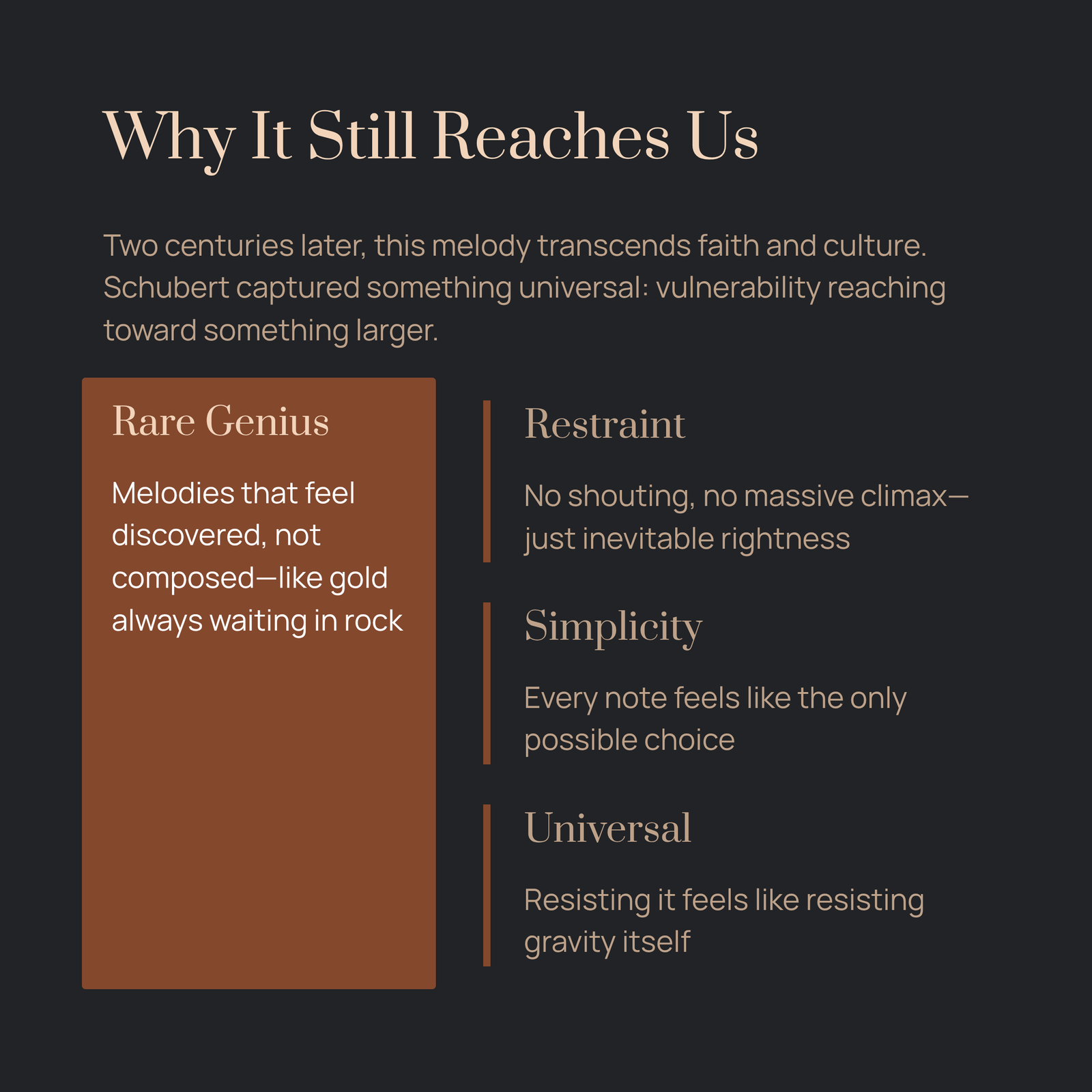
There is a reason this piece transcends every boundary of faith, culture, and context. It is not because of its religious association — many people who are moved to tears by this music have no connection to Catholicism or Christianity. It is because Schubert captured something universal: the sound of a human being reaching out from vulnerability toward something larger than themselves.
The genius of the piece lies in its restraint. Schubert does not shout. He does not build to a massive orchestral climax. He does not demand your attention with complexity or virtuosity. Instead, he offers a melody so simple, so inevitably right, that resisting it feels like resisting gravity. Every note seems to be the only possible note that could follow the one before it.
This quality — this sense of inevitability — is extraordinarily rare in music. Many composers can write beautiful melodies. Very few can write melodies that feel as though they were not composed at all, but discovered, like a vein of gold that was always there in the rock, waiting.
A Guide for Your Ears
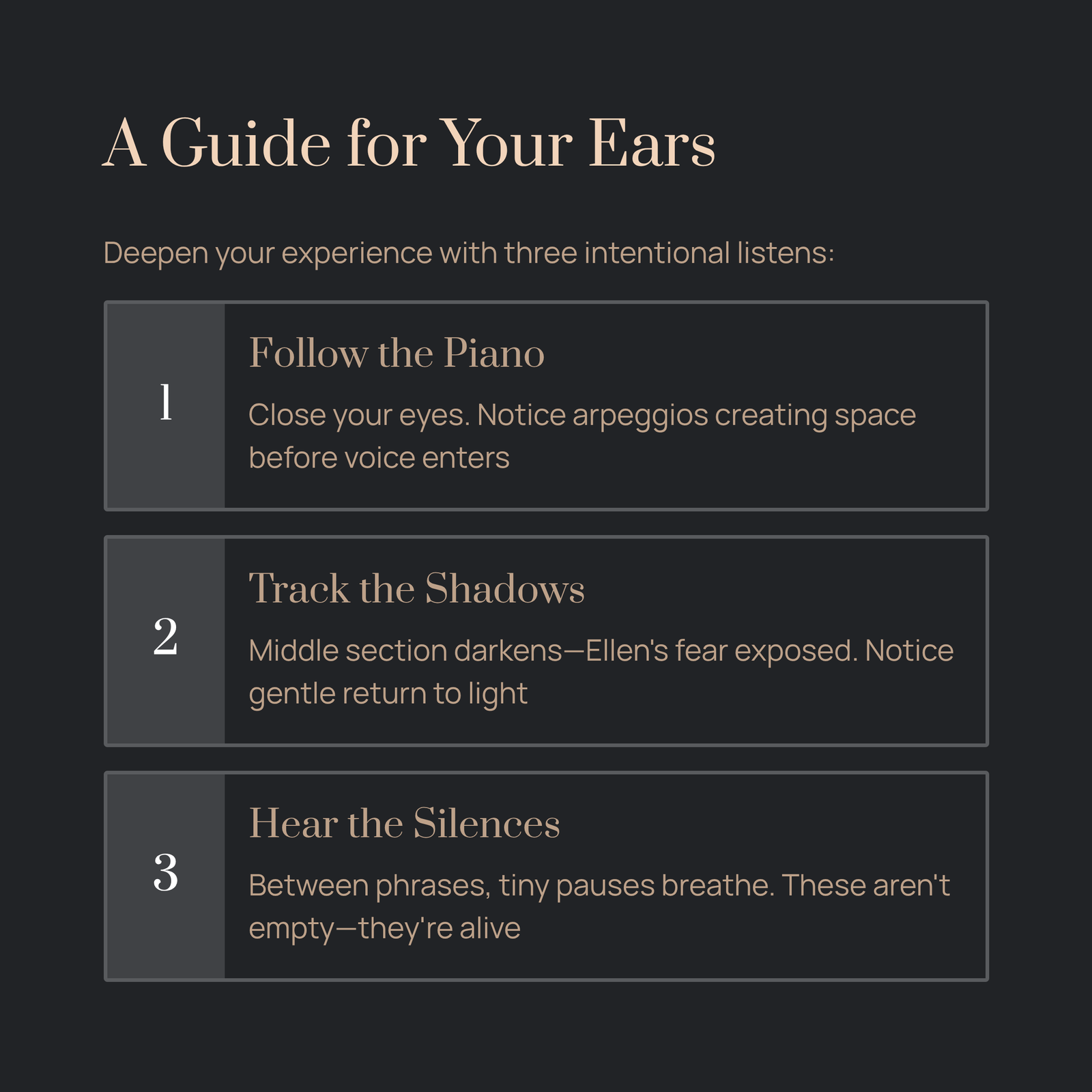
If you are listening to this piece for the first time — or the hundredth — here are some ways to deepen the experience.
First listen: Close your eyes and follow the piano. Before the voice enters, the piano establishes a world. Notice how the arpeggiated pattern creates a sense of space, almost like standing inside a room with high ceilings. Let that acoustic space settle around you before the melody arrives.
Second listen: Track the moments of shadow. Around the middle of the piece, the harmony darkens. The music moves into minor territory, and the vocal line becomes more urgent, more pleading. This is the emotional core — the moment where Ellen’s fear is most exposed. Notice how briefly this darkness lasts, and how gently the music guides itself back to the light.
Third listen: Pay attention to the silences. Between phrases, there are tiny pauses where the voice rests but the piano continues. These silences are not empty. They are where the music breathes, and where you breathe with it.
Recordings That Deserve Your Time
The interpretation of Ave Maria varies enormously depending on the performer. Here are recordings worth seeking out, each offering a different dimension of the piece.
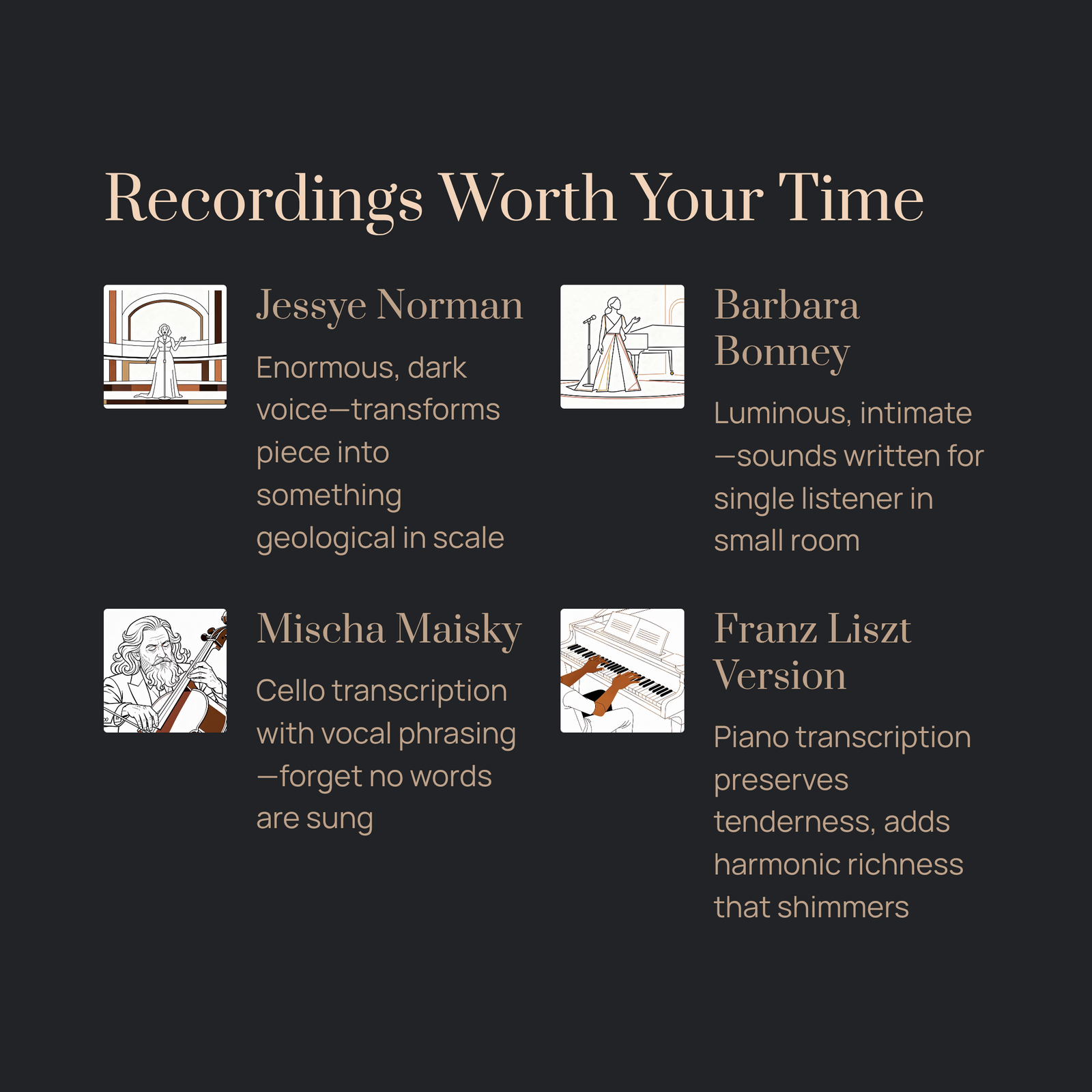
Jessye Norman delivers what might be the definitive vocal recording. Her voice — enormous, dark, and impossibly controlled — transforms the piece into something almost geological in scale. When she sings, the melody feels less like a prayer and more like the earth remembering something ancient.
Barbara Bonney, accompanied by Geoffrey Parsons, offers the opposite approach: luminous, transparent, intimate. Her version sounds like the piece was written for a single listener in a small room, and it is devastating in its simplicity.
For an instrumental experience, Mischa Maisky’s cello transcription is remarkable. The cello’s range and timbre are uncannily close to the human voice, and Maisky plays with a vocal phrasing that makes you forget no words are being sung.
If you enjoy piano alone, listen to Franz Liszt’s transcription (S.558 No.12). Liszt, who worshipped Schubert, created a piano version that preserves the original’s tenderness while adding harmonic richness that makes the piece shimmer.
The Sound That Remains
Schubert died in 1828, three years after composing this piece. He was thirty-one. He never heard his symphonies performed by a full orchestra. He never experienced the fame that would eventually make him one of the most beloved composers in Western history. He never knew that a melody he wrote for a fictional Scottish woman hiding in a cave would become one of the most performed pieces of sacred music on the planet.
There is something fitting about this. Ave Maria is, at its heart, a piece about reaching toward something you cannot see and trusting it is there. Schubert reached toward posterity without knowing it would answer. He reached toward beauty without any guarantee it would survive. And yet here we are, two centuries later, still inside the room his piano arpeggios built — still breathing in the silences between phrases, still following a melody that feels less like music and more like memory itself.
That is the quiet miracle of this piece. It does not argue for transcendence. It simply is transcendence — six minutes of sound that make the distance between one human heart and another feel, for a moment, like no distance at all.

![Read more about the article Air Cooled CPU vs Water Cooled CPU: Choose the right cooling system for PCs out of 2 [Part.1]](https://rvmden.com/wp-content/uploads/2024/01/Air-Cooled-CPU-vs-300x169.png)